
Loading, please wait...
LOT 0374
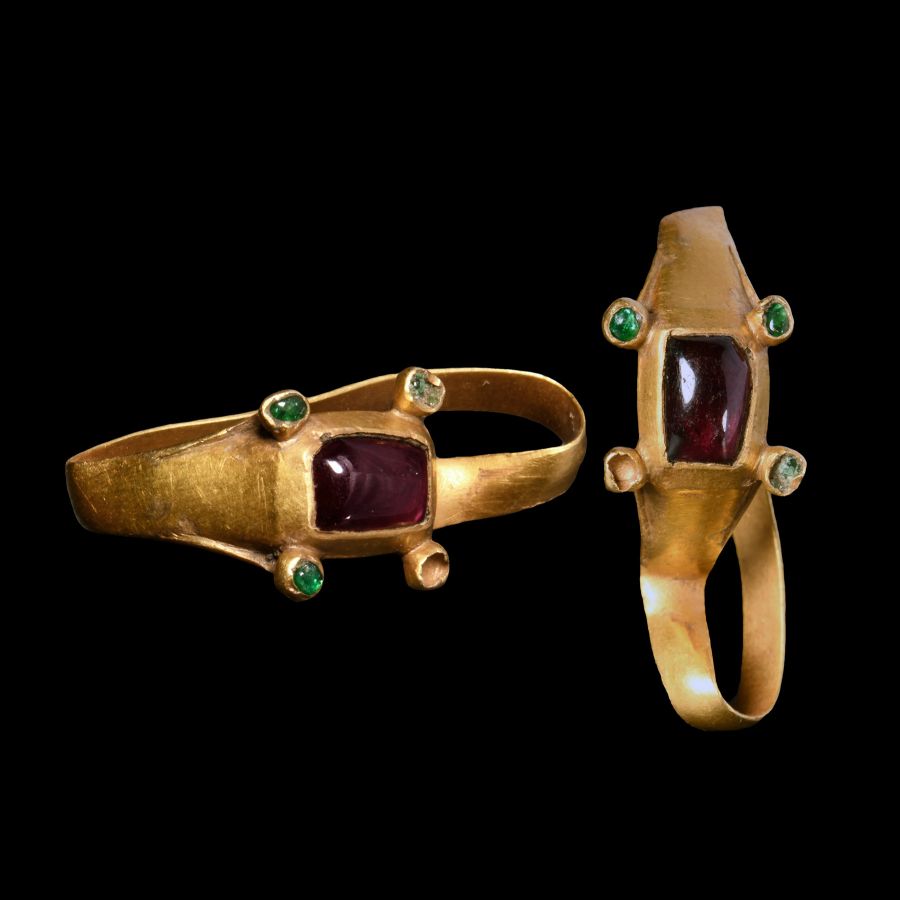
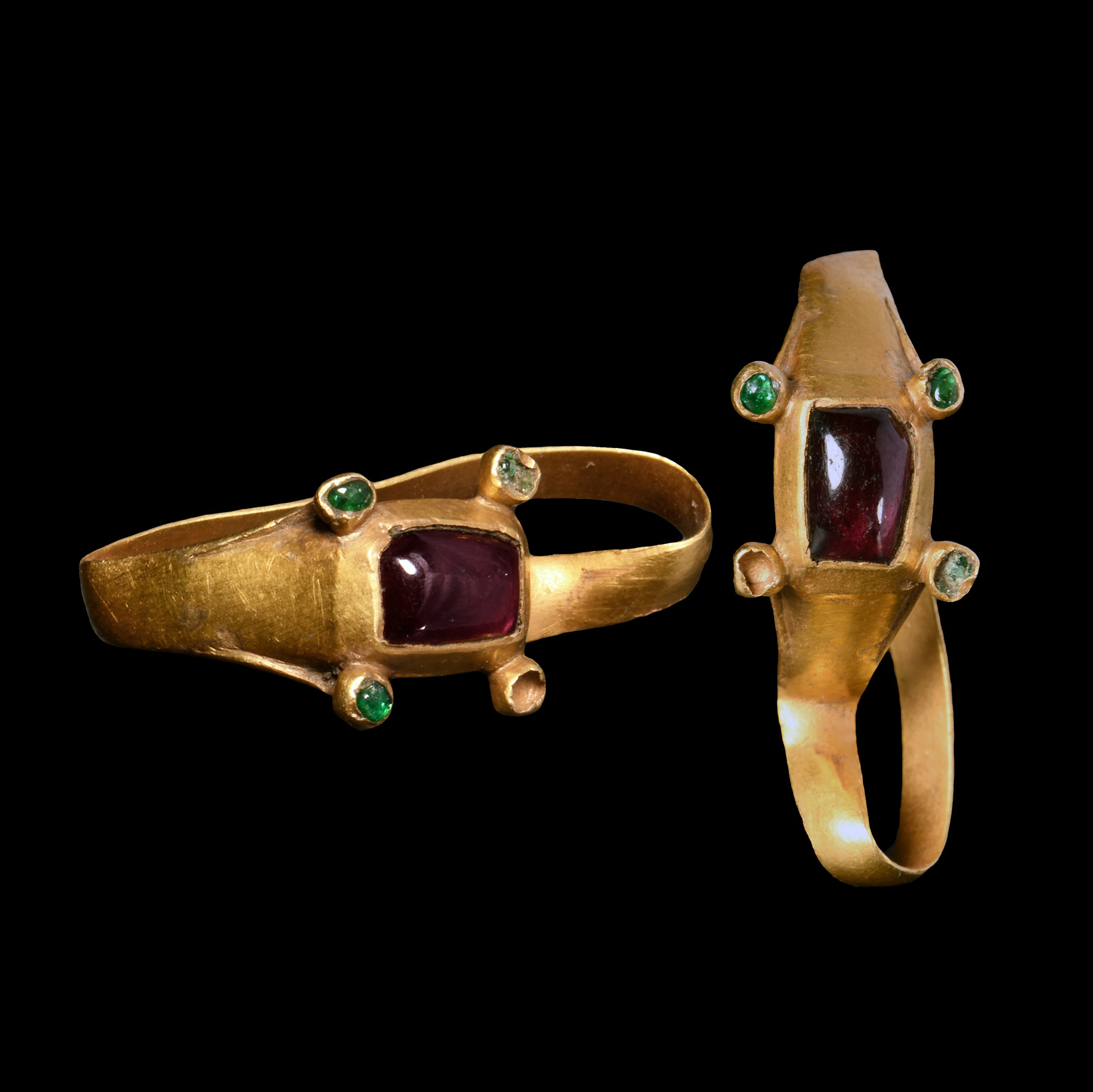
Medieval Gold Ring Set with Gemstones
1200-1400 A.D.
1 in. (2.81 grams, 27 mm).
With a slender D-section hoop, bevelled rectangular cell set with a garnet cabochon; satellite settings at the corners, each with a green cabochon (one absent), the ring preserved in the same condition as it was when found.
ProvenanceFound whilst searching with a metal detector near Finchampstead, Wokingham, Berkshire, UK, on Sunday 16th January 2022.
Accompanied by a copy of the British Museum's Portable Antiquities Scheme (PAS) report no.SUSS-95B0C7.
Reported as Treasure under the stipulations of the Treasure Act 1996 with reference no.2022T118, and subsequently disclaimed.
This lot has been checked against the Interpol Database of stolen works of art and is accompanied by search certificate no.11979-208180.
Cf. Chadour, A.B., Rings. The Alice and Louis Koch Collection, volume I, Leeds, 1994, item 567, for type.
CONDITIONTimeLine Auctions follows a vetting process to ensure the authenticity and legality of all items, reinforcing our commitment to integrity and responsible trading. Each antiquity, antique, and coin lot undergoes thorough examination by a vetting committee of at least ten external specialists, professional trade association members, scientists, and archaeologists: Our Vetting Process
AUCTIONS:
TimeLine is a leading auction house specialising in antiquities, ancient art, collectables, natural history, coins, medals, and books. Our auctions offer museums, collectors, historians, and enthusiasts the opportunity to acquire unique and historically significant pieces.
-
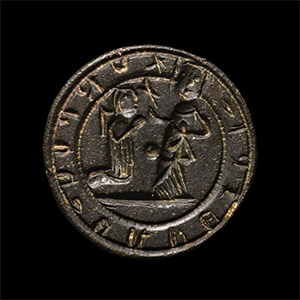
Large Medieval Bronze Seal Matrix with Scene Showing Robed Figures
14th-15th century A.D.Estimate: £150 - 200 (+bp*)
Opening Bid: £83
With facetted stem and pierced pentagonal finial, incised orientation cross to top face; circular die with outer rim bearing enigmatic legend; standing robed figure with one hand extended towards a kneeling hooded figure. 15.5 grams, 25.3 mm
Fine condition.
Acquired 1970s. Ex UK collection. Property of a Hampshire, UK gentleman. -
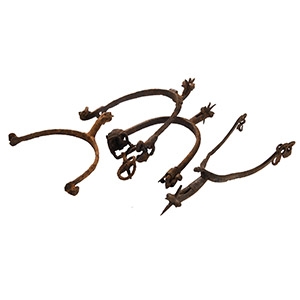
Medieval Iron Rowel Spur Collection
Circa 13th-16th century A.D.Sold for (Inc. bp): £143
Comprising examples of various types, including some retaining the rowel, buckle and other fitting elements. 249 grams total, 11.5-15 cm
Acquired 1990s-early 2000s. East Anglian private collection.
The early rowel spurs had short necks and small four-six or seven point star rowels, while four rowels were uncommon. After c.1350 the multipoint rowel became voguish though the former shapes continued. -
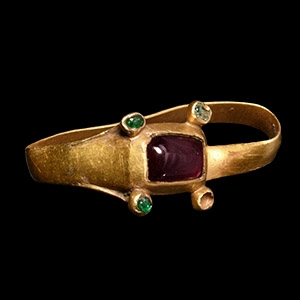
Medieval Gold Ring Set with Gemstones
1200-1400 A.D.Sold for (Inc. bp): £4,160
With a slender D-section hoop, bevelled rectangular cell set with a garnet cabochon; satellite settings at the corners, each with a green cabochon (one absent), the ring preserved in the same condition as it was when found. 2.81 grams, 27 mm
Found whilst searching with a metal detector near Finchampstead, Wokingham, Berkshire, UK, on Sunday 16th January 2022. Accompanied by a copy of the British Museum's Portable Antiquities Scheme (PAS) report no.SUSS-95B0C7. Reported as Treasure under the stipulations of the Treasure Act 1996 with reference no.2022T118, and subsequently disclaimed. This lot has been checked against the Interpol Database of stolen works of art and is accompanied by search certificate no.11979-208180.
