
Loading, please wait...
_900x900.jpg "Gilt Framed Set of Historical Prints")
_200x200.jpg "Gilt Framed Set of Historical Prints")
.jpg "Gilt Framed Set of Historical Prints")
LOT 1470
Gilt Framed Set of Historical Prints
19TH CENTURY A.D.
12 3/4 x 9 5/8 in. (2.35 kg total, 32.5 x 24.5 cm each).
A set of four framed and glazed historical prints: William Pitt, Earl of Chatham, engraved by W. Holl., published London, 1833, by Harding & Lepard; Horation, First Lord Walpole, engraved by W. Holl., published London, 1835, by Harding & Lepard; Henry Spencer, First Earl of Sunderland, engraved by H. Robinson, published London, 1832, by Harding & Lepard; Walter, First Lord Aston, engraved by W.T. Mote, published London, 1832, by Harding & Lepard. [4, No Reserve]
ProvenanceEx property of a North London, UK, gentleman.
CONDITIONTimeLine Auctions follows a vetting process to ensure the authenticity and legality of all items, reinforcing our commitment to integrity and responsible trading. Each antiquity, antique, and coin lot undergoes thorough examination by a vetting committee of at least ten external specialists, professional trade association members, scientists, and archaeologists: Our Vetting Process
AUCTIONS:
TimeLine is a leading auction house specialising in antiquities, ancient art, collectables, natural history, coins, medals, and books. Our auctions offer museums, collectors, historians, and enthusiasts the opportunity to acquire unique and historically significant pieces.
-
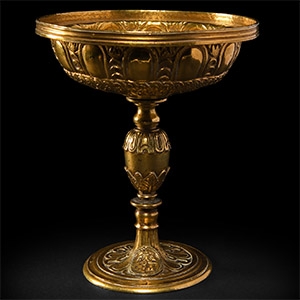
Post Medieval Gilt Silver Dated Decorated Chalice
15th-16th century A.D.Sold for (Inc. bp): £1,950
A gilt silver chalice with bowl decorated with repoussé arcading, fluting and entwined motifs, balustered stem with ovoid centre adorned with pseud-architectural and leaf detailing, fluting below splaying out onto a circular foot bearing an applied oval armorial cartouche; interior base with foliate roundel in raised relief; dated 1589 in Roman numerals incised on the base. 309 grams, 13.5 cm high
English private collection. -
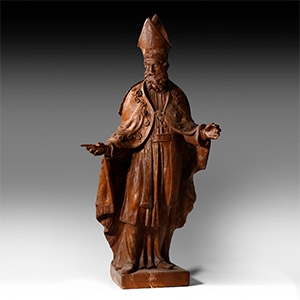
Post Medieval Statue of Saint Nicholas
16th-17th century A.D. or laterEstimate: £3,000 - 4,000 (+bp*)
Opening Bid: £1,500
A ceramic statue of St Nicholas standing in episcopal attire with stole and pallium, pectoral cross and mitre; his hands spread in a benevolent gesture, head turned slightly downwards; rosette and other detailing to the robes and headgear; integral rectangular base; repaired. 1.10 m high
English private collection. This lot has been checked against the Interpol Database of stolen works of art and is accompanied by search certificate number no.11675-199817. -
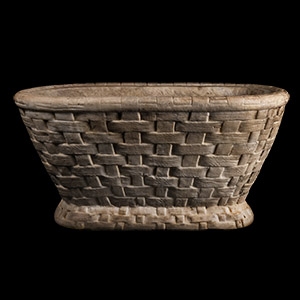
Post Medieval Marble Basket
16th-18th century A.D.Sold for (Inc. bp): £1,560
A marble basket carved in the round with an oblong shape, woven body splayed base and a hollowed interior. 27.8 kg, 48 cm wide
English private collection.
