
Loading, please wait...
_900x900.jpg "German WWII Stick Grenade Group")
_200x200.jpg "German WWII Stick Grenade Group")
.jpg "German WWII Stick Grenade Group")
LOT 1180
German WWII Stick Grenade Group
1914-1945 A.D.
17 1/2 in. (684 grams, 44.5 cm).
German practice stick grenade group including: a WWII model 24 Stielhandgranate with pierced red-coloured head; together with a restored relic head of WWI date.
ProvenanceAcquired from The Lanes Armoury, Brighton, and Graham Currie Militaria.
The Kusmirek Collection, UK.
Accompanied by copies of the listings.
The brb-code name for Richard Rinker GmbH, was used for training German armed forces during WWII. Its distinctive appearance lead to it being dubbed the stick grenade' or 'potato masher' in British army slang. It used a friction igniter, with a pull cord running through the hollow wooden handle terminating in a porcelain ball.
CONDITIONTimeLine Auctions follows a vetting process to ensure the authenticity and legality of all items, reinforcing our commitment to integrity and responsible trading. Each antiquity, antique, and coin lot undergoes thorough examination by a vetting committee of at least ten external specialists, professional trade association members, scientists, and archaeologists: Our Vetting Process
AUCTIONS:
TimeLine is a leading auction house specialising in antiquities, ancient art, collectables, natural history, coins, medals, and books. Our auctions offer museums, collectors, historians, and enthusiasts the opportunity to acquire unique and historically significant pieces.
-
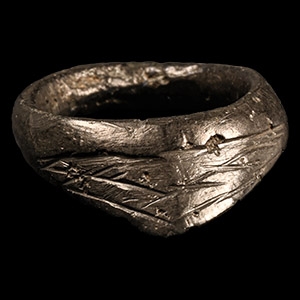
Medieval Child's Bronze Archer's Ring
14th-16th century A.D.Sold for (Inc. bp): £85
Displaying incised dashed lines to the bezel. 3.19 grams, 23.87 mm overall, 14.01 mm internal diameter (approximate size British F 1/2, USA 3, Europe 4.3, Japan 4)
Private collection formed since the 1940s. UK art market. Property of an Essex gentleman. -
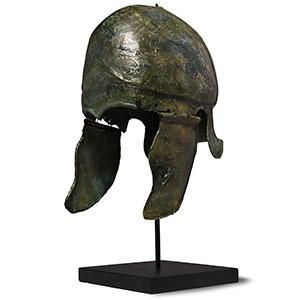
Greek Bronze Chalcidian Helmet
5th-4th century B.C.Estimate: £3,000 - 4,000 (+bp*)
Opening Bid: £1,667
Of Kunze Group VII, formed from two curved segments, each with a flared rim, nasal, raised panels to the upper section of the bowl, repoussé ridge forming curved brows, a recess for the ear to each side; star-shaped attachment to the top with slot for plumes; restored and with replica cheek pieces. 2.7 kg total, 42.5 cm high including stand
Restored, but in general good condition, rare details
Acquired in the 1970s. Ex private Austrian collection. The Kusmirek Collection, UK Accompanied by an academic report by Dr Raffaele D'Amato. Accompanied by a report of metallurgical analytical results, written by metallurgist Dr Brian Gilmour of the Research Laboratory for Archaeology and History of Art, University of Oxford. This lot has been checked against the Interpol Database of stolen works of art and is accompanied by search certificate number no.11763-203979.
Among the Chalcidian helmet types, the fifth and last typology, corresponding to the Kunze group VII (Pflug, 1988, p.138), was characterised by the presence of detached cheek-guards. By the end of the 5th century BC, the fixed cheek-pieces had been entirely abandoned on the Chalcidian helmets for the more versatile hinged cheek pieces. Several district regional workshops produced such helmets by the 5th century B.C.: mainland Greece, the Black Sea Coast, Thrace, Southern Italy and Iberia. -
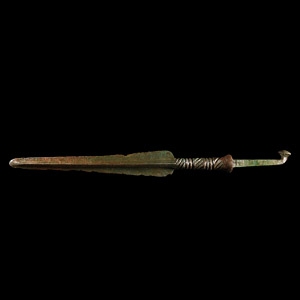
Marlik Type Bronze Decorated Spearhead
13th-12th century B.C.Estimate: £300 - 400 (+bp*)
Opening Bid: £160
With a long blade, broad midrib, rectangular-section long tang, engraved reinforced shaft and rounded shoulders. 481 grams, 43 cm
Acquired 1980-2015. Ex Abelita family collection.
In this category (Type II of the Khorasani typology) the blade has three fullers, and the shaft is usually engraved with diagonal lines. Similar spearheads were excavated by Dr Negahban in Marlik.
