
Loading, please wait...
LOT 1497
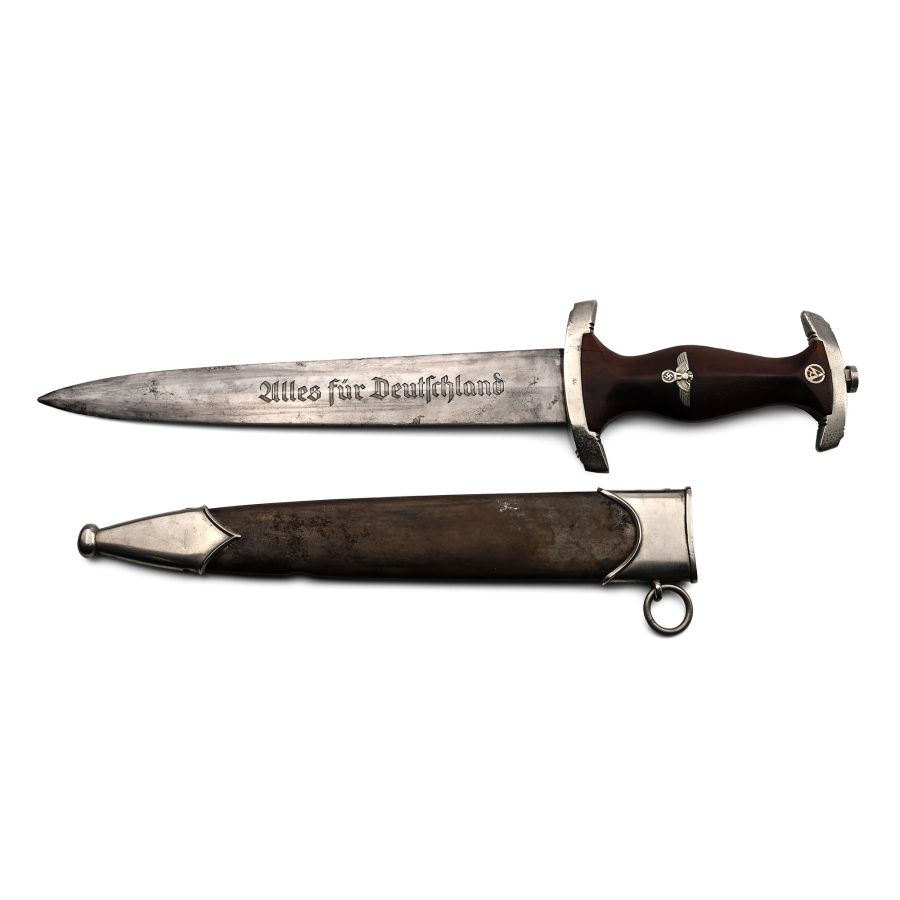
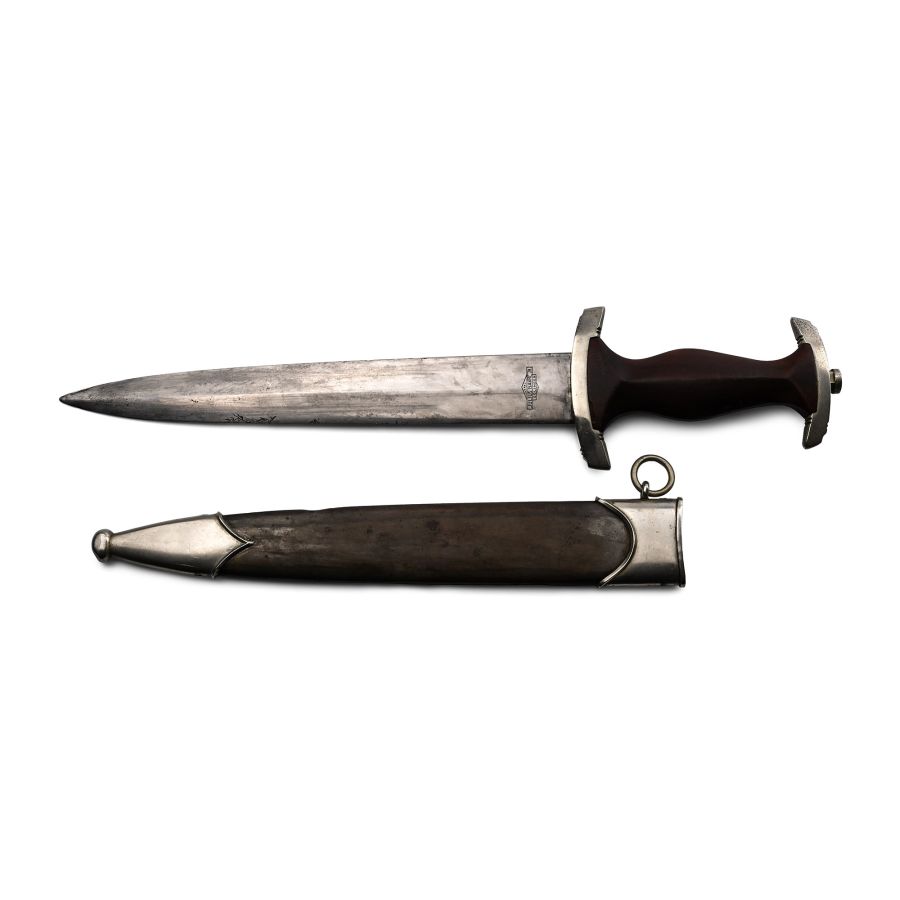
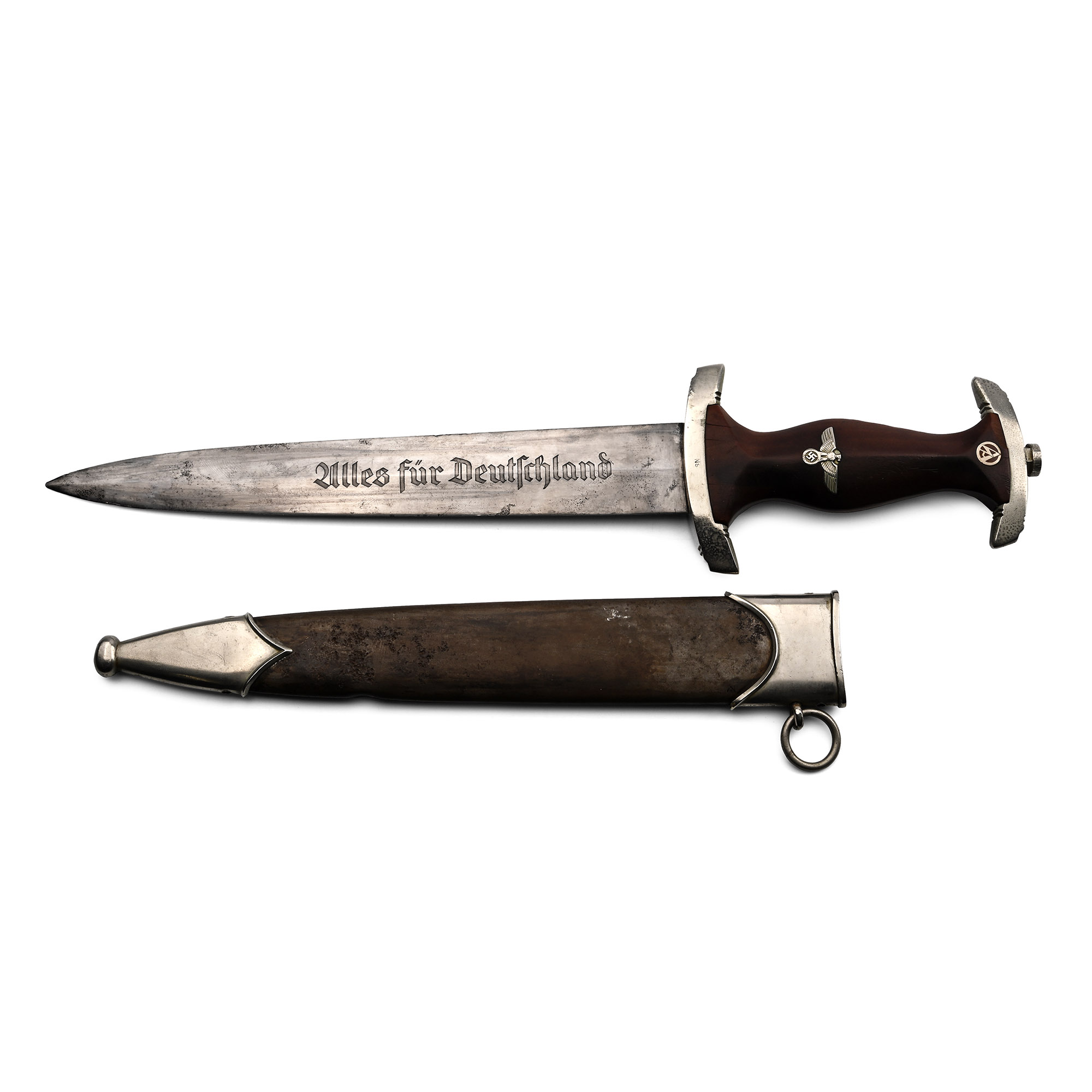
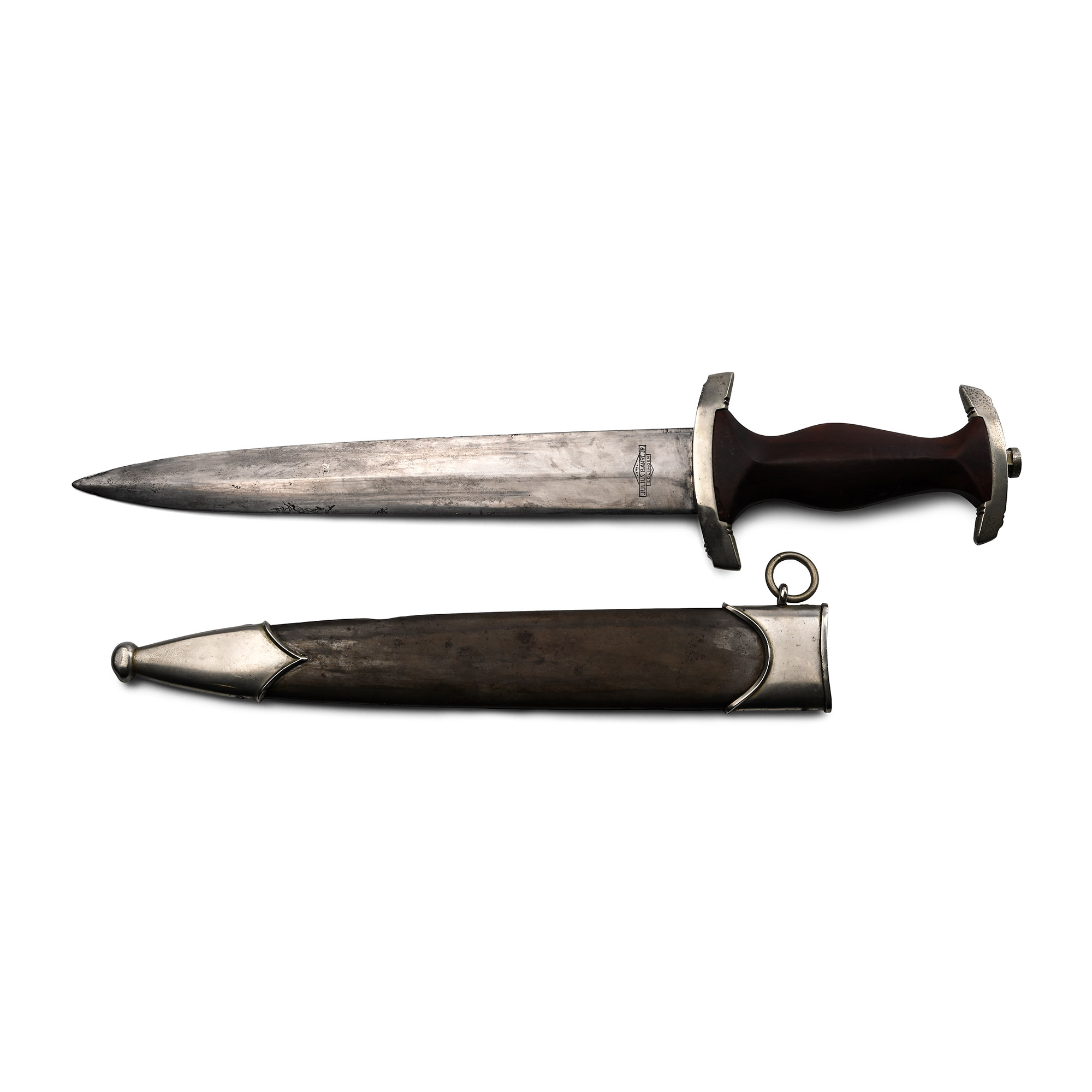
German Third Reich SA Dagger by Julius Bahrl Jr.Solingen
1933 A.D.
14 3/4 in. (444 grams, 37.5 cm).
Comprising a broad blade with inscription 'Alles für Deutschland' ('everything for Germany') and maker's mark 'Julius Bahrl Jr., Solingen', slightly curved hilt, wooden grip bearing inset logo of eagle and swastika within a ring; sheath with attachment hoop and knob at scabbard chape.
ProvenanceFrom the private collection of a Colchester, UK, gentleman.
FootnotesThe Julius Bahrl Jr. steel goods factory from Solingen-Merscheid is among the smaller Solingen makers that are only partially documented today. A verified founding year is not clearly preserved in the sources; however, the company is known to have been active in the early 1930s. This dagger is an Early Model 1933 SA Dagger (Sturmabteilung Dienstdolch).
CONDITIONTimeLine Auctions follows a vetting process to ensure the authenticity and legality of all items, reinforcing our commitment to integrity and responsible trading. Each antiquity, antique, and coin lot undergoes thorough examination by a vetting committee of at least ten external specialists, professional trade association members, scientists, and archaeologists: Our Vetting Process
AUCTIONS:
TimeLine is a leading auction house specialising in antiquities, ancient art, collectables, natural history, coins, medals, and books. Our auctions offer museums, collectors, historians, and enthusiasts the opportunity to acquire unique and historically significant pieces.
LOT 1497
German Third Reich SA Dagger by Julius Bahrl Jr.Solingen
Sold for (Inc. bp): £780
-
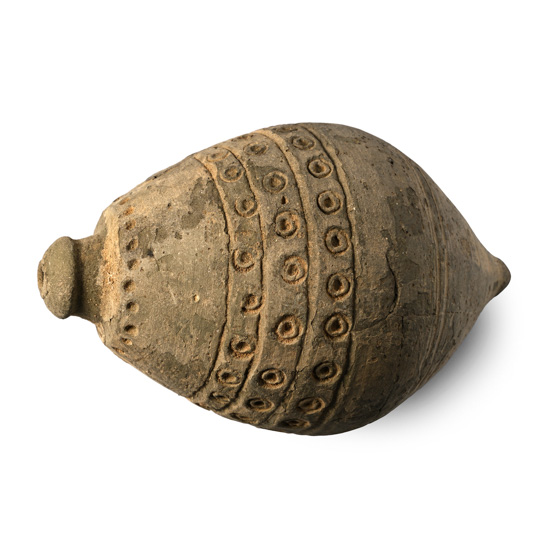
Byzantine 'Greek Fire' Fire Bomb or Hand Grenade
9th-11th century A.D.Sold for (Inc. bp): £91
A piriform vessel with short neck, domed lip and conical base, bands to the shoulder with impressed annulets and other detailing; intended to be filled with explosive liquid and a wick, and used as a hand grenade. 885 grams, 16.3 cm
Fine condition.
From the collection of a North London gentleman, latterly with a London gallery as a display collection exhibiting the wide range of decorative types; accompanied by an academic paper by military specialist Dr Raffaele D'Amato, dated 15 July 2019 and titled Eastern Roman Empire - Greek Fire Bomb or Hand Grenade (μεσαίον kακάβιον) 9th-11th century AD. -
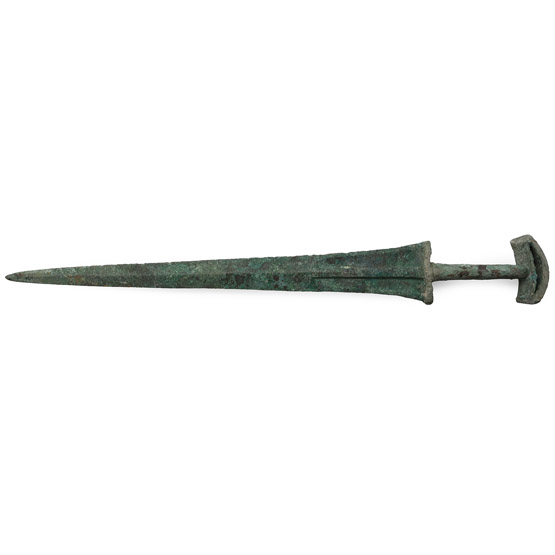
Luristan Bronze Short Sword
2nd-1st millennium B.C.Sold for (Inc. bp): £884
Triangular blade with single median rib, crescent-shaped hollow pommel open at the edges to accept an organic insert, columnar grip and lower guard at the juncture between hilt and blade. 499 grams, 50 cm
Ex Norri collection, Milton Keynes, Bedfordshire, UK, 1980s-1990s. -
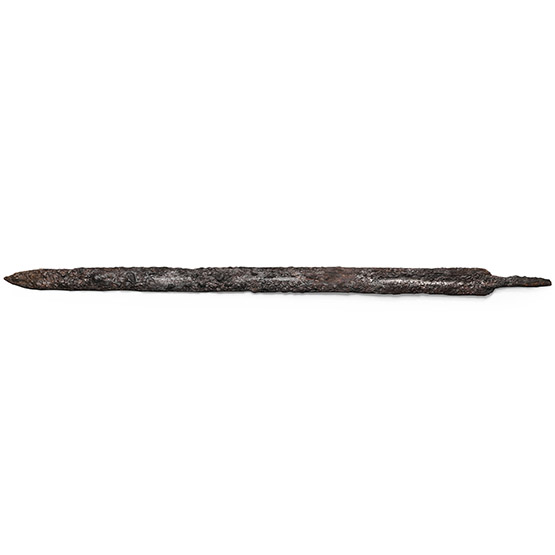
Merovingian Iron Pattern-Welded Sword
Circa 6th century A.D.Sold for (Inc. bp): £975
A double-edged spatha with a lentoid parallel-sided blade and pointed tip; evidence of battle nicks on both cutting edges; long tang and traces of wooden scabbard on the blade; signs of damask pattern running along the length of the blade, especially on the upper part; cleaned and conserved. 694 grams, 86.5 cm
From the private collection of a London gentleman, from his grandfather's collection formed before the early 1970s. Accompanied by an academic report by Dr Raffaele D’Amato. This lot has been checked against the Interpol Database of stolen works of art and is accompanied by search certificate number no.12919-245174.
Usually the term ‘damascened’ is only used for blades, describing the way in which their individual rods are forged to create a desired pattern effect that remained visible on the surfaces of the finished product (technique B.II.1.2.). The shape and regularity of the pattern was essentially dependent on the number and nature of the individual rods and on the skills of the blacksmith. The scholars differentiate on this basis more or less careful and complicated variants (e.g. striped, diamond, herringbone, angular, rosette, mosaic, etc.), in which the individual rods from different iron lamellae, which are parallel or twisted (torsion pattern-welding), were built up often in connection with each other (technique B.II.1.2.1-2). Combining striped rods that were partially straight and partially twisted - clockwise or counter-clockwise - allowed the formation of a very decorative blade.
