
Loading, please wait...
LOT 1013
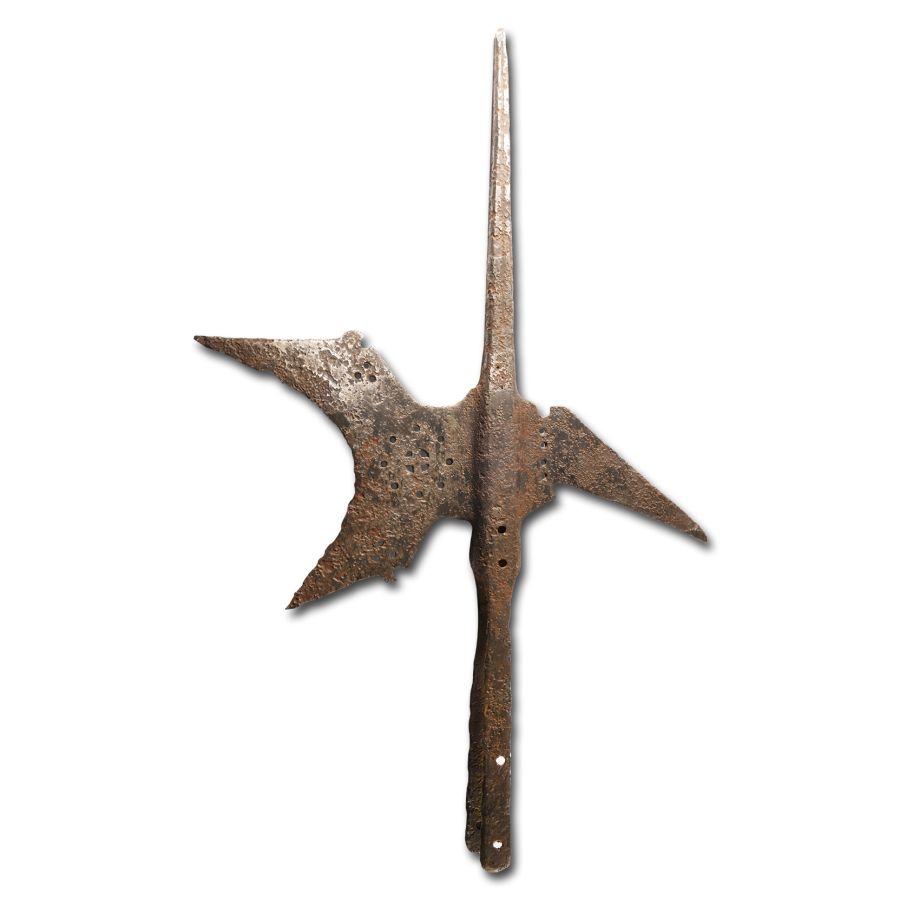
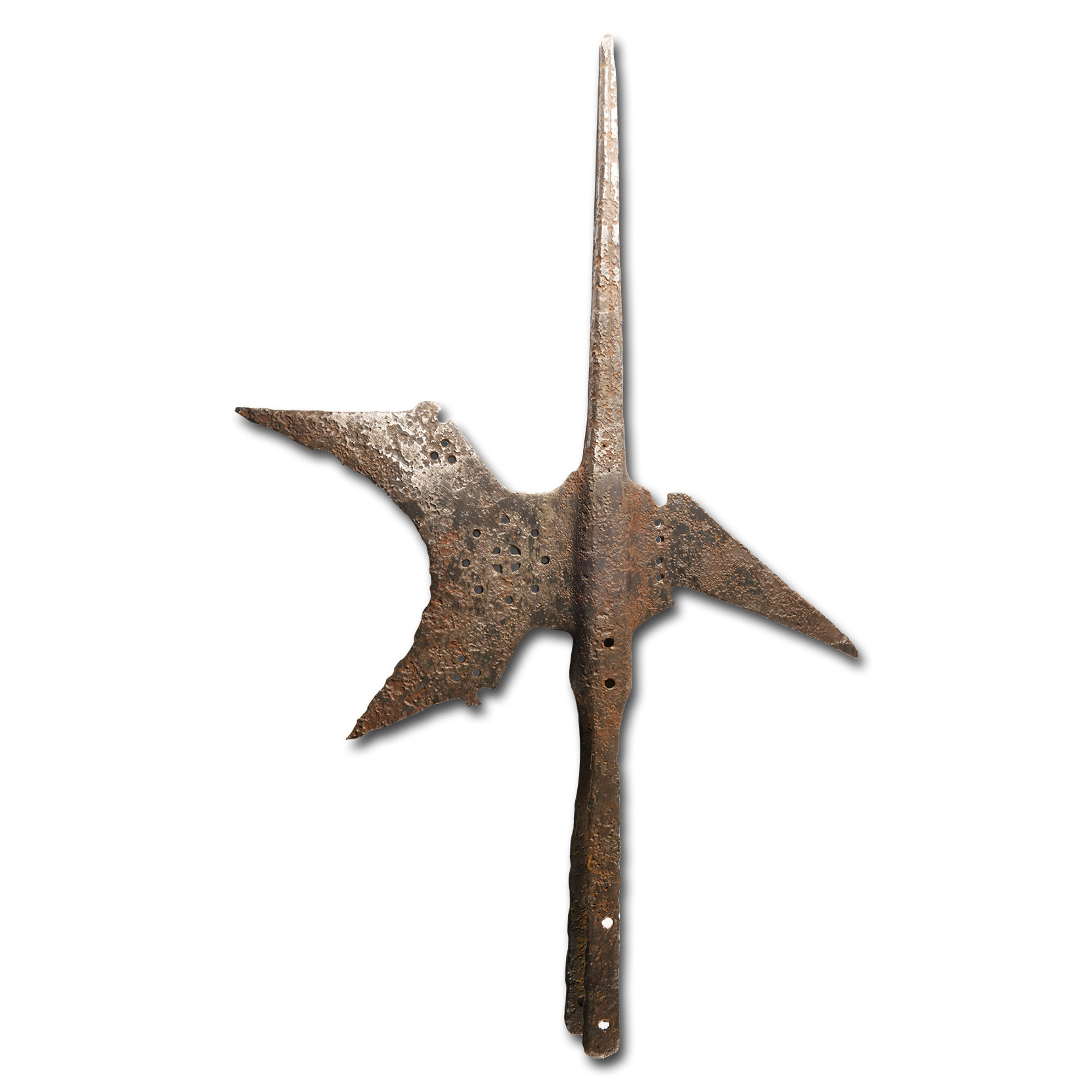
German Socketted Iron Halberd
15TH-16TH CENTURY A.D.
17 3/4 in. (756 grams, 45 cm).
With square-section body and tapering spike, lateral languets pierced for attachment to the haft, hook to the rear and thick blade with crescent recess, pierced.
ProvenanceEx California, USA, collection formed since the late 1960s.
European art market before the late 1990s.
Cf. similar in the Tower Armouries Collection, Leeds, under accession no.VII.1534.
CONDITIONTimeLine Auctions follows a vetting process to ensure the authenticity and legality of all items, reinforcing our commitment to integrity and responsible trading. Each antiquity, antique, and coin lot undergoes thorough examination by a vetting committee of at least ten external specialists, professional trade association members, scientists, and archaeologists: Our Vetting Process
AUCTIONS:
TimeLine is a leading auction house specialising in antiquities, ancient art, collectables, natural history, coins, medals, and books. Our auctions offer museums, collectors, historians, and enthusiasts the opportunity to acquire unique and historically significant pieces.
-
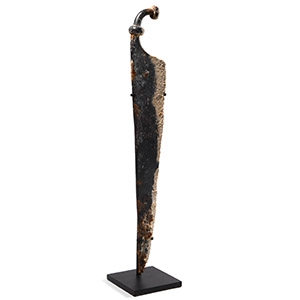
Iron Age Celtic La Tene Dagger
1st century B.C.-1st century A.D.Sold for (Inc. bp): £975
Featuring a gently curved single-edged iron blade and one-sided fuller, curved handle with knot pommel; mounted on a custom-made display stand. 525 grams total, 35 cm high including stand
Dutch art market. Private collection of K.S., Cologne, Germany, acquired 1996.
One of the military insignia of a Celtic warrior was the war-knife, usually between 33 and 35 cm long. For example, in the collection of Celtic military equipment from Galish-Lovachka, the archaeologists have found a short sword with an X-shaped handle (l = 41 cm), two middle La Tène swords (72.5 and 75 cm long), 12 large curved knives, 27 spearheads, two javelin heads, 14 arrowheads, and nine iron chain belts for hanging a sword. The war-knife was also used for hunting, as a spare weapon, or to cut the throat of an enemy in a surprise attack. -
.jpg)
Western Asiatic Bronze Arrowheads, Javelin Heads and Daggers
3rd millennium-7th century B.C.Estimate: £180 - 240 (+bp*)
Opening Bid: £90
Comprising ten slender tanged arrowheads, javelin heads and daggers, some lozenge-section and some with raised midribs. 329 grams total, 14-21.5 cm
Acquired 1980-2015. Ex Abelita family collection.
Most of these blades are bipartite, but the definition of the bipartite type is not absolute as it brings together weapons of very different and unrelated designs. In fact, some weapons do not have a sufficiently characteristic shape to be interpreted as a spear, dagger, or long arrowhead. The javelin heads classified by Gernez as type Type L 3 are characterized by the simplicity of their design. They have a sharp and/or pointed active part, a flat, elliptical or rhomboidal cross-section and an elongated tang with a rectangular, square or circular section, ending in a pointed, widened, curved or folded blade. -
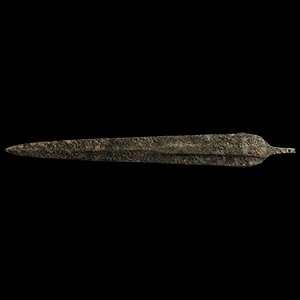
North-Western Persian Type Sword Blade
1st millennium B.C.Sold for (Inc. bp): £143
With rounded shoulders and shallow square-sectioned mid-rib running to the blade tip; short tang with fastening hole. 220 grams, 37 cm
Acquired 1980-2015. Ex Abelita family collection.
The Luristan people produced fine metalwork, which according to Dr. Khorasani, was made possible by a settled period which arose as a result of the defeat of the Elamites by the Babylonians, leaving the Luristani people in relative peace for a period of time after 1200 B.C. According to Khorasani, 'A culture of innovation and experimentation flourished, and the repertoire of the Luristan smiths expanded in the period between 1150-1050 BC.' It became widespread throughout Mesopotamia, the Caucasus and the Near East.
