
Loading, please wait...
_900x900.jpg "German Silver-Gilt and Enamelled Figure of a Sailor")
_200x200.jpg "German Silver-Gilt and Enamelled Figure of a Sailor")
.jpg "German Silver-Gilt and Enamelled Figure of a Sailor")
LOT 0391
German Silver-Gilt and Enamelled Figure of a Sailor
17TH CENTURY A.D.
2 1/8 in. (31.62 grams, 54 mm).
The mariner modelled in a lively stance, holding a coiled rope in both hands, which falls in a naturalistic spiral at his feet, wearing a brimmed and gilt-edged cap, a red enamelled doublet with chased detail, and voluminous green enamelled trunk-hose, his boots and gloves parcel-gilt.
ProvenanceAcquired on the European art market.
LiteratureCf. British Museum, The Mechanical Galleon by Hans Schlottheim, Augsburg, 1580–1590, inv. 1866,1030.1, with deck figures of sailors; Victoria and Albert Museum, nef by Esaias zur Linden, Nuremberg, before 1628, inv. M.425-1956, with enamelled mariners; Victoria and Albert Museum, nef, Regensburg, c. 1610, inv. M.15-1954, with related figures; The Metropolitan Museum of Art, Ship (Nef), Nuremberg, c. 1609–1620, inv. 17.190.319, showing similarly enamelled crew; The Metropolitan Museum of Art, Ship (Nef), Augsburg, Heinrich Winterstein, c. 1620, inv. 17.190.318; the British Museum, nef, France/Switzerland, c. 1530 with later additions, inv. AF.3059.
CONDITIONTimeLine Auctions follows a vetting process to ensure the authenticity and legality of all items, reinforcing our commitment to integrity and responsible trading. Each antiquity, antique, and coin lot undergoes thorough examination by a vetting committee of at least ten external specialists, professional trade association members, scientists, and archaeologists: Our Vetting Process
AUCTIONS:
TimeLine is a leading auction house specialising in antiquities, ancient art, collectables, natural history, coins, medals, and books. Our auctions offer museums, collectors, historians, and enthusiasts the opportunity to acquire unique and historically significant pieces.
LOT 0391
German Silver-Gilt and Enamelled Figure of a Sailor
Estimate £700 - 900€810 - 1,040 (for guidance only)$950 - 1,220 (for guidance only)
-
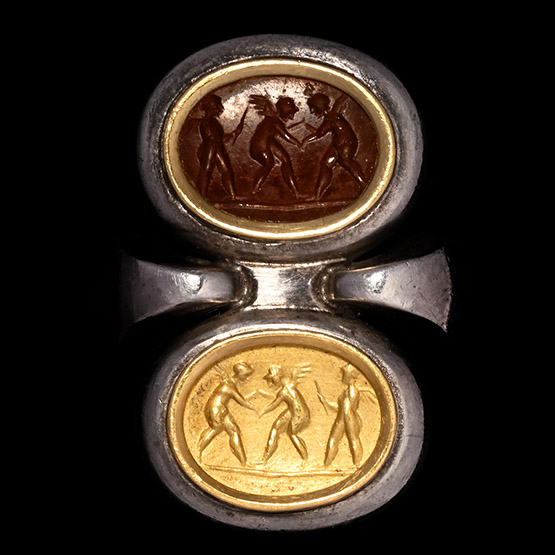
Roman Intaglio of Three Wrestling Erotes in Silver Ring
1st-2nd century A.D. and laterSold for (Inc. bp): £780
D-section hoop with widening lozenge-shaped shoulders supporting two discoid bezels; one with orange stone intaglio of three winged erotes, two engaged in a wrestling competition; a mirror image in gold below. 16.07 grams, 29.75 mm overall, 17.58 mm internal diameter (approximate size British O, USA 7, Europe 14.98, Japan 14)
Private collection, Europe. Acquired on the English art market. -
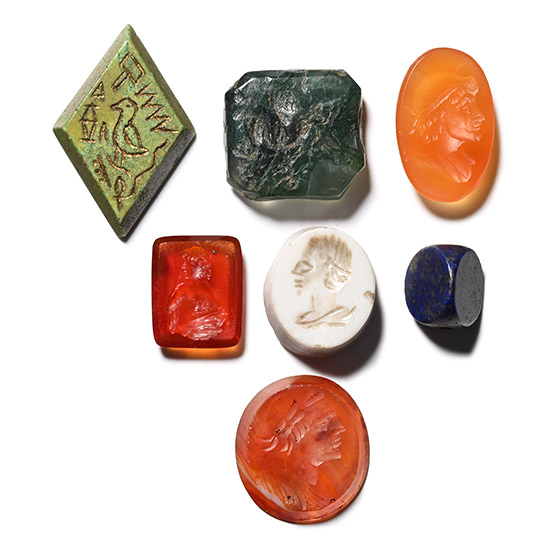
Post Classical Gemstone Collection
19th century A.D.Sold for (Inc. bp): £143
Comprising: three carnelian intaglios with profile busts; an agate intaglio with profile bust; a lozenge-shaped intaglio with bird and other symbols, possibly made of stained bone; an octagonal green stone intaglio with worn motif; and a lapis lazuli bead. 9.71 gram stotal, 9-24 mm
Acquired on the European art market. -
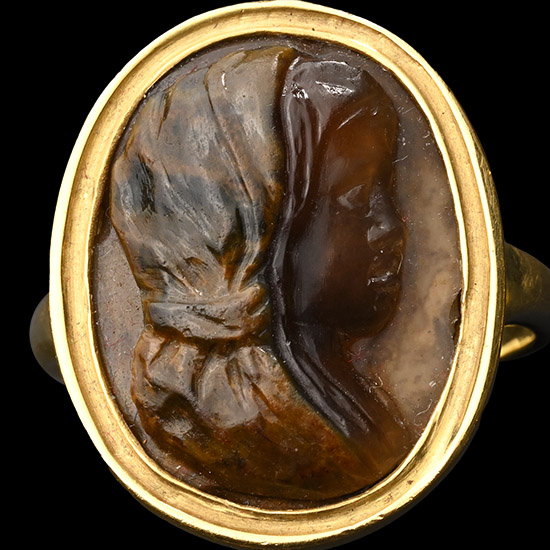
Renaissance Agate Cameo of a Woman in Gold Ring
Italy, 16th-17th century A.D.Estimate: £2,000 - 3,000 (+bp*)
Opening Bid: £1,000
Brown oval cameo depicting a profile bust of a veiled young woman with large eyes and a small button nose, set in a ring with a closed-back setting. 10.26 grams, 24.74 mm overall, 18.91 mm internal diameter (approximate size British N, USA 6 1/2, Europe 13.72, Japan 13)
Acquired on the European art market. This lot has been checked against the Interpol Database of stolen works of art and is accompanied by search certificate number no.13399-257955.
