
Loading, please wait...
LOT 1198
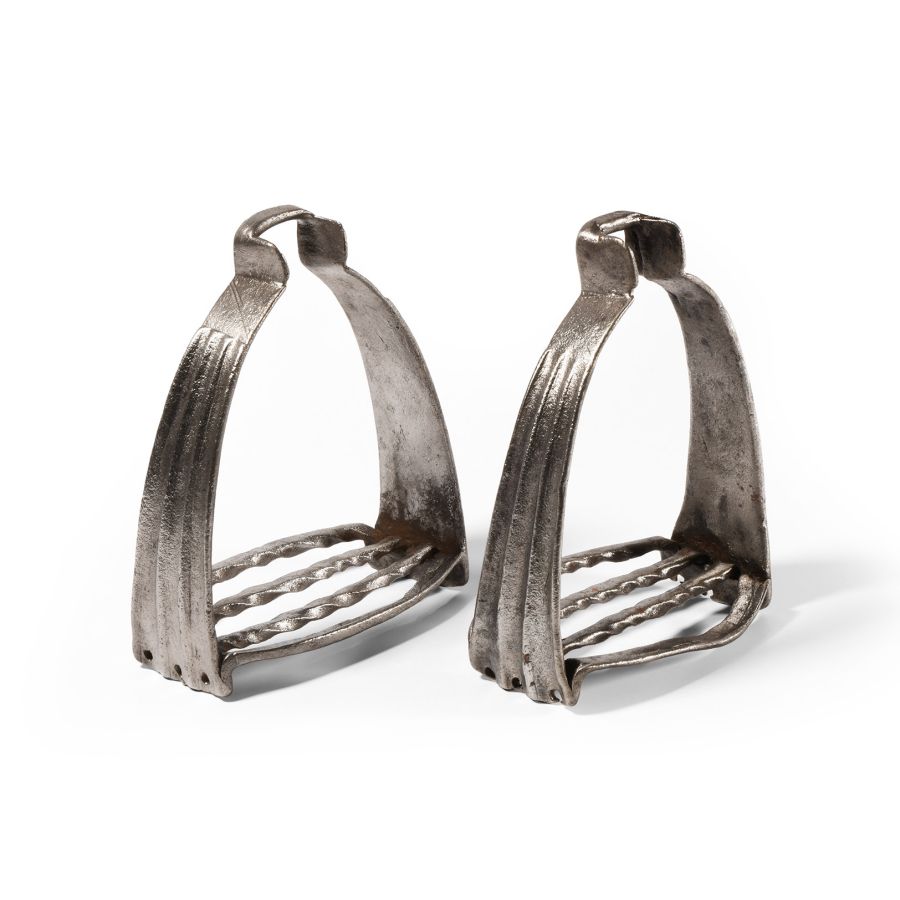
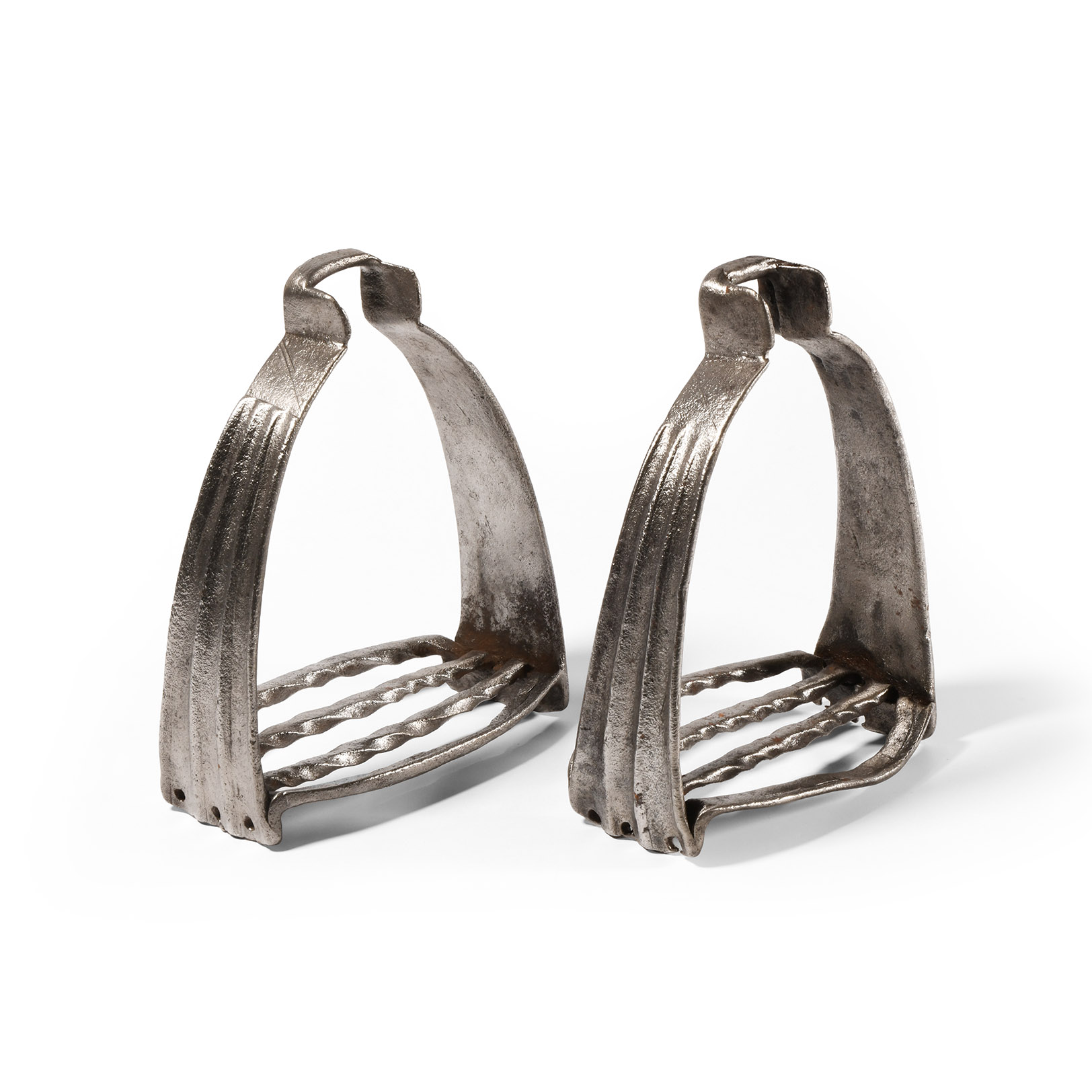
German Iron Stirrup Pair
16TH CENTURY A.D.
6 1/2 in. (780 grams total, 16.5 cm each).
Featuring twisted bar open treads, arched side pieces grooved and connected by a strap bar. [2]
ProvenanceAcquired from Czerny's Auctions, Italy, 2016, lot 313.
The Kusmirek Collection, UK.
Accompanied by a copy of Czerny's invoice and lot details.
TimeLine Auctions follows a vetting process to ensure the authenticity and legality of all items, reinforcing our commitment to integrity and responsible trading. Each antiquity, antique, and coin lot undergoes thorough examination by a vetting committee of at least ten external specialists, professional trade association members, scientists, and archaeologists: Our Vetting Process
AUCTIONS:
TimeLine is a leading auction house specialising in antiquities, ancient art, collectables, natural history, coins, medals, and books. Our auctions offer museums, collectors, historians, and enthusiasts the opportunity to acquire unique and historically significant pieces.
LOT 1198
German Iron Stirrup Pair
Estimate £200 - 300€230 - 350 (for guidance only)$270 - 410 (for guidance only)
-
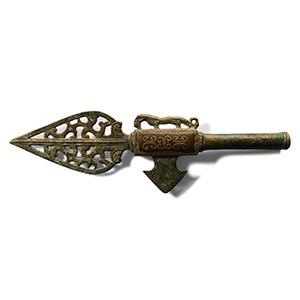
Chinese Style Bronze Ceremonial Halberd Sceptre Head
20th century A.D.Sold for (Inc. bp): £29
The leaf-shaped head displaying sinuous openwork animals on either side, rectangular collar with etched ornament, possibly a nameplate, repeated on both faces, a feline to one side and a flat-section arrow to the other, tubular socket below. 293 grams, 28 cm
Acquired in Germany. Property of RWM Collection.
During the Warring States Period (475-221 B.C.), Chinese warfare evolved. Kings and princes were replaced on the battlefield by infantries lead by military generals. New arms and armour were invented, including the halberd and crossbow. This sceptre head has a spearhead finial that features an openwork motif that is both decorative as well as functional, since it decreases the weight of the bronze, making the spear cheaper to produce and lighter to use. -
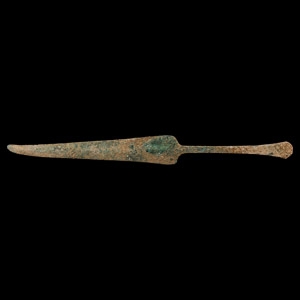
Luristan Bronze Handled Dagger
Circa 1000 B.C.Estimate: £100 - 140 (+bp*)
Opening Bid: £50
Having a narrow triangular blade with gentle midrib and narrow point, scooped shoulders, long flat-section tang with lobe finial. 123 grams, 35 cm
Acquired 1980-2015. Ex Abelita family collection.
The type of the present dirk or dagger corresponds to type IX of Medvedskaya classification. The type consists of a bronze blade with organic handle, possibly made of bone or wood, and a long tang, which was usually bent at the extremity. According to Moorey, the exact dating of these pieces is uncertain. -
.jpg)
Civil War Starr Percussion 1858 Army Revolver
1861-1865 A.D.Estimate: £1,100 - 1,500 (+bp*)
Opening Bid: £611
Double-action with .44 calibre six-shot cylinder, hinged frame and loading arm with 15cm (6") barrel; marked 'STARR ARMS CO NEW YORK' to left frame, 'STARR'S PATENT JAN 15 1858' to right, numbered 705 to cylinder and 8795/W to front frame; plain wood grip with illegible stamped inspector mark each side; action slightly weak. 1.12 kg, 29 cm
Acquired from Bottomley Antiques & Armour, 2014. The Kusmirek Collection, UK. Accompanied by a copy of the Bottomley invoice.
Sold as an exempt item under Section 58 (2) of the Firearms Act, 1968, to be held as a curiosity or ornament. No license required but buyer must be over 18 years of age. Overseas bidders should note that, due to UK regulations governing export of all firearms, overseas buyers will need to make arrangements for shipping this lot out of the UK directly, by air freight, with a specialist company or agent.
