
Loading, please wait...
_900x900.jpg "German Closed Iron Helm")
_200x200.jpg "German Closed Iron Helm")
_900x900.jpg "German Closed Iron Helm")
_200x200.jpg "German Closed Iron Helm")
.jpg "German Closed Iron Helm")
.jpg "German Closed Iron Helm")
LOT 0277
German Closed Iron Helm
CIRCA 1560 A.D.
12 1/4 in. (2 kg, 31 cm high).
An armet with rounded one-piece skull raising to a roped medial comb, visor, prow shaped upper bevor and bevor attached by common pivots, each secured at the right side by a spring-catch, the visor with stepped centrally divided visor-slit and two gorget-plates.
ProvenanceAcquired on the European art market.
The Kusmirek Collection, UK.
Accompanied by a copy of an invoice.
Accompanied by an academic report by Dr Raffaele D'Amato
This lot has been checked against the Interpol Database of stolen works of art and is accompanied by search certificate number no.11767-203981.
Cf. Mauro, M., Armeria della Rocca, mostra di armi antiche, Ancona, 1989, no.1, for similar.
FootnotesThe term armet is generally used to denote a visored helmet of particular construction, one in which large cheekpieces are hinged to the base of the bowl just above the ears and close in front of the chin. From about 1515 A.D., the Germans produced a variant armet where the downward extension of the skull was made much wider, reaching as far forward as the ears. The cheekpieces on this type of helmet opened sideways, on vertical hinges on the edges of this wider neck element.
CONDITIONTimeLine Auctions follows a vetting process to ensure the authenticity and legality of all items, reinforcing our commitment to integrity and responsible trading. Each antiquity, antique, and coin lot undergoes thorough examination by a vetting committee of at least ten external specialists, professional trade association members, scientists, and archaeologists: Our Vetting Process
AUCTIONS:
TimeLine is a leading auction house specialising in antiquities, ancient art, collectables, natural history, coins, medals, and books. Our auctions offer museums, collectors, historians, and enthusiasts the opportunity to acquire unique and historically significant pieces.
-
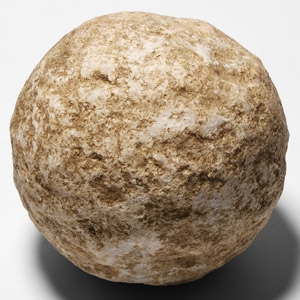
Roman Marble Ballista Catapult Shot
1st-3rd century A.D.Sold for (Inc. bp): £1,430
Suitable for use with an onager or other small catapult-type siege weapon; with roughened, abrasive surface. 682 grams, 79 mm
Acquired 1971-1972. From the collection of the vendor's father. Property of a London, UK, collector.
The operation of the onager (Latin for 'wild ass') is first mentioned in 353 A.D. by Ammianus Marcellinus in his Res Gestae and more fully in Vegetius's Epitoma Rei Militaris probably written in the reign of Emperor Theodosius I (378-395 A.D.). -
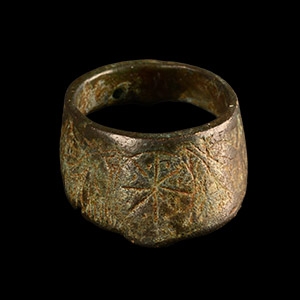
Medieval Bronze Archer's Ring
13th-15th century A.D.Sold for (Inc. bp): £124
Incuse geometric detail to the hoop, flange with wheel motif. 10.19 grams, 34.62 mm overall, 20.76 mm internal diameter (approximate size British W 1/2, USA 11 1/4, Europe 25.66, Japan 24)
English collection, early 2000s. Ex central London gallery. -
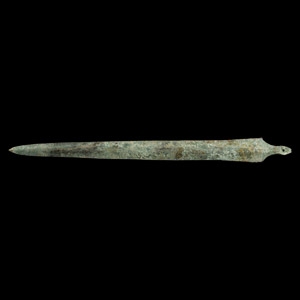
North-West Persian Bronze Sword Blade
Early 1st millennium B.C.Sold for (Inc. bp): £130
Narrow triangular blade with raised median panel, scooped shoulders and short tang with pierced bulb finial. 370 grams, 45 cm
Ex German collection, Cologne, 1980-1990s.
The hilt of this magnificent sword would have originally been made of organic material. The forms of hilt are often replicated on cast metal counterparts. As proved by excavations of sites like Sangtarashan, stones were often used for decorating metal weapons, especially for bronze dagger pommels.
