
Loading, please wait...
_900x900.jpg "Georgian Silver Memento Mori Ring with Skull and Snakes")
_200x200.jpg "Georgian Silver Memento Mori Ring with Skull and Snakes")
.jpg "Georgian Silver Memento Mori Ring with Skull and Snakes")
LOT 1495
Georgian Silver Memento Mori Ring with Skull and Snakes
18TH CENTURY A.D.
1 in. (10.11 grams, 26.62 mm overall, 18.12 mm internal diameter (approximate size British P, USA 7 1/2, Europe 16.23, Japan 15)).
A silver memento mori ring with D-section hoop expanding at the shoulders to a facetted bezel, openwork flower bud to each shoulder, incised hatched triangles to the scooped facets above, 'MORS' inscribed to the upper panel, 'SOIFI' to the lower; pale gold insert to central cell engraved with a skull amid entwined snakes. [No Reserve]
ProvenanceAcquired since before 1970.
Ex private collection of a West Sussex, UK, collector.
TimeLine Auctions follows a vetting process to ensure the authenticity and legality of all items, reinforcing our commitment to integrity and responsible trading. Each antiquity, antique, and coin lot undergoes thorough examination by a vetting committee of at least ten external specialists, professional trade association members, scientists, and archaeologists: Our Vetting Process
AUCTIONS:
TimeLine is a leading auction house specialising in antiquities, ancient art, collectables, natural history, coins, medals, and books. Our auctions offer museums, collectors, historians, and enthusiasts the opportunity to acquire unique and historically significant pieces.
LOT 1495
Georgian Silver Memento Mori Ring with Skull and Snakes
Sold for (Inc. bp): £312
-
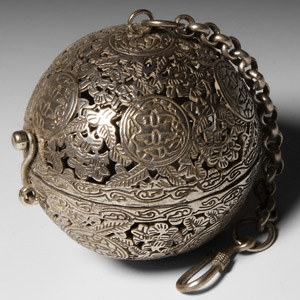
Post Medieval Gimballed Incense Burner
20th century A.D.Sold for (Inc. bp): £130
A silver hinged spherical incense burner with swivel clasp and gimbal; pierced decoration of foliate form with roundels incised with flying insects; swivel clasp and suspension chain with decorated hook; Chinese characters (possibly a maker's name) inscribed to hook. 91 grams, 16 cm long
with a London, UK gallery 1971-early 2000s. -
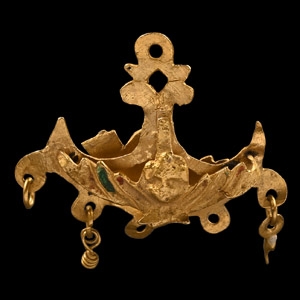
Elizabethan Boat-Shaped Pendant with Putti
16th-early 17th century A.D.Estimate: £1,000 - 1,400 (+bp*)
Opening Bid: £475
A gold pendant formed as a crescent frame with vertical bar and two outer bands; bar with trefoil finial, pierced for suspension; crescent with pierced lugs to the lower edge and wire dangles; outer bands with putto mask to the centre, frond detailing and green enamelling. 2.77 grams, 27 mm
Acquired 1960s-1990s. Late Alison Barker collection, a retired London barrister. -
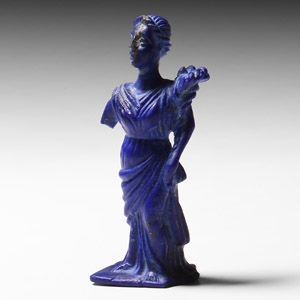
Statuette of Demeter in Lapis Lazuli
18th-19th century A.D.Sold for (Inc. bp): £127
A free-standing Grand Tour statuette of the goddess Demeter, carved from brilliant blue lapis lazuli; modelled in the round standing on an integral polygonal base, wearing a floor-length peplos and mantle, holding a cornucopia. 14.4 grams, 55 mm
Fine condition, right arm lost in antiquity.
Private UK collection. Property of a Cambridgeshire gentleman.
