
Loading, please wait...
LOT 2044
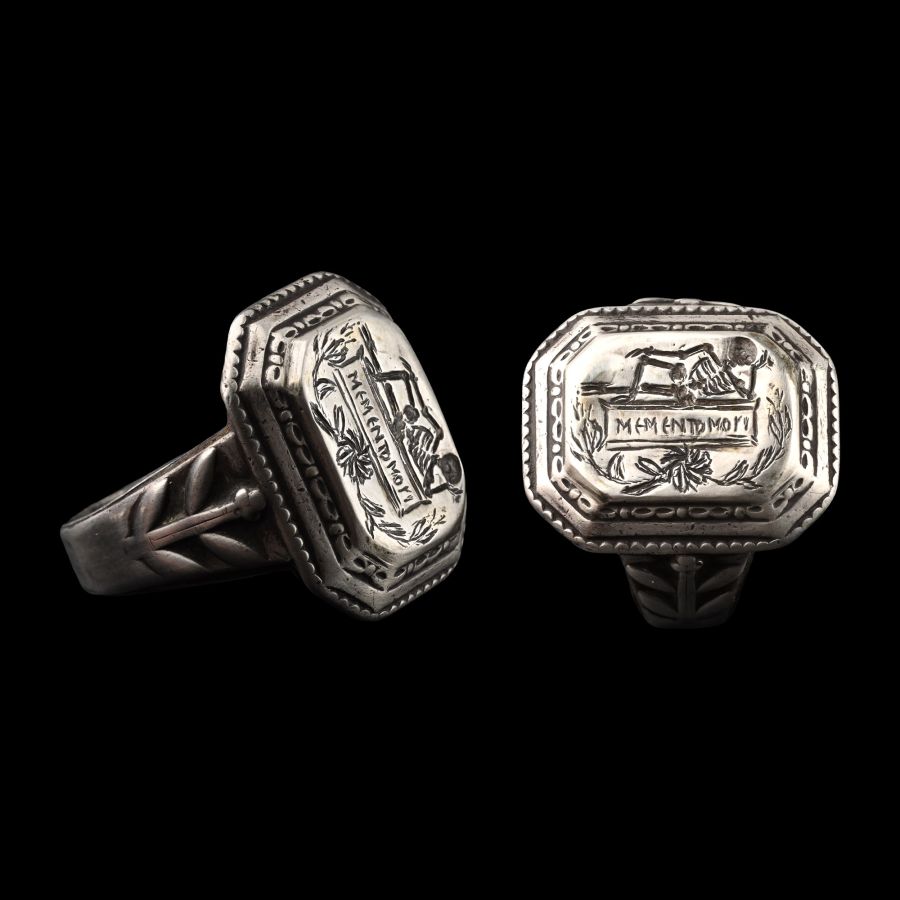
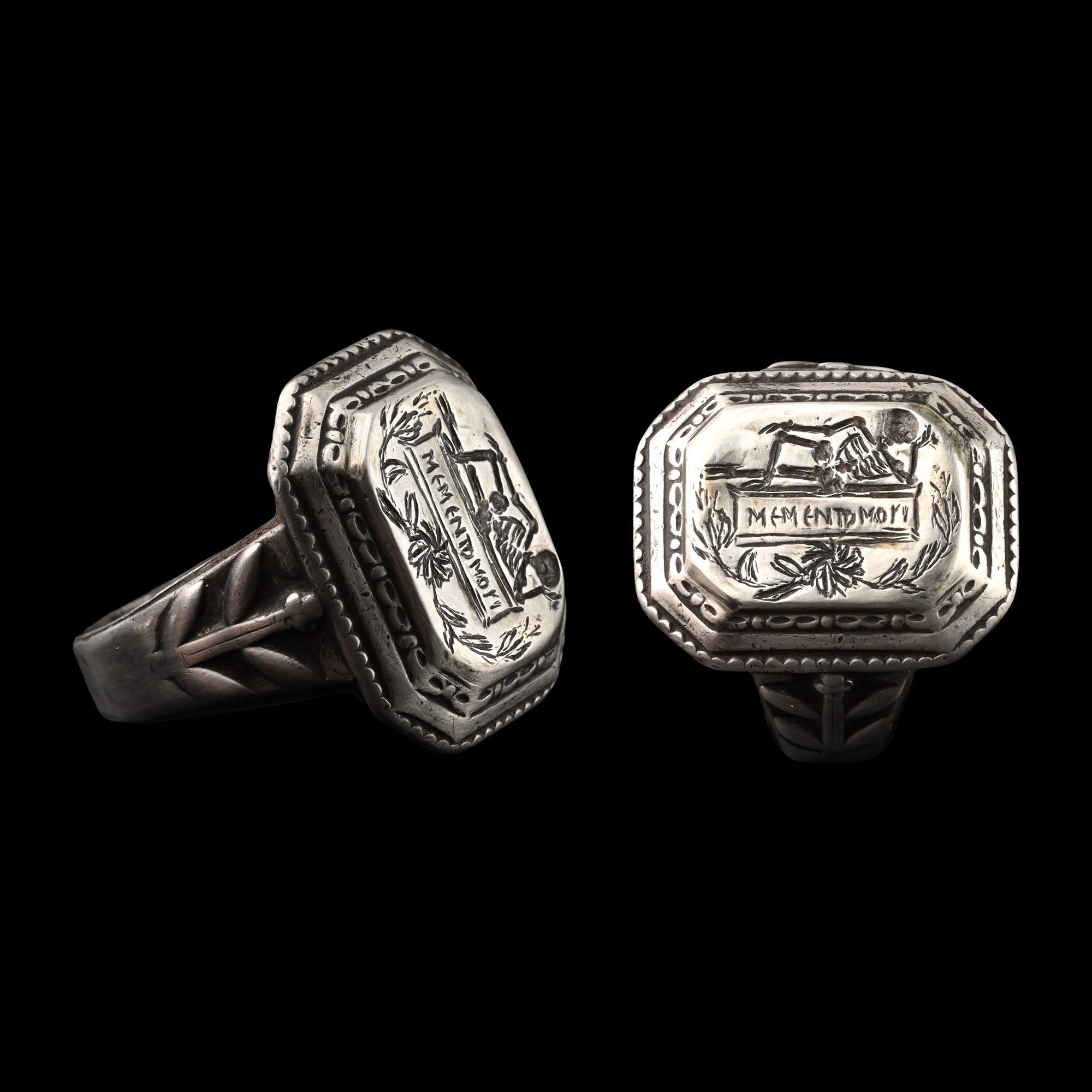
Georgian Silver Memento Mori Ring with Skeleton Reclining on a Coffin
18TH CENTURY A.D.
1 1/8 in. (9.56 grams, 28.24 mm overall, 21.10 mm internal diameter (approximate size British X, USA 11 1/2, Europe 26.29, Japan 25)).
With circular hoop and arms decorated by laurel leaves; raised octagonal bezel with engraved rectangular coffin and inscription 'MEMENTO MORI', a reclining skeleton in profile resting upon it, a pair of laurel branches below. [No Reserve]
ProvenanceFrom an East Sussex, UK, private collection; acquired 1980s-1990s.
This lot is accompanied by an illustrated lot declaration signed by the Head of the Antiquities Department, Dr Raffaele D'Amato.
TimeLine Auctions follows a vetting process to ensure the authenticity and legality of all items, reinforcing our commitment to integrity and responsible trading. Each antiquity, antique, and coin lot undergoes thorough examination by a vetting committee of at least ten external specialists, professional trade association members, scientists, and archaeologists: Our Vetting Process
AUCTIONS:
TimeLine is a leading auction house specialising in antiquities, ancient art, collectables, natural history, coins, medals, and books. Our auctions offer museums, collectors, historians, and enthusiasts the opportunity to acquire unique and historically significant pieces.
LOT 2044
Georgian Silver Memento Mori Ring with Skeleton Reclining on a Coffin
Sold for (Inc. bp): £1,430
-

Wall Cabinet Containing an Assembly of Livery and Military Badges
Estimate: £800 - 1,000 (+bp*)
Opening Bid: £400
Fifty-six livery and military badges and metalled horse trappings, housed in a glazed wall cabinet with opening front. 54 kg, 61 x 123 x 12 cm
Ex Morningthorpe Manor, Norfolk, UK. This lot is accompanied by an illustrated lot declaration signed by the Head of the Antiquities Department, Dr Raffaele D'Amato.
The parish of Morningthorpe is situated in south Norfolk, east of Long Stratton and west of Hempnall. The parish was certainly well established by the time of the Norman Conquest, its population, land ownership and productive resources being detailed in the Domesday Book of 1086. -

Stuart Period Silver Thimble
17th century A.D.Sold for (Inc. bp): £65
Tubular in form and slightly tapering with stamped waffle-pattern panels and reserved framing. 5.01 grams, 23 mm
Found whilst searching with a metal detector in Somersham, Suffolk, UK, in December 2019, declared as Treasure and disclaimed with Treasure reference no.2020 T286. Accompanied with a copy of the report for H M Coroner and the Treasure Act receipt. Recorded with the British Museum's Portable Antiquities Scheme (PAS) with report no.SF-E27D26. This lot is accompanied by an illustrated lot declaration signed by the Head of the Antiquities Department, Dr Raffaele D'Amato. -
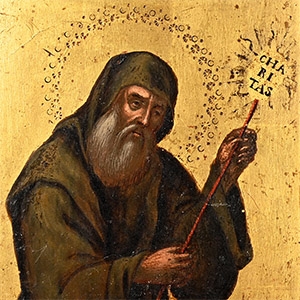
Veneto-Cretan Icon of St Francis of Paola
17th century A.D.Sold for (Inc. bp): £4,160
Tempera on wood panel, on a golden background, erect figure in three-quarter view in dark cowl and habit, holding a staff in both hands; halo ornately punched; the staff with nimbus finial surrounding majuscule legend 'CHA/RI/TAS' ('love, charity'); transverse mounting block to reverse and holes for another. 168 grams, 18.5 x 13 cm
Acquired on the European art market. Private collection, London, UK. This lot is accompanied by an illustrated lot declaration signed by the Head of the Antiquities Department, Dr Raffaele D'Amato.
Francis of Paola (1416-1507) was an Italian monk and the founder of the Order of Minims, a religious order focused on humility, penance, and charity. Born in Paola, Calabria, he was known for his ascetic lifestyle and deep spirituality. Francis was credited with performing miracles, including healing the sick and even crossing the sea on his cloak. He became a spiritual advisor to King Louis XI of France in his final years. Canonized in 1519, Francis of Paola is venerated as the patron saint of sailors and fishermen, symbolising humility and devotion to God.
