
Loading, please wait...
_900x900.jpg "Georgian 'In Unity Lets Live & Die' Gold Posy Ring")
_200x200.jpg "Georgian 'In Unity Lets Live & Die' Gold Posy Ring")
.jpg "Georgian 'In Unity Lets Live & Die' Gold Posy Ring")
LOT 0332
Georgian 'In Unity Lets Live & Die' Gold Posy Ring
18TH CENTURY A.D.
3/4 in. (1.37 grams, 19.64 mm overall, 17.97 mm internal diameter (approximate size British P 1/2, USA 7 3/4, Europe 16.86, Japan 16)).
A slender annular gold band inscribed in cursive hand to the interior: 'In Unity lets live & die', followed by maker's mark 'JK' within a rectangular cartouche.
ProvenanceFound Romney Marsh area, Kent, UK.
Property of a Kent gentleman.
Cf. The British Museum, museum number 'posy ring AF.1315', for a very similar ring with this inscription and seemingly the same maker's mark; it is noted that this maker's mark has not been identified in any standard reference works; believed active c.1755-1764.
CONDITIONTimeLine Auctions follows a vetting process to ensure the authenticity and legality of all items, reinforcing our commitment to integrity and responsible trading. Each antiquity, antique, and coin lot undergoes thorough examination by a vetting committee of at least ten external specialists, professional trade association members, scientists, and archaeologists: Our Vetting Process
AUCTIONS:
TimeLine is a leading auction house specialising in antiquities, ancient art, collectables, natural history, coins, medals, and books. Our auctions offer museums, collectors, historians, and enthusiasts the opportunity to acquire unique and historically significant pieces.
-
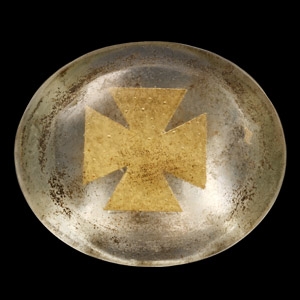
Glass Ring with Inlaid Gold Cross
20th century A.D. or earlierSold for (Inc. bp): £234
A translucent, colourless glass finger ring composed of a D-section hoop, expanding at the shoulders to an oval bezel, displaying an encapsulated gold foil cross with expanding arms. 9.73 grams, 29.44 mm overall, 18.16 mm internal diameter (approximate size British P, USA 7 1/2, Europe 16.23, Japan 15)
Acquired 1969-1999. London collection of the late Mr S.M., thence by descent. -
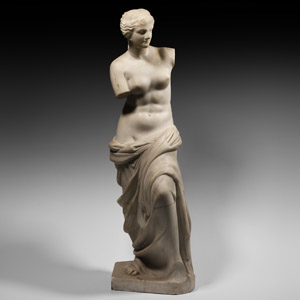
Venus of Milo Statue
19th century A.D.Estimate: £1,200 - 1,700 (+bp*)
Opening Bid: £600
A white marble copy of the famous Venus of Milo, naturalistically portrayed with her garment having fallen from her shoulders, hanging loose at her waist and exposing her breasts. 34.8 kg, 77 cm high
French collection, 1960s-early 2000s. From an important Paris gallery, France.
Aphrodite of Milos, better known as the Venus of Milo, is an ancient Greek statue and one of the most famous works of ancient Greek sculpture known today, created between 130-100 years B.C. The original is currently displayed at the Louvre in Paris. -
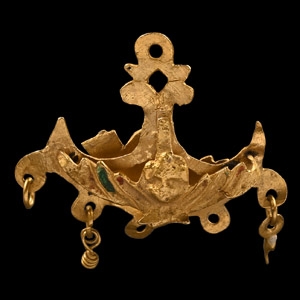
Elizabethan Boat-Shaped Pendant with Putti
16th-early 17th century A.D.Estimate: £1,000 - 1,400 (+bp*)
Opening Bid: £475
A gold pendant formed as a crescent frame with vertical bar and two outer bands; bar with trefoil finial, pierced for suspension; crescent with pierced lugs to the lower edge and wire dangles; outer bands with putto mask to the centre, frond detailing and green enamelling. 2.77 grams, 27 mm
Acquired 1960s-1990s. Late Alison Barker collection, a retired London barrister.
