
Loading, please wait...
_900x900.jpg "Georgian Gold Poison Ring")
_200x200.jpg "Georgian Gold Poison Ring")
.jpg "Georgian Gold Poison Ring")
LOT 0341
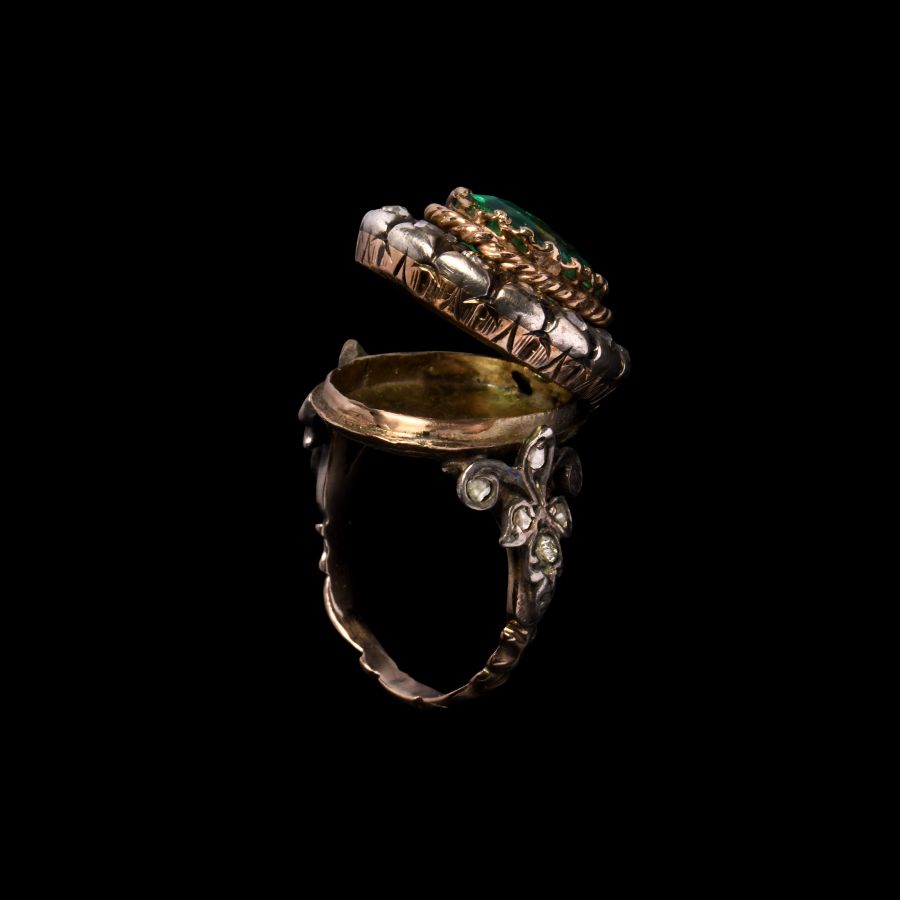
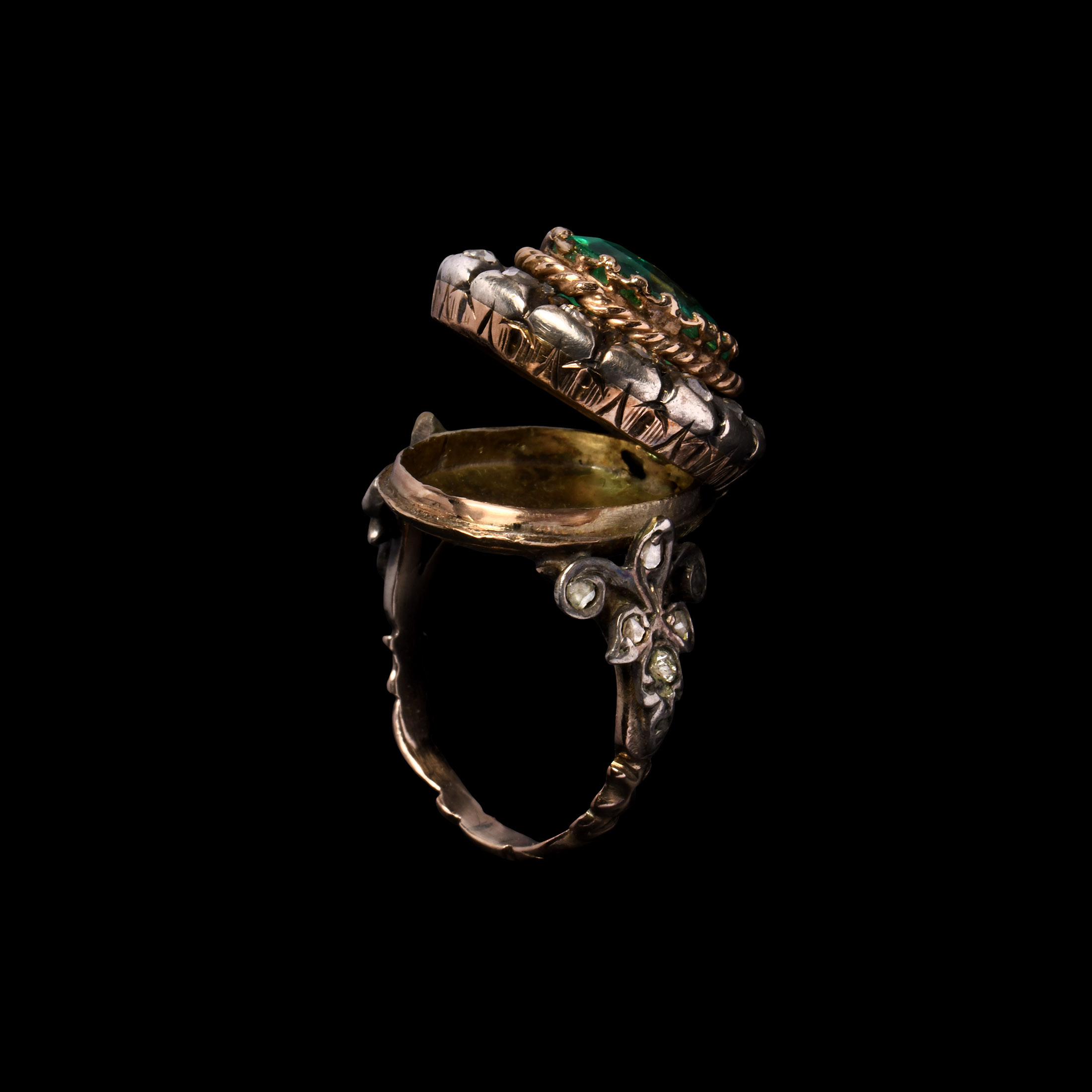
Georgian Gold Poison Ring
18TH-19TH CENTURY A.D.
1 1/8 in. (10.02 grams, 28.41 mm overall, 17.91 mm internal diameter (approximate size British O, USA 7, Europe 14.98, Japan 14)).
A Georgian-era 15 carat gold and silver 'poison' ring, composed of a slender hoop of scrolls and crescents with a plain panel at the base, expanding shoulders formed as openwork foliate flourishes set with small stones; oval cluster bezel set with a central cushion-cut emerald weighing approximately 4.06 cts, held in a pierced setting with twisted gold wire collar, and surrounded by rose-cut diamonds; hinged bezel revealing a secret compartment beneath, the reverse domed and engraved with a stylised shell motif.
ProvenanceAcquired from Platt Boutique Jewelry, Inc., West Hollywood, California, USA, 2016.
Property of an East Sussex collector.
Accompanied by a copy of the Platt Boutique Jewelry invoice.
This lot has been checked against the Interpol Database of stolen works of art and is accompanied by search certificate no.11668-197586.
See discussion in Jones, W., Finger-ring Lore, London, 1877, p.433.
Footnotes'Poison rings' became popular in Europe during the 16th century, and Lucrezia Borgia is popularly believed to have used one. The compartment within the bezel was used to conceal poison, a lock of hair or other substances.
CONDITIONTimeLine Auctions follows a vetting process to ensure the authenticity and legality of all items, reinforcing our commitment to integrity and responsible trading. Each antiquity, antique, and coin lot undergoes thorough examination by a vetting committee of at least ten external specialists, professional trade association members, scientists, and archaeologists: Our Vetting Process
AUCTIONS:
TimeLine is a leading auction house specialising in antiquities, ancient art, collectables, natural history, coins, medals, and books. Our auctions offer museums, collectors, historians, and enthusiasts the opportunity to acquire unique and historically significant pieces.
-
.jpg)
Post Byzantine Triptych Centre Icon of the Intercession
17th-19th century A.D.Sold for (Inc. bp): £44
A central plaque from a brass triptych with standing nimbate Mother of God, dressed in a chlamys and tunica talaris, with her arms extended outward and the head turned to the right, surrounded by two groups of worshippers, arranged in three rows: the angels at the top, the right ones at the centre and prophets with angels at the bottom; two flags flying horizontally on each side of her head, surrounded by plant decorations, while the sun and moon are depicted at the two corners of the plaque, separated by an inscription in Russian; in the upper part, in the shape of an eastern dome, is represented the Holy Trinity, Father and Son, seated on a throne of clouds, a cross in the middle surmounted by a dove. 142 grams, 13 cm high
Fair condition.
Acquired on the UK art market, 2000s. Property of an Essex gentleman.
The icon represents the Intercession of Mary, 'Joy of all who sorrow'. It formed the central part of a triptych with the Mother of God at the centre, surmounted by iconography of veneration. The (here missing) other parts of the triptych were embossed with scenes of the lives of Christ or Mary. -
Post Medieval Culinary Artefact
16th-18th century A.D.Sold for (Inc. bp): £7
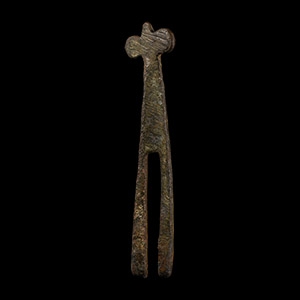
A copper-alloy artefact, likely a pastry cutter handle, composed of a lobed finial and two prongs with evidence of perforations for bar to suspend the cutter. 15.6 grams, 71 mm
Fine condition.
Found Wiltshire, UK. -
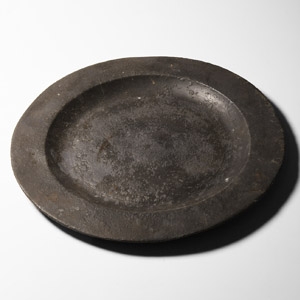
Post Medieval 'Thames' John Duncombe of London Pewter Plate
Early 18th century A.D.Sold for (Inc. bp): £26
A pewter plate bearing worn stamps to the reverse and a label reading 'John Duncombe London'; initials stamped to upper face of rim 'M[ ]E'. 334 grams, 22 cm wide
Found on the Thames foreshore, London, UK. Acquired on the UK antiques market between 1974-1985. Albert Ward collection, Essex, UK.
