
Loading, please wait...
_900x900.jpg "Georgian Gold Mourning Ring with Opening Clasped Hands")
_200x200.jpg "Georgian Gold Mourning Ring with Opening Clasped Hands")
_900x900.jpg "Georgian Gold Mourning Ring with Opening Clasped Hands")
_200x200.jpg "Georgian Gold Mourning Ring with Opening Clasped Hands")
_900x900.jpg "Georgian Gold Mourning Ring with Opening Clasped Hands")
_200x200.jpg "Georgian Gold Mourning Ring with Opening Clasped Hands")
_900x900.jpg "Georgian Gold Mourning Ring with Opening Clasped Hands")
_200x200.jpg "Georgian Gold Mourning Ring with Opening Clasped Hands")
.jpg "Georgian Gold Mourning Ring with Opening Clasped Hands")
.jpg "Georgian Gold Mourning Ring with Opening Clasped Hands")
.jpg "Georgian Gold Mourning Ring with Opening Clasped Hands")
.jpg "Georgian Gold Mourning Ring with Opening Clasped Hands")
LOT 0362
Georgian Gold Mourning Ring with Opening Clasped Hands
DATED 14TH DECEMBER 1774 A.D.
1 in. (8.44 grams, 24.71 mm overall, 17.09 mm internal diameter (approximate size British N, USA 6 1/2, Europe 13.72, Japan 13)).
Formed of a wide band with faux-ropework borders and plaited brown hair, hinged outer cover with the locking mechanism formed as two clasping hands, three circular openings with decorative cuts on each arm; inside engraved with 'Dbre 14/74'. [No Reserve]
ProvenanceFrom the old family collection of a West Country, UK, lady; acquired by descent from her grandfather circa 2001.
LiteratureCf. Chadour, A.B., Rings. The Alice and Louis Koch Collection, volume I, Leeds, 1994, item 759, for type.
FootnotesThis ring features the ancient fede motif of two hands clasped together. These symbols represented love and fidelity. The ring was likely a token of love symbolising everlasting devotion, or possibly a betrothal ring. The motif of the two clasped hands was already in use in ancient Rome, as a symbol of pledging of vows, which derives from the Roman dextarum iunctio (right hand joined). Fede rings remained popular throughout Europe until well into the 19th century.
CONDITIONTimeLine Auctions follows a vetting process to ensure the authenticity and legality of all items, reinforcing our commitment to integrity and responsible trading. Each antiquity, antique, and coin lot undergoes thorough examination by a vetting committee of at least ten external specialists, professional trade association members, scientists, and archaeologists: Our Vetting Process
AUCTIONS:
TimeLine is a leading auction house specialising in antiquities, ancient art, collectables, natural history, coins, medals, and books. Our auctions offer museums, collectors, historians, and enthusiasts the opportunity to acquire unique and historically significant pieces.
LOT 0362
Georgian Gold Mourning Ring with Opening Clasped Hands
Sold for (Inc. bp): £2,860
-
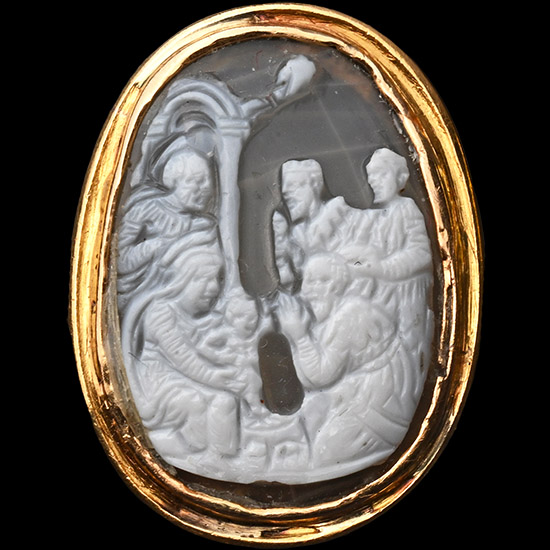
Post Medieval Gold Ring with Sardonyx Cameo with Adoration of the Magi
Italy, 15th century A.D.Estimate: £5,000 - 7,000 (+bp*)
Opening Bid: £2,500
Featuring a finely carved sardonyx cameo illustrating the Nativity, with the Virgin Mary extending the Christ Child toward the three Magi bearing gifts, while Joseph stands beside her; the family shown emerging from an arched doorway, beneath the Star of Bethlehem; set in a 19th-century high-carat gold mount, probably English in origin. 4.62 grams, 21.88 mm overall, 18.25 mm internal diameter (approximate size British Q, USA 8, Europe 17.49, Japan 16)
Acquired on the European art market. This lot has been checked against the Interpol Database of stolen works of art and is accompanied by search certificate number no.13334-258013.
The scene is staged horizontally, with the Holy Family at one end and the Magi and their entourage proceeding towards it, essentially unfolding in the foreground in a sort of procession, one behind the other. This was the standard image, although in the Italian School of Renaissance the same scene was often modified according to the vision of Botticelli, who put at the centre the Holy Family. -
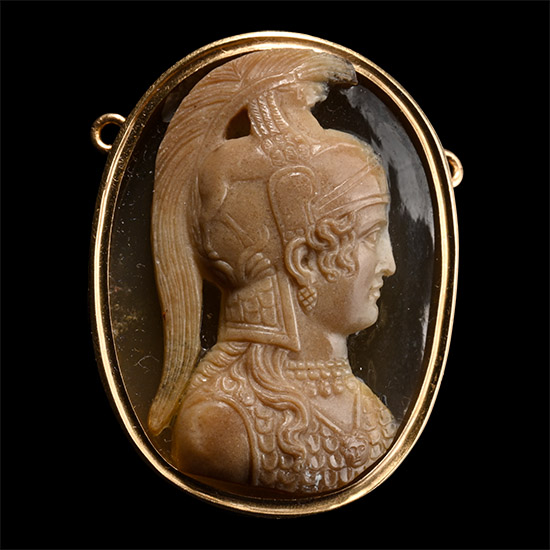
Sardonyx Cameo of the Greek Goddess Athena in Gold Mount
Europe, 18th century A.D.Sold for (Inc. bp): £1,690
Finely carved, high-relief cameo depicting profile bust of the goddess, wearing a plumed helmet with the crest supported by a winged Pegasus, her hair modelled in soft curls framing the face and falling over the shoulder above articulated lorica (battle armour); small grape-shaped earrings and multiple necklaces carefully rendered, creating an appealing contrast between martial attributes and feminine ornament; set in an unmarked, high-carat gold frame, probably struck and finished in England after the gem’s return from the Grand Tour, two lateral suspension loops. 14.98 grams, 36 mm
Acquired on the European art market.
The relief shows confident toolwork: crisp contours to the facial profile, detailed treatment of the helmet and feathers, and subtle gradations of planes between the figure and the background. -
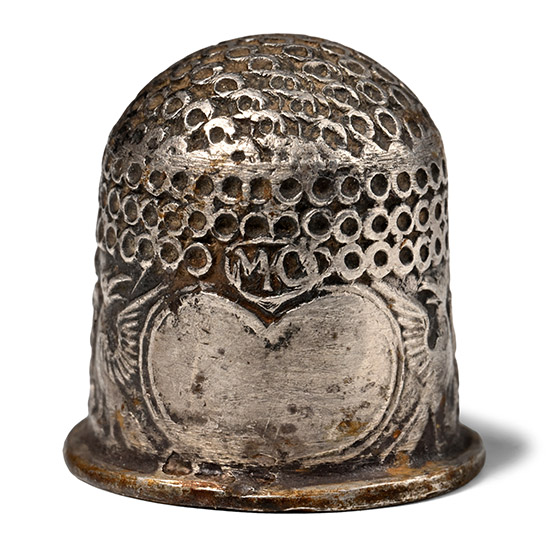
Post Medieval Silver Thimble with Heart-Shaped Cartouche Flanked by Birds
1650-1750 A.D.Sold for (Inc. bp): £143
The body decorated by annulets on the sides and top, the maker's initials 'MC' above an empty heart-shaped cartouche flanked by supporters in the form of birds regardant; on the interior immediately above the base, two very indistinct stamps, the lower one possibly a lion. 3.14 grams, 16 mm
Found in North Walsham, Norfolk, UK, on Saturday 13th August 2011, declared as Treasure under the Treasure Act with reference no.2011 T596, and disclaimed by the Crown and returned to the finder. Accompanied by a copy of the British Museum's Portable Antiquities Scheme (PAS) report no.NMS-190428. Accompanied by a copy of the Treasure Report for HM Coroner with reference no.2011 T596. Accompanied by a copy of a letter from the British Museum explaining that the Crown's interest in the thimble has been disclaimed.
