
Loading, please wait...
_900x900.jpg "Gemstone Collection")
_200x200.jpg "Gemstone Collection")
.jpg "Gemstone Collection")
LOT 2141
Gemstone Collection
20TH CENTURY AD.
3/8 - 3/4 in. (17 grams total, 9-21 mm).
Mainly discoid and ellipsoid cloisons with intaglio designs including mythical beast, profile bust and other types. [12, No Reserve]
ProvenanceAcquired on the UK art market.
Property of a North London, UK, gentleman.
This lot is accompanied by an illustrated lot declaration signed by the Head of the Antiquities Department, Dr Raffaele D’Amato.
TimeLine Auctions follows a vetting process to ensure the authenticity and legality of all items, reinforcing our commitment to integrity and responsible trading. Each antiquity, antique, and coin lot undergoes thorough examination by a vetting committee of at least ten external specialists, professional trade association members, scientists, and archaeologists: Our Vetting Process
AUCTIONS:
TimeLine is a leading auction house specialising in antiquities, ancient art, collectables, natural history, coins, medals, and books. Our auctions offer museums, collectors, historians, and enthusiasts the opportunity to acquire unique and historically significant pieces.
-
.jpg)
Russian Wooden Icon with Christ Pantocrator
19th century A.D.Sold for (Inc. bp): £390
Showing Christ Pantocrator (Lord of the Universe) making a blessing gesture with the right hand, dressed in red chiton and blue chlamys, the left hand holding the gospel with Cyrillic inscription from Matthew 11:28 Прiиди́те ко мнѣ́ вси́ труждáющiися и обременéннiи, и áзъ упокóю вы́, translating 'Come unto me, all who labour and are heavy-laden, and I will give you rest'; inscriptions beside the Christ's head 'IC XC' for 'Jesus Christ' and Cyrillic inscription 'Господь Вседержитель'= 'Lord Almighty on both sides of His Body'. 1.08 kg, 36 x 27.5 cm
Property of a London, UK, gentleman collector. This lot is accompanied by an illustrated lot declaration signed by the Head of the Antiquities Department, Dr Raffaele D’Amato.
This fine Russian religious work depicts Christ Pantocrator, ‘Almighty’ or ‘All Powerful’. It is a compound word formed from the Greek words for ‘all’ and the noun ‘strength’ (kratos). -
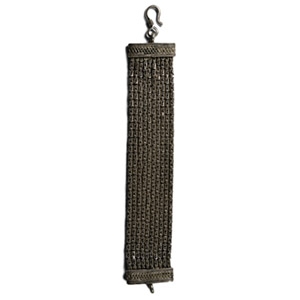
Post Medieval Multi-Stranded Silver Chain Bracelet
20th century A.D.Sold for (Inc. bp): £65
Composed of ten round Byzantine chains with oval terminals, the terminals with applied ropework and filigree decoration; loop-and-hook closure. 131 grams, 22.5 cm
Acquired on the UK art market. Ex property of a County Durham collector. This lot is accompanied by an illustrated lot declaration signed by the Head of the Antiquities Department, Dr Raffaele D’Amato. -
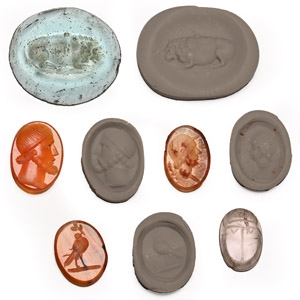
Mixed Gemstone Collection
20th century A.D.Sold for (Inc. bp): £46
Mainly plano-convex types with engraved intaglios of a recumbent lion, portrait bust (2) and a perching bird; offered with a rock crystal scarab with engraving to underside of three crosses and 'W'; intaglios supplied with a museum-quality impression. 6.18 grams total, 14-24 mm
From the collection of a London antiquarian, formed since the 1980s. This lot is accompanied by an illustrated lot declaration signed by the Head of the Antiquities Department, Dr Raffaele D’Amato.
