
Loading, please wait...
_900x900.jpg "Gemstone Collection")
_200x200.jpg "Gemstone Collection")
.jpg "Gemstone Collection")
LOT 2195
Gemstone Collection
19TH-20TH CENTURY A.D.
1/2 - 3/4 in. (4.66 grams total, 14-18 mm).
Comprising: profile male and female busts in carnelian and other stones; each supplied with a museum-quality impression. [4]
ProvenancePrivate collection, England.
This lot is accompanied by an illustrated lot declaration signed by the Head of the Antiquities Department, Dr Raffaele D’Amato.
TimeLine Auctions follows a vetting process to ensure the authenticity and legality of all items, reinforcing our commitment to integrity and responsible trading. Each antiquity, antique, and coin lot undergoes thorough examination by a vetting committee of at least ten external specialists, professional trade association members, scientists, and archaeologists: Our Vetting Process
AUCTIONS:
TimeLine is a leading auction house specialising in antiquities, ancient art, collectables, natural history, coins, medals, and books. Our auctions offer museums, collectors, historians, and enthusiasts the opportunity to acquire unique and historically significant pieces.
LOT 2195
Gemstone Collection
Estimate £150 - 200€170 - 230 (for guidance only)$200 - 270 (for guidance only)
-
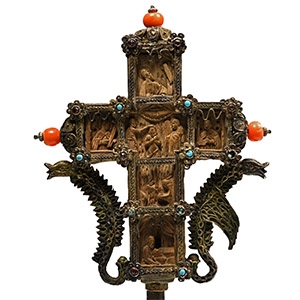
Mount Athos Wooden Cross with Silver-Gilt Mounts
Late 18th century A.D.Sold for (Inc. bp): £2,730
Comprising: a wooden cross with carved scenes from the life of Christ (Nativity and others to one face, Crucifixion and others to the other face) housed in a filigree frame; addorsed winged beasts supporting the arms of the cross; three coral beads to the arms, smaller glass beads to each face; balustered stem and domed base. 170 grams, 21.5 cm
Ex Iconastas, London SW1, UK, in 2004. Property of a London, UK, gentleman collector. Accompanied by a copy of the Iconastas invoice dated 18 February 2004. This lot is accompanied by an illustrated lot declaration signed by the Head of the Antiquities Department, Dr Raffaele D’Amato. -
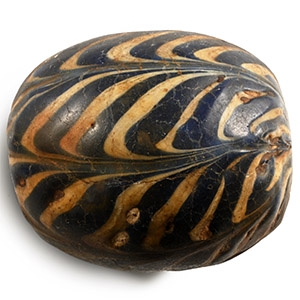
Massive Western Asiatic Style Glass Bead
20th century A.D.Sold for (Inc. bp): £65
A substantial oblate bead with dragged trails to the surface. 1.24 kg, 10.6 cm
Acquired 1970-1999. London collection of the late Mr S.M., thence by descent. This lot is accompanied by an illustrated lot declaration signed by the Head of the Antiquities Department, Dr Raffaele D’Amato. -
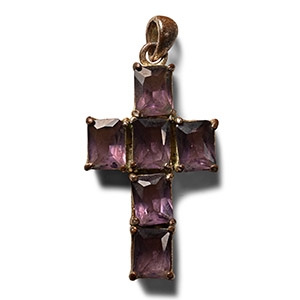
Silvered Cross Pendant with Amethyst Gemstones
Circa 19th century A.D.Sold for (Inc. bp): £85
Cruciform in plan with open reverse to each cell, inset table-cut amethysts, plain bale. 7.68 grams, 43 mm
Acquired on the London art market in the late 1980s-1990s. From the family collection of an East London, UK, gentleman. This lot is accompanied by an illustrated lot declaration signed by the Head of the Antiquities Department, Dr Raffaele D’Amato.
