
Loading, please wait...
LOT 1072
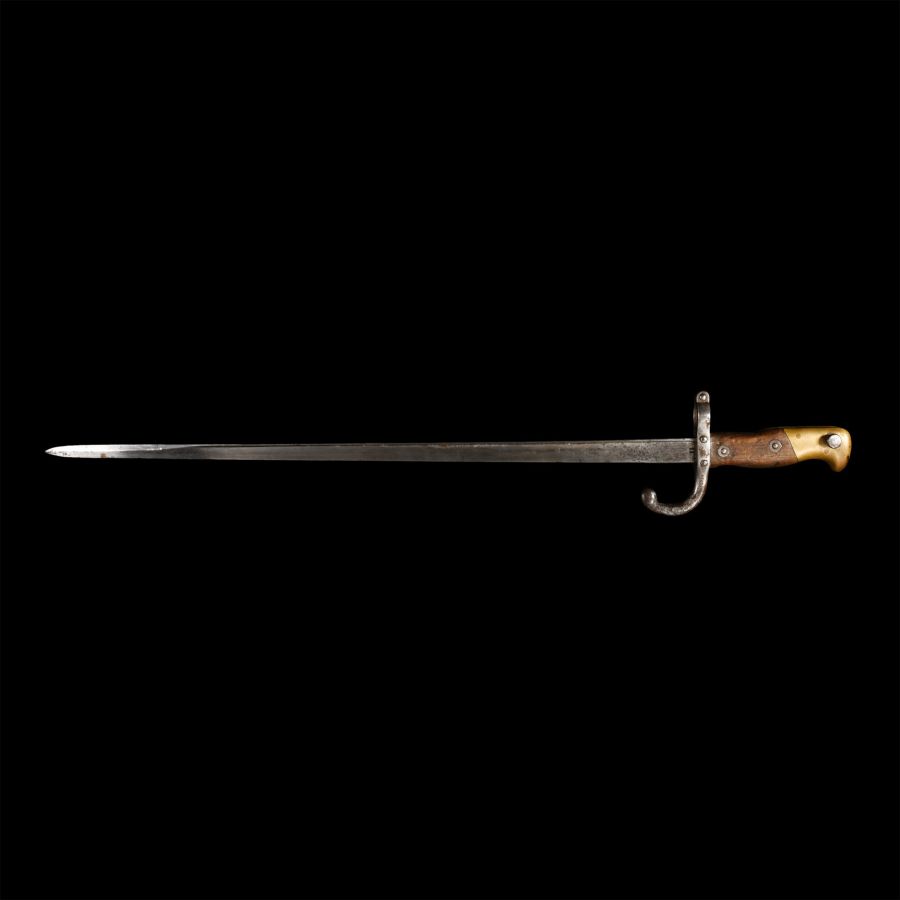
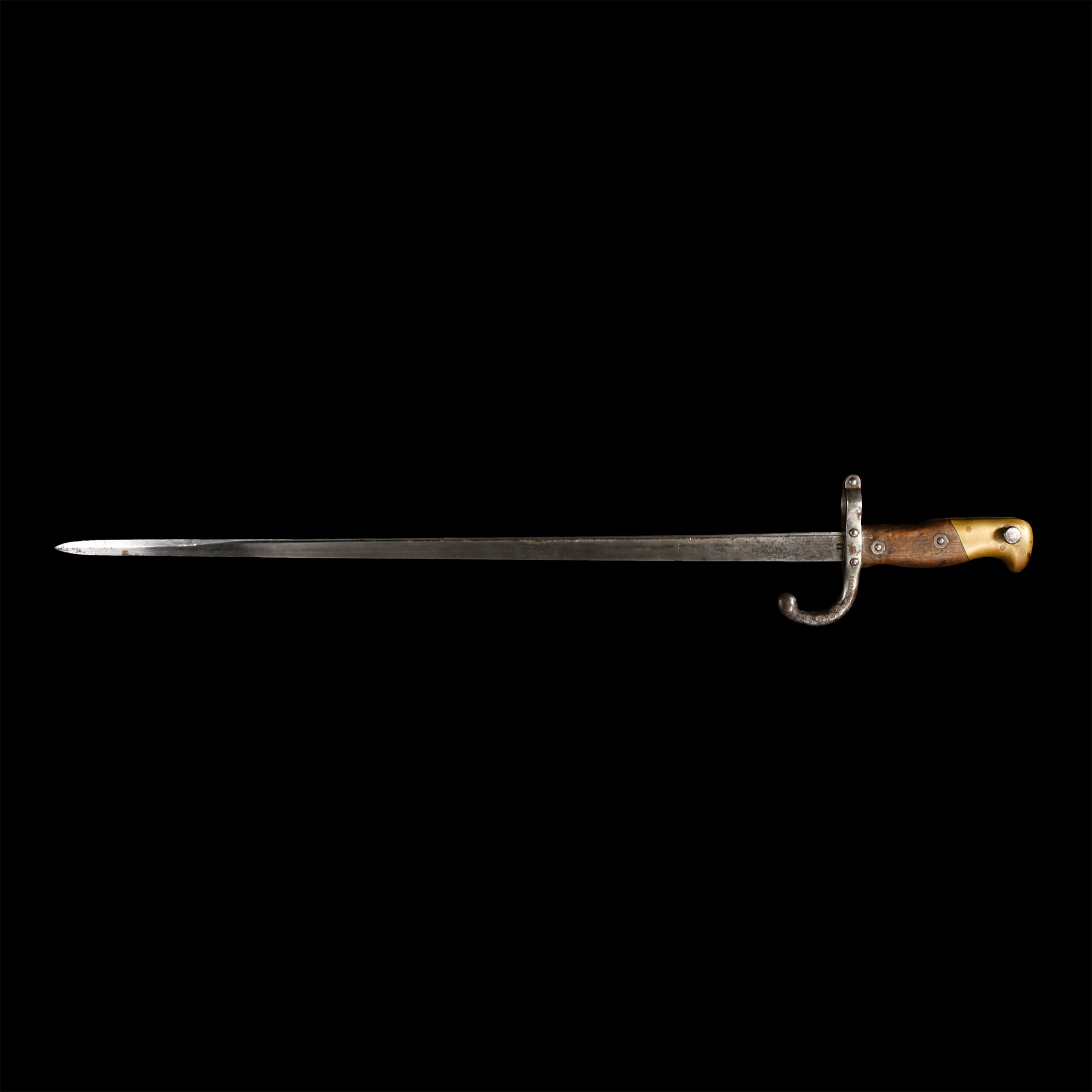
French Gras Model 1874 Rifle Bayonet
DATED 1878 A.D.
25 3/8 in. (573 grams,64.5 cm).
A Gras bayonet with T-shaped tapering 'epee' blade fitted with steel perforated quillon, rivetted wood grip scales and brass pommel slotted to fit the rifle barrel key; various punchmarks and numbered '54506' to quillon, the back of the blade inscribed 'Mme d'Arennes de Chatrs Avril 1878' in script. [No Reserve]
ProvenanceAcquired on the UK antiques market between 1974-1985.
Albert Ward collection, Essex, UK.
See Capwell, Dr Tobias, Knives Daggers & Bayonets, 2009, p.179.
CONDITIONTimeLine Auctions follows a vetting process to ensure the authenticity and legality of all items, reinforcing our commitment to integrity and responsible trading. Each antiquity, antique, and coin lot undergoes thorough examination by a vetting committee of at least ten external specialists, professional trade association members, scientists, and archaeologists: Our Vetting Process
AUCTIONS:
TimeLine is a leading auction house specialising in antiquities, ancient art, collectables, natural history, coins, medals, and books. Our auctions offer museums, collectors, historians, and enthusiasts the opportunity to acquire unique and historically significant pieces.
-
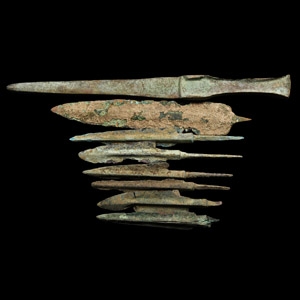
Luristan Mixed Blade Group
2nd-1st millennium B.C. and laterSold for (Inc. bp): £169
A mixed group of bronze bladed weapons including arrowheads; dagger believed to be a reproduction. 374 grams total, 11.4-26.5 cm
Acquired 1970s-1990s. Ex Rabi Gallery, Mayfair, London, U.K. From a specialist collection of pottery. -
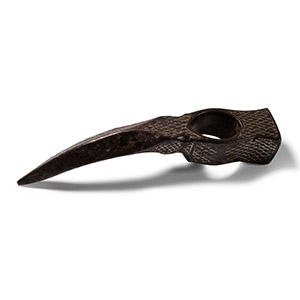
Eastern European Silver Inlaid War-Hammer
16th century A.D.Sold for (Inc. bp): £598
A copper-alloy war-hammer composed of ellipsoidal socket, waisted butt with shallow conical face and tapering, lozenge-section head, inlaid with a silver 'net' design. 453 grams, 18.5 cm
Private collection of Mr M.B., Mainz, Germany, 1990s. Property of a London businessman. This lot has been checked against the Interpol Database of stolen works of art and is accompanied by search certificate no.11203-186235.
The name obuch is Polish and means 'the blind end of an axe', but already at the beginning of the 15th century it meant a [unspecified] war hammer. According to Polish sources of 17th century, the war-hammer could have been formed into the shape of an axe (czekan), or in the form of a thick, slightly sloping spike (nadziak), or curved like a round cracknel (obuch). A 17th century description states: 'It was a terrible instrument in the hand of a Pole...With the sabre one could cut off somebody’s hand, cut the face, injure the head, and the running blood of the adversary would calm down the rancour. But with the obuch one could cause a deadly wound without even seeing the blood, and – not seeing it – he would not calm down instantly, but would strike several times without cutting the skin, breaking ribs and bones at the same time.' -
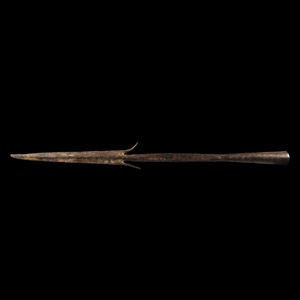
Medieval Socketted Catapult Dart
14th-16th century A.D.Sold for (Inc. bp): £169
An iron catapult dart formed with a tapering cylindrical socket, square-section neck and barbed triangular head with full-length medial rib to both faces. 94 grams, 29 cm
Acquired before 2000. From the collection of a European gentleman living in the UK.
