
Loading, please wait...
LOT 1208
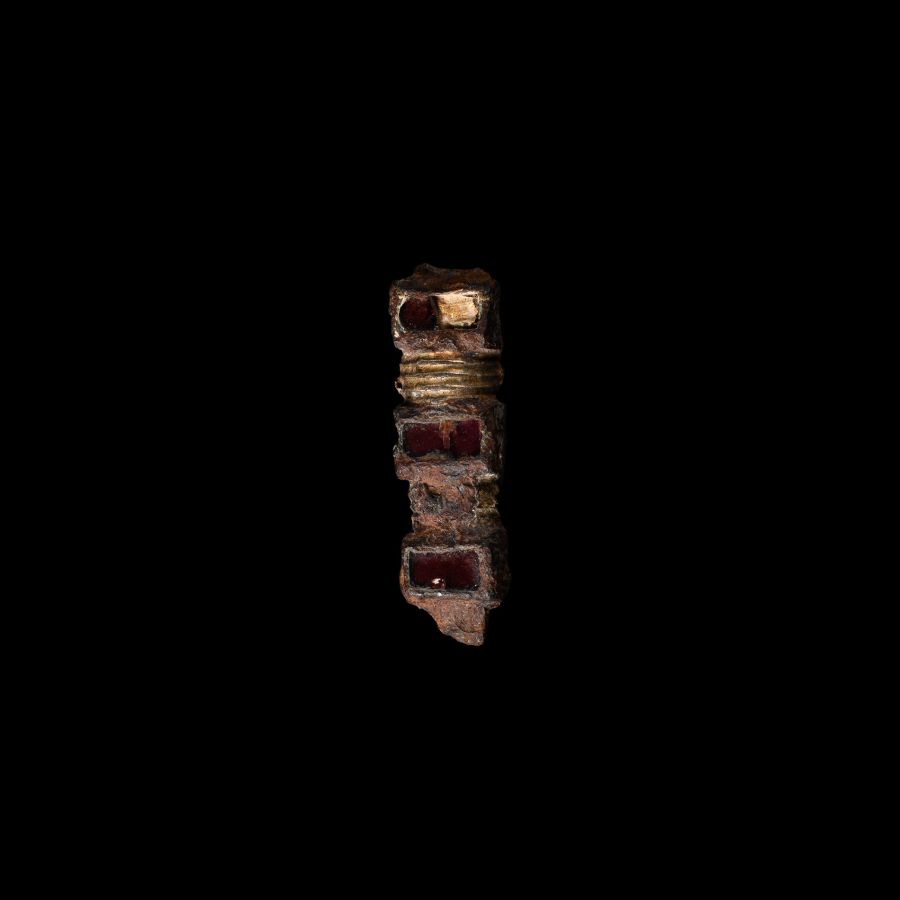
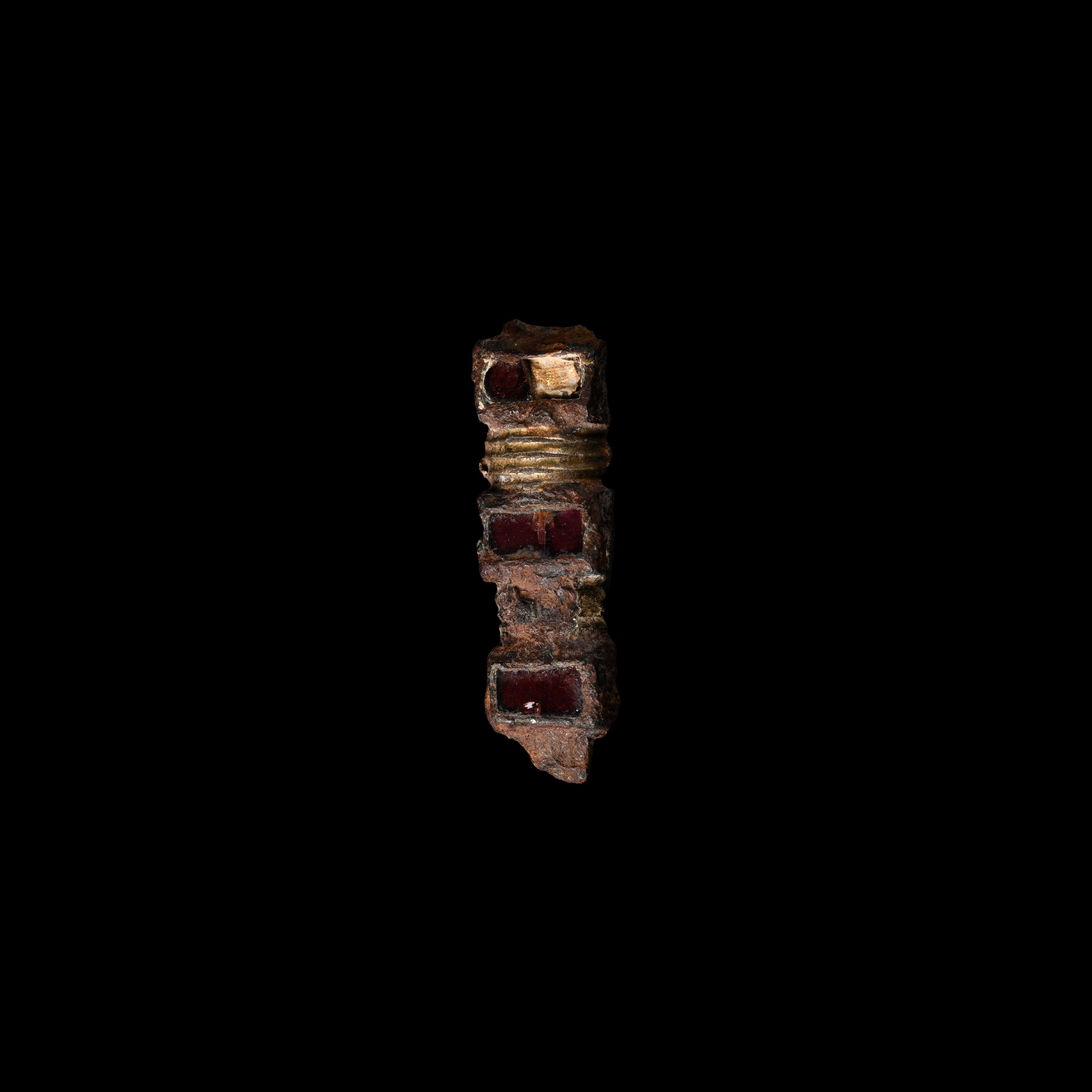
Frankish Gilt Chip-Carved Scabbard Mount with Garnets
CIRCA 6TH CENTURY A.D.
1 3/4 in. (11.8 grams, 44 mm).
A gilt copper-alloy mount or scabbard-slider (Menghin's Typ IIIa Basel-Gotterbarmweg-Entringen) comprising three horizontal rectangular cells to the upper, middle and lower third of the body, each with gilt frame and set with a polished garnet cloison; the interstitial bridges with gilt ribbing; iron remains to verso. [No Reserve]
ProvenanceFound UK.
Acquired in the 1990s.
From a North Yorkshire private collection, UK.
Cf. Menghin, W., Das Schwert im Frühen Mittelalter, Stuttgart, 1983, p.155.
CONDITIONTimeLine Auctions follows a vetting process to ensure the authenticity and legality of all items, reinforcing our commitment to integrity and responsible trading. Each antiquity, antique, and coin lot undergoes thorough examination by a vetting committee of at least ten external specialists, professional trade association members, scientists, and archaeologists: Our Vetting Process
AUCTIONS:
TimeLine is a leading auction house specialising in antiquities, ancient art, collectables, natural history, coins, medals, and books. Our auctions offer museums, collectors, historians, and enthusiasts the opportunity to acquire unique and historically significant pieces.
-
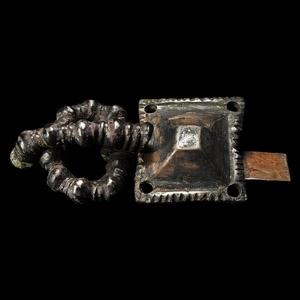
Large Germanic Silver Buckle
6th century A.D.Sold for (Inc. bp): £127
A heavy silver belt buckle, the bow and tongue decorated with raised nodules, rectangular plate with beaded edges, pierced through the corners, modern plate for attachment. 101 grams, 87 mm
Fine condition.
Acquired mid 1980s to early 1990s. Private family collection formed in London.
The construction of the buckle loop and tongue could suggest that this object originates from the Heruli culture, when compared to finds like those from the Ulów graves. Another possibility is that the buckle belongs to Alemannic or Frankish culture. The rectangular buckle plate seems to be an addition from a different buckle of Gothic type, but the assemblage could have been done already in antiquity. -
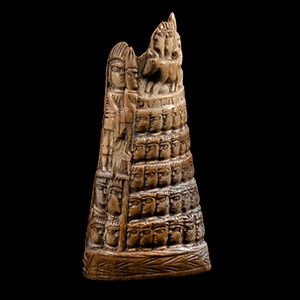
Post Roman Gallic Figural Amuletic Bone Carving
5th-7th century A.D. or laterSold for (Inc. bp): £1,690
A carved bone panel, roughly triangular in plan with a curved profile, carved in relief with a stylised figural scene: left, above: two figures standing right, four large heads below; partial figures with a hound facing left above right, text below: 'JVLIANVS'; panel of five orderly rows of heads facing left, with geometric border below; notching to the edges to reverse; repaired. 31.4 grams, 91 mm
Previously in the Alison Barker collection, a retired London barrister. From a Cambridge collection. Property of a North London gentleman.
The piece is probably a panel from a carved casket. The imagery relates to the Emperor Julian, later known as 'the Apostate', who was the cousin of Emperor Constantius II and ruled from 3 November 361-26 June 363. Julian was well-educated in the Greek tradition and rejected the Christian faith imposed on the eastern Empire under his uncle, Constantine. On his succession, Julian embarked on a military campaign against the Sassanian Empire in 363 which initially went well, but at the battle of Samarra in the same year he was badly wounded. -
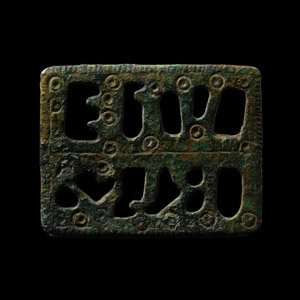
Merovingian Lettered Openwork Plate Brooch
6th-7th century A.D.Sold for (Inc. bp): £165
A rectangular bronze brooch decorated with punched ring-and-dot motifs and openwork lettering, possibly 'RIC/VLF'; hinged pin and catch to reverse. 15.6 grams, 43 mm
Fine condition.
Acquired 1970s-1980s. Ex UK collection. Property of a Portsmouth, UK gentleman.
The item was probably part of a Merovingian belt fitting, later transformed in brooch with the application of the pin and catch. The name 'Riculf' or 'Ricolf' belonged to a bishop of Cologne, Germany, from 763 to 784 A.D.
