
Loading, please wait...
_900x900.jpg "Framed Indian Watercolour Manuscript Leaf with Potentate and Attendant")
_200x200.jpg "Framed Indian Watercolour Manuscript Leaf with Potentate and Attendant")
_900x900.jpg "Framed Indian Watercolour Manuscript Leaf with Potentate and Attendant")
_200x200.jpg "Framed Indian Watercolour Manuscript Leaf with Potentate and Attendant")
.jpg "Framed Indian Watercolour Manuscript Leaf with Potentate and Attendant")
.jpg "Framed Indian Watercolour Manuscript Leaf with Potentate and Attendant")
LOT 2676
Framed Indian Watercolour Manuscript Leaf with Potentate and Attendant
19TH CENTURY A.D.
12 1/4 x 9 3/4 in. (733 grams, 31 x 25 cm).
A manuscript leaf with painted scene of a potentate sitting on a dais beneath a canopy with an attendant to his rear and another standing before him; panels of nastaliq text surrounding the scene; mounted in a reveal within a glazed wooden frame. [No Reserve]
ProvenanceAcquired on the UK art market, 1980s-1990s.
The Woodbridge collection of Indo-Persian art.
TimeLine Auctions follows a vetting process to ensure the authenticity and legality of all items, reinforcing our commitment to integrity and responsible trading. Each antiquity, antique, and coin lot undergoes thorough examination by a vetting committee of at least ten external specialists, professional trade association members, scientists, and archaeologists: Our Vetting Process
AUCTIONS:
TimeLine is a leading auction house specialising in antiquities, ancient art, collectables, natural history, coins, medals, and books. Our auctions offer museums, collectors, historians, and enthusiasts the opportunity to acquire unique and historically significant pieces.
LOT 2676
Framed Indian Watercolour Manuscript Leaf with Potentate and Attendant
Sold for (Inc. bp): £124
-
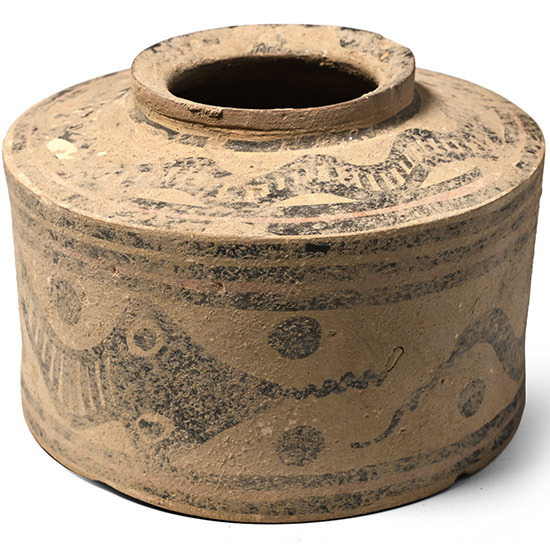
Indus Valley Terracotta Vessel with Snakes
3rd-2nd millennium B.C.Sold for (Inc. bp): £169
With low sidewall, flat shoulder and everted rim to the broad mouth; painted serpent band to side and shoulder. 398 grams, 11.3 cm wide
From the private collection of the late David Gold, 1990s. David Gold was one of the co founders of the Iconic Lord John brand in Carnaby Street that sparked a style revolution in the swinging sixties dressing The Rolling Stones, The Beatles and The Kinks and were at the heart of 'all things cool'.
The decoration of the vase evokes the 'fish scale style' from Harappa. Images of water creatures were often stylised. In the Harappan Period the fish scale motif was one of the major painted pattern of that culture. -
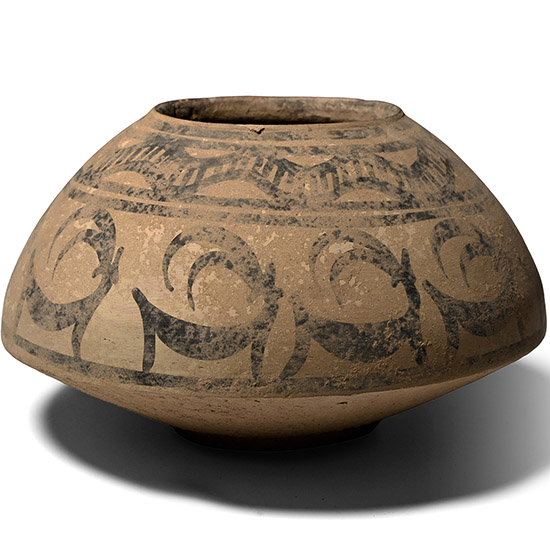
Indus Valley Terracotta Vessel with Ibex
3rd-2nd millennium B.C.Sold for (Inc. bp): £208
Biconvex jar with flat mouth, painted bands of serpents and ibexes to the shoulder. 330 grams, 13 cm wide
From the private collection of the late David Gold, 1990s. David Gold was one of the co founders of the Iconic Lord John brand in Carnaby Street that sparked a style revolution in the swinging sixties dressing The Rolling Stones, The Beatles and The Kinks and were at the heart of 'all things cool'.
Common animal motifs on Indus Valley pottery include the ibex, goat, ox, deer, blackbuck, and stag. In early pottery, they are found in stylised or geometrical forms, then in naturalistic forms. -
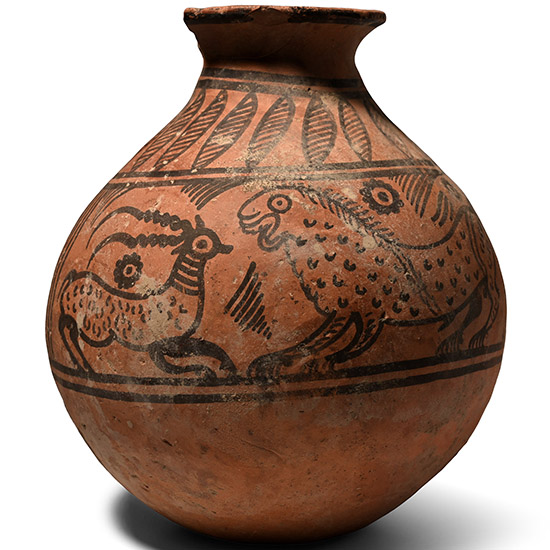
Large Indus Valley Terracotta Vessel with Animals
3rd-2nd millennium B.C.Sold for (Inc. bp): £390
Globular with everted rim, painted polychrome frieze of a lion and a facing ibex with geometric panels in between; rim chipped. 917 grams, 18.5 cm
From the private collection of the late David Gold, 1990s. David Gold was one of the co founders of the Iconic Lord John brand in Carnaby Street that sparked a style revolution in the swinging sixties dressing The Rolling Stones, The Beatles and The Kinks and were at the heart of 'all things cool'.
