
Loading, please wait...
LOT 0046
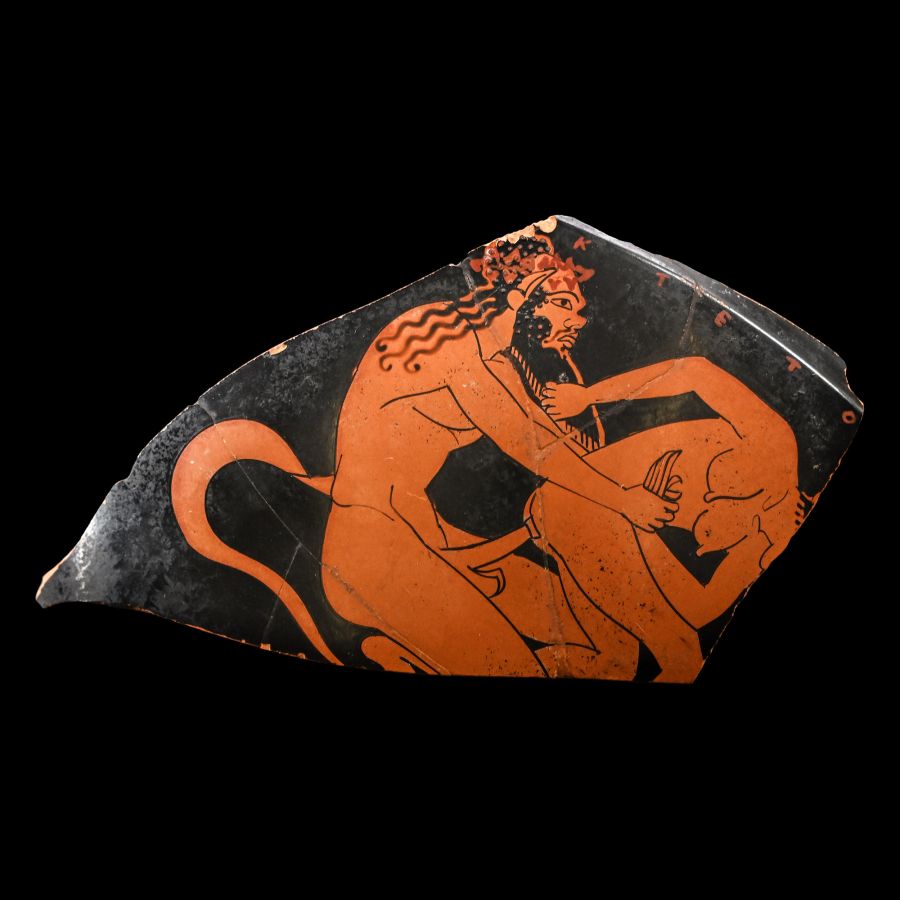
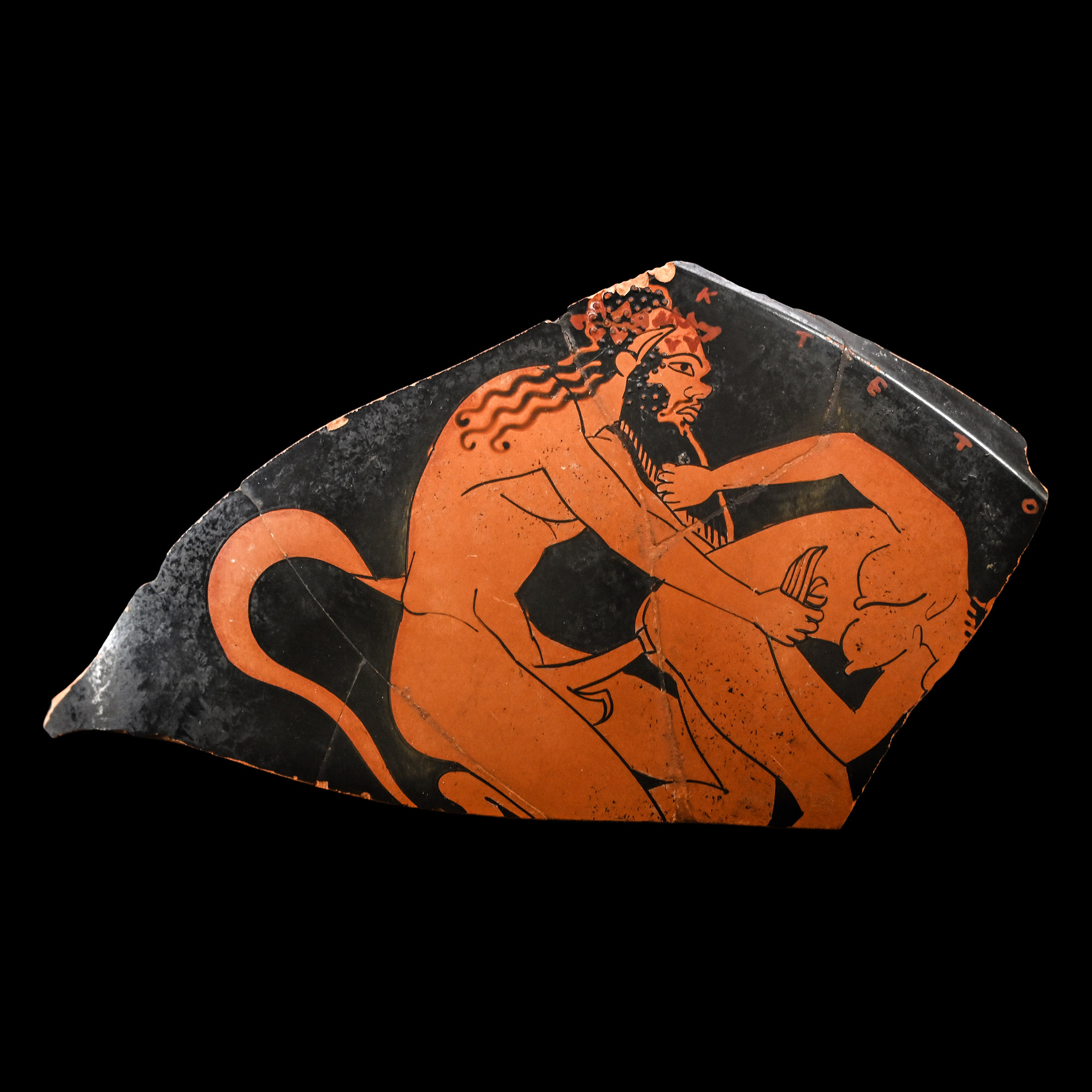
Fragment of an Attic Red-Figure Cup Depicting a Satyr Copulating with a Maenad, Attributed to Epiktetos
CIRCA 520–490 B.C.
4 5/8 in. (31.2 grams, 11.7 cm).
Dynamic scene featuring a nude, muscular satyr engaged in coitus with a young maenad; the satyr depicted with long curly hair and long dressed beard, a crown of ivy leaves resting on his head, holding the hand of the maenad with his right hand and her waist with the other; the maenad depicted in a half-kneeling position with her right hand grasping the beard of the satyr; partial Greek inscription above 'KTETO' referring to the artist Epiktetos.
ProvenanceOswald Burchard collection, Zurich, until 1983.
M. Hess collection, Hotel Jura, Basel.
Private collection, Germany.
Private collection, London.
One fragment, Antikenmuseum [ACR] Auctions, 17, 30 June 2015, no.14.
Two fragments, Bertolami Fine Art, Auction 43, 19 April 2018, no.55.
Comprising three fragments, subsequently joined.
This lot has been checked against the Interpol Database of stolen works of art and is accompanied by search certificate number no.13326-258216.
See The Metropolitan Museum of Art, New York, object no.1978.11.21, for a kylix painted by the same artist; the British Museum, London, museum no.1867,0508.1029, for a kylix painted by Epiktetos and showing a kneeling satyr; and a fragmentary erotic scene on a Kylix attributed to Epiktetos, again in Metropolitan Museum of Art, inv. no. 2011.604.1.5930a–c.
FootnotesEpiktetos is considered a master of the circular image and painted mainly the interiors of cups—specifically "eye-cups," so named because of the two painted eyes on the exterior, which likely served an apotropaic function. His so-called "bilingual" vases feature black-figure painting on the interior, while the exterior of the bowl is decorated in the red-figure style. He painted few mythological scenes (Theseus confronting the Minotaur; a red-figure cup fragment attributed to him depicts Hermes, Apollo, and Artemis or large-scale compositions; instead, he mostly depicted scenes from daily life (an archer, a mounted warrior, figures at a banquet, a sculptor at work as well as erotic scenes featuring men or satyrs.
CONDITIONTimeLine Auctions follows a vetting process to ensure the authenticity and legality of all items, reinforcing our commitment to integrity and responsible trading. Each antiquity, antique, and coin lot undergoes thorough examination by a vetting committee of at least ten external specialists, professional trade association members, scientists, and archaeologists: Our Vetting Process
AUCTIONS:
TimeLine is a leading auction house specialising in antiquities, ancient art, collectables, natural history, coins, medals, and books. Our auctions offer museums, collectors, historians, and enthusiasts the opportunity to acquire unique and historically significant pieces.
LOT 0046
Fragment of an Attic Red-Figure Cup Depicting a Satyr Copulating with a Maenad, Attributed to Epiktetos
Estimate £4,000 - 6,000€4,640 - 6,960 (for guidance only)$5,400 - 8,100 (for guidance only)
Opening Bid
£2,000 (EUR 2,320; USD 2,700) +BP*
-
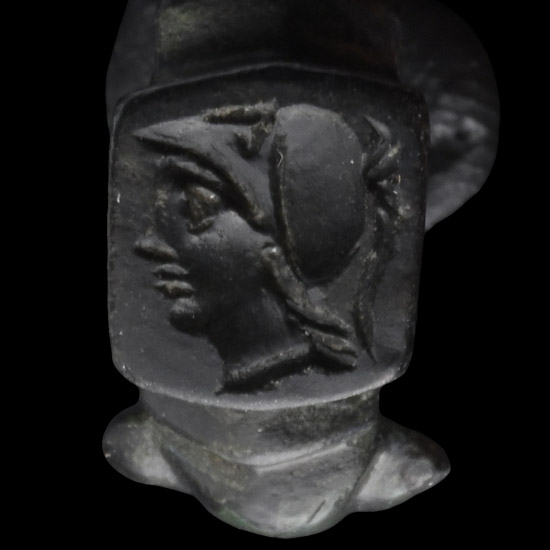
Graeco-Roman Bronze Ring with Bust of Athena
Circa 1st century B.C.Estimate: £200 - 300 (+bp*)
Opening Bid: £100
D-section hoop with stepped rims and trefoil shoulders, cuboid bezel with incuse profile bust of Athena to the upper face. 10.19 grams, 27.01 mm overall, 17.71 mm internal diameter (approximate size British O 1/2, USA 7 1/4, Europe 15.61, Japan 15)
Ex German art market, 2000s. Acquired from an EU collector living in London. From the collection of a Surrey, UK, gentleman. -
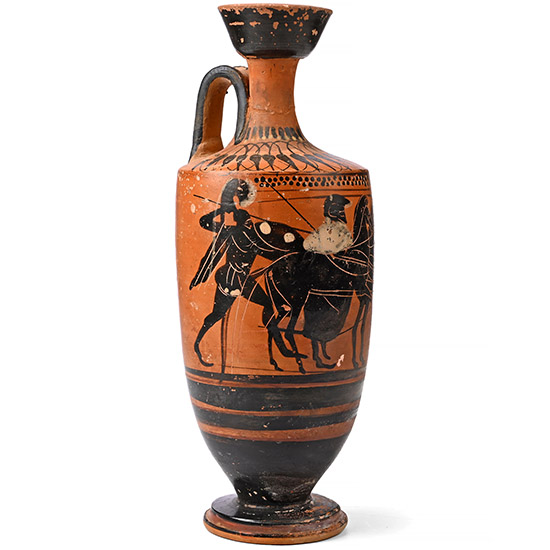
Attic Black-Figure Lekythos with Horses and Fighting Warriors
Attic, 4th century B.C.Estimate: £1,200 - 1,700 (+bp*)
Opening Bid: £600
Cylindrical with echinus mouth and stepped torus foot, on the body a dynamic scene consisting of four rearing horses, side-by-side and wearing harnesses, nestled between the horses a standing warrior wearing a crested helmet, behind the horses an advancing warrior wearing a plumed helmet, holding a long spear in his raised hand a round shield in the other; before the horses a fleeing opponent in a running pose, facing back and holding a spear in one hand while protecting himself with a shield held in the other; long tongue motifs on the shoulder; restored. 472 grams, 23.5 cm
Ex Bonhams, Knightsbridge, London, 1990s. Private collection, Suffolk.
The scene depicts a battle between hoplites, possibly an episode from the Iliad. Originally, one or two of the combatants were positioned on a chariot; four horses from it remain visible. The scene may represent the wounding of Ares, the god of war, as he is pursued by Diomedes and accompanied by the goddess Pallas, whose helmet is emerging from behind the horses. -
.jpg)
Etruscan Amber Head Pendant
Etruria, 5th century B.C.Estimate: £1,800 - 2,400 (+bp*)
Opening Bid: £900
Carved from translucent red-brown amber as a profile head with stylised Archaic features, large almond eye beneath a defined brow ridge, a softly smiling mouth, and carefully delineated hair arranged in striated bands sweeping back from the face; a drilled perforation at the crown indicates its original function as a suspended ornament; accompanied by a display stand. 23 grams, 50 mm (242 grams total, 81 mm including stand)
Sotheby's, London, 14-15 December 1981, no.206. American private collection; acquired at the above sale. This lot has been checked against the Interpol Database of stolen works of art and is accompanied by search certificate number no.13329-257968.
Amber was a prestigious imported material in Etruria, highly prized for its rarity, colour, and perceived apotropaic power. From the late 6th century B.C. onwards, figured amber pendants appear in elite tombs, particularly those of women, reflecting both personal identity and a protective role within funerary belief systems. The prominent, wide-open eye here may have served as a talismanic motif, thought to ward off malign forces and ensure the wearer’s vigilance and well-being in life and beyond the grave. This piece reflects the distinctive aesthetic of Etruscan amber carving, in which Mediterranean influences are reinterpreted with a locally expressive sculptural style.
