
Loading, please wait...
LOT 0046
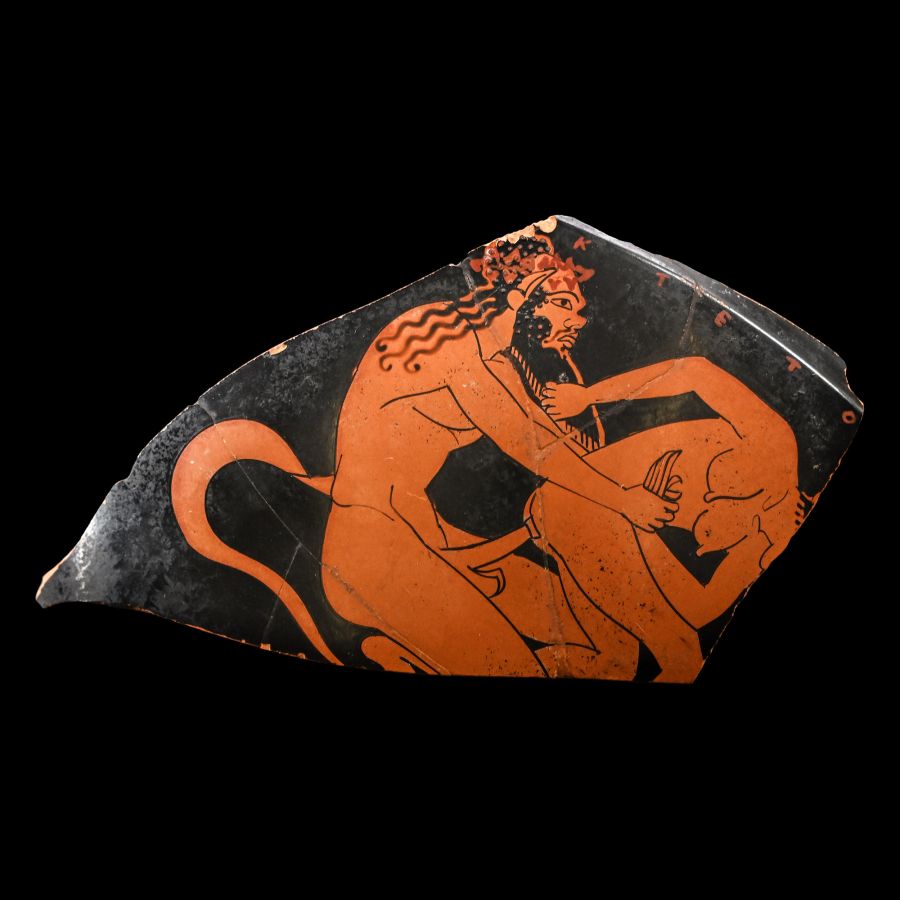
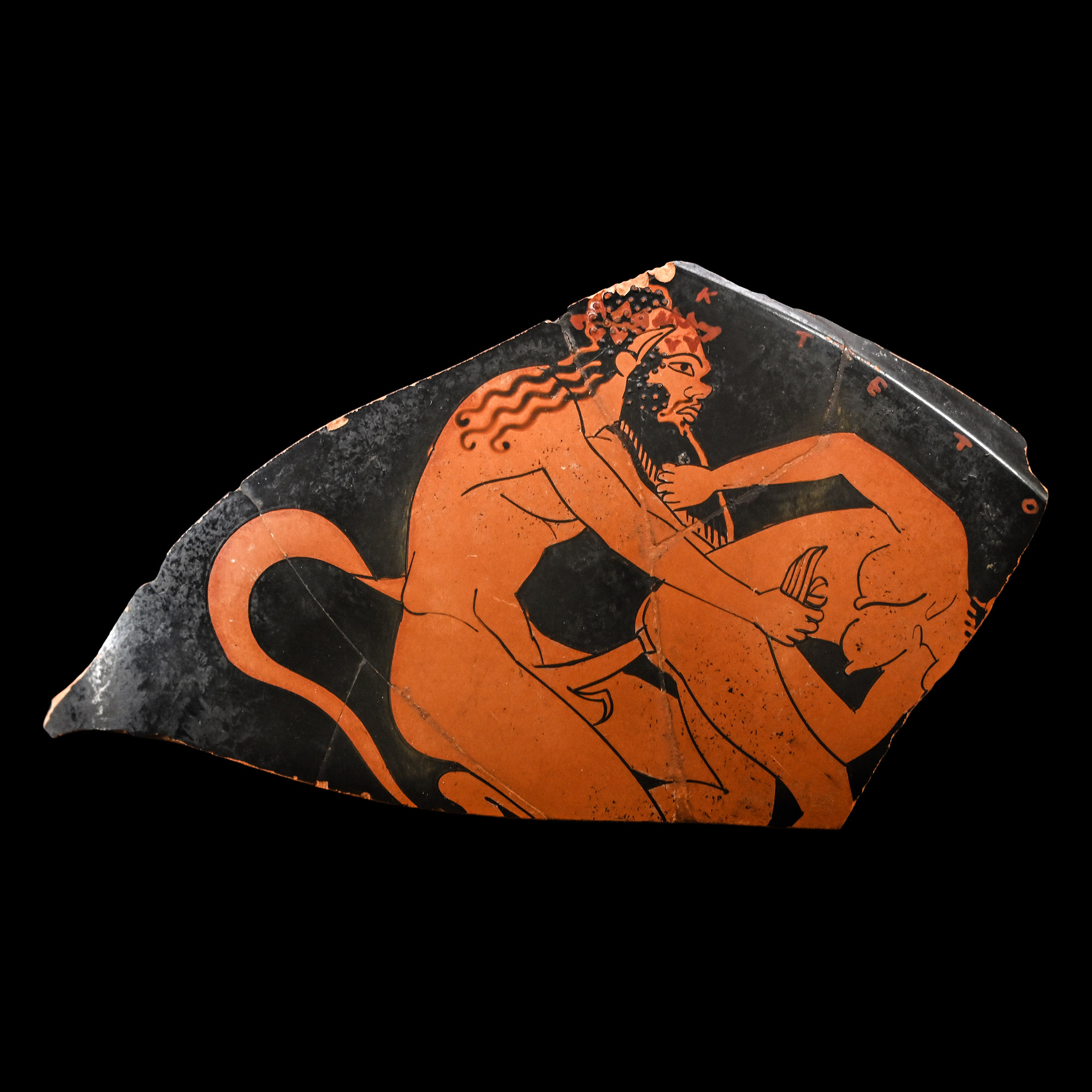
Fragment of a Greek Red-Figure Cup Depicting a Satyr Copulating with a Maenad, Attributed to Epiktetos
ATTIC, CIRCA 520–490 B.C.
4 5/8 in. (31.2 grams, 11.7 cm).
Dynamic scene featuring a nude, muscular satyr engaged in coitus with a young maenad; the satyr depicted with long curly hair and long dressed beard, a crown of ivy leaves resting on his head, holding the hand of the maenad with his right hand and her waist with the other; the maenad depicted in a half-kneeling position with her right hand grasping the beard of the satyr; partial Greek inscription above 'KTETO' referring to the artist Epiktetos.
ProvenanceOswald Burchard collection, Zurich, until 1983.
M. Hess collection, Hotel Jura, Basel.
Private collection, Germany.
Private collection, London.
One fragment, Antikenmuseum [ACR] Auctions, 17, 30 June 2015, no.14.
Two fragments, Bertolami Fine Art, Auction 43, 19 April 2018, no.55.
Comprising three fragments, subsequently joined.
This lot has been checked against the Interpol Database of stolen works of art and is accompanied by search certificate number no.13326-258216.
See The Metropolitan Museum of Art, New York, object no.1978.11.21, for a kylix painted by the same artist; the British Museum, London, museum no.1867,0508.1029, for a kylix painted by Epiktetos and showing a kneeling satyr; and a fragmentary erotic scene on a Kylix attributed to Epiktetos, again in Metropolitan Museum of Art, inv. no. 2011.604.1.5930a–c.
FootnotesEpiktetos is considered a master of the circular image and painted mainly the interiors of cups—specifically "eye-cups," so named because of the two painted eyes on the exterior, which likely served an apotropaic function. His so-called "bilingual" vases feature black-figure painting on the interior, while the exterior of the bowl is decorated in the red-figure style. He painted few mythological scenes: Theseus confronting the Minotaur; a red-figure cup fragment attributed to him depicts Hermes, Apollo, and Artemis or large-scale compositions; instead, he mostly depicted scenes from daily life (an archer, a mounted warrior, figures at a banquet, a sculptor at work), as well as erotic scenes featuring men or satyrs.
CONDITIONTimeLine Auctions follows a vetting process to ensure the authenticity and legality of all items, reinforcing our commitment to integrity and responsible trading. Each antiquity, antique, and coin lot undergoes thorough examination by a vetting committee of at least ten external specialists, professional trade association members, scientists, and archaeologists: Our Vetting Process
AUCTIONS:
TimeLine is a leading auction house specialising in antiquities, ancient art, collectables, natural history, coins, medals, and books. Our auctions offer museums, collectors, historians, and enthusiasts the opportunity to acquire unique and historically significant pieces.
LOT 0046
Fragment of a Greek Red-Figure Cup Depicting a Satyr Copulating with a Maenad, Attributed to Epiktetos
Estimate £4,000 - 6,000€4,640 - 6,960 (for guidance only)$5,400 - 8,100 (for guidance only)
-
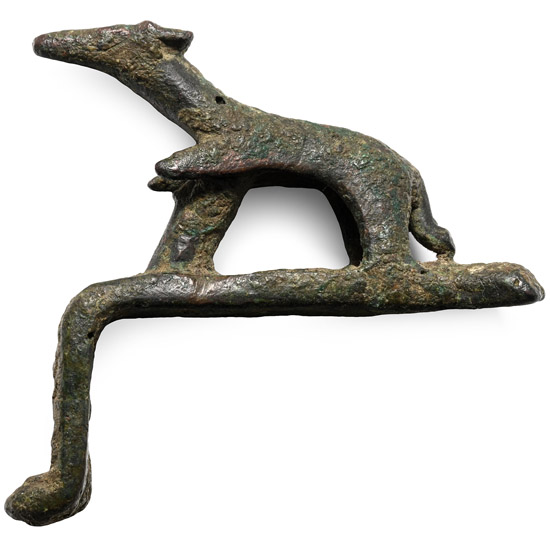
Greek Bronze Fitting with Fox
Circa 5th century B.C.Estimate: £150 - 200 (+bp*)
Bids: 2 | Current Bid: £10
L-shaped bracket with a leaping fox, the beast with an elongated muzzle and swept-back ears. 46.7 grams, 62 mm
From the private coin collection of a West London, UK, gentleman, formed since the mid 1980s. -
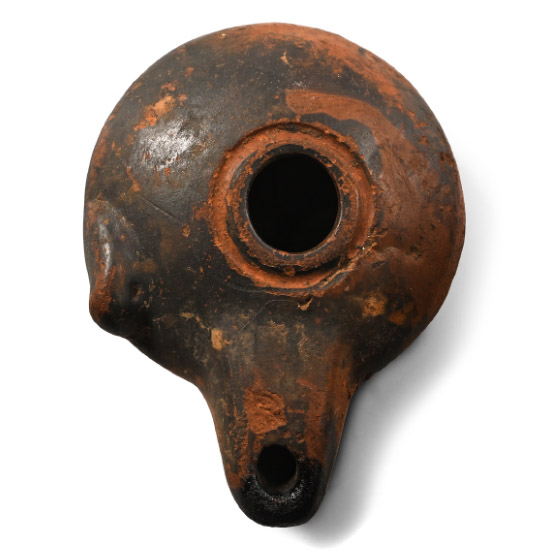
Greek Terracotta Oil Lamp
Hellenistic, circa 3rd-2nd century B.C.Estimate: £40 - 60 (+bp*)
Bids: 2 | Current Bid: £10
Rounded body with large central filler hole and pointed lug on the shoulder, the rim with a low-relief ovolo decoration, elongated nozzle with scooped nozzle; low basal ring. 103 grams, 99 mm
From a UK collection formed in the 1980s. Property of an Essex, UK, gentleman. -
.jpg)
Etruscan Carnelian Scarab with Bust of a Warrior in Later Victorian Gold Brooch
5th-4th century B.C. and laterEstimate: £2,000 - 3,000 (+bp*)
Bids: 1 | Current Bid: £1,000
The scarab with anatomical detailing on the carapace, underside with a profile bust of a helmetted warrior; set in a later brooch frame with swivel mount for the scarab. 10.35 grams, 55 mm
Acquired on the European art market. This lot has been checked against the Interpol Database of stolen works of art and is accompanied by search certificate number no.13358- 257891.
Egyptian-style scarabs and scaraboids were characteristic of Etruscan art from the 8th century B.C. Originally made in Phoenicia, Cyprus or Rhodes, these objects were made of faience, blue paste, glass paste, bone, or semi-precious stones of varying hardness, from steatite to quartz, onyx and jasper. Mounted in settings on revolving pendants of precious metal, later imitated by Etruscan goldsmiths, these Egyptianising items performed prophylactic-religious functions.
