
Loading, please wait...
LOT 1125
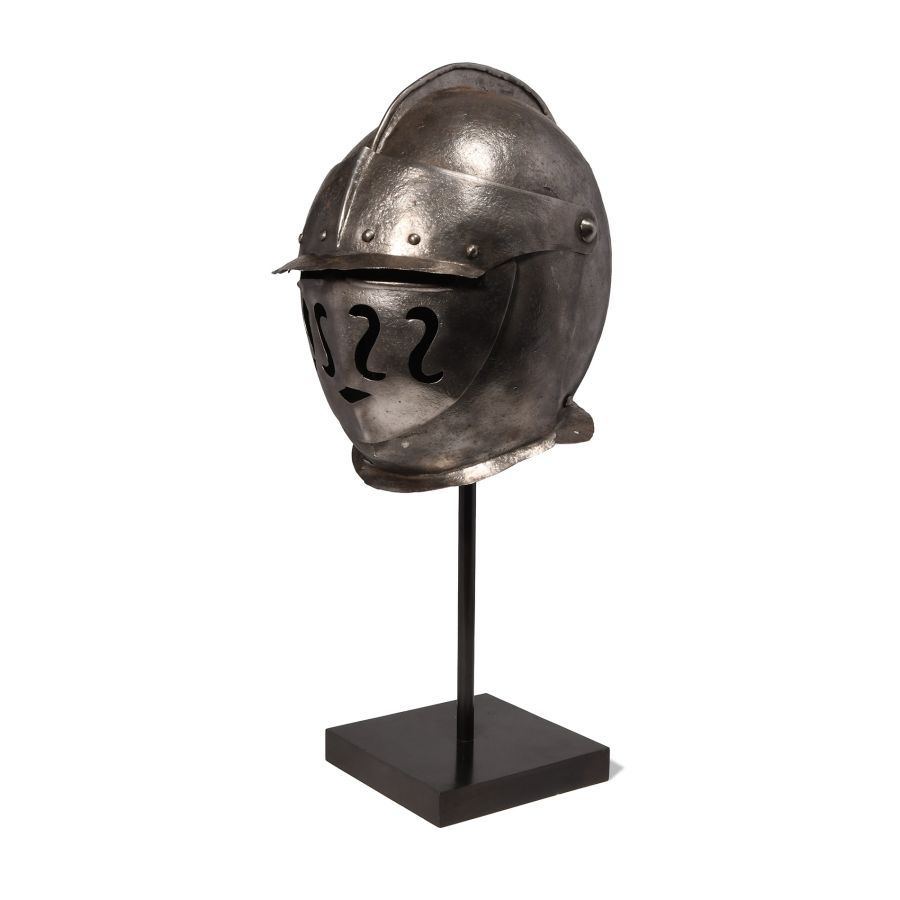
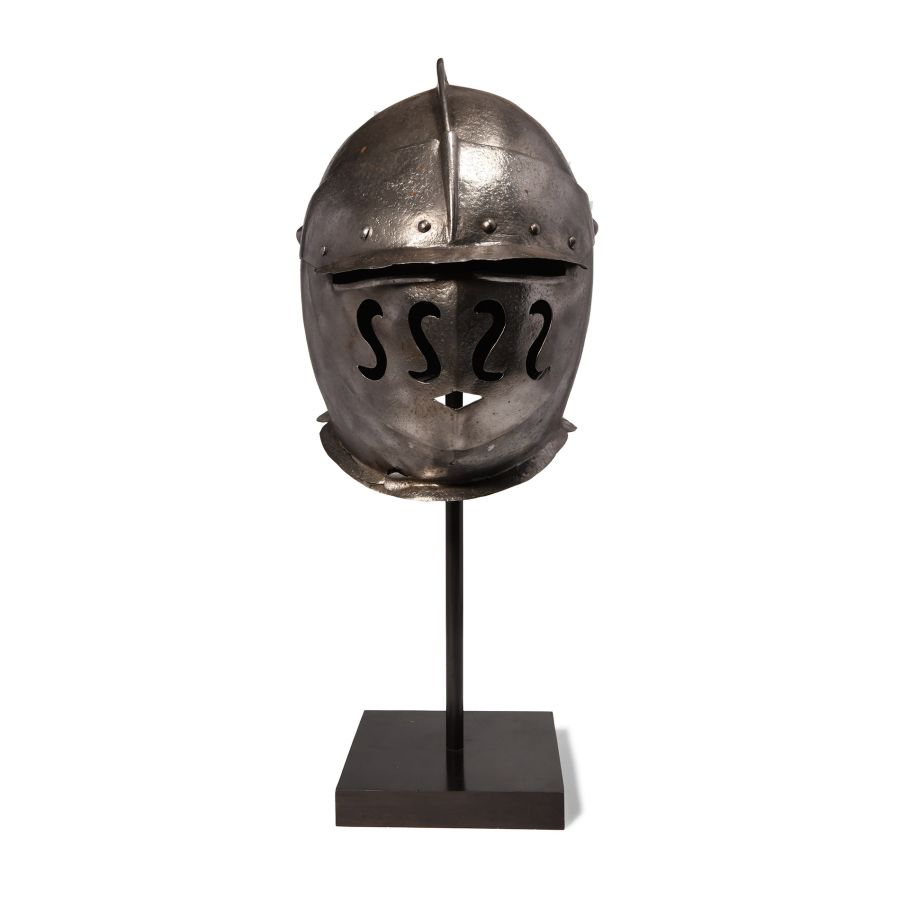
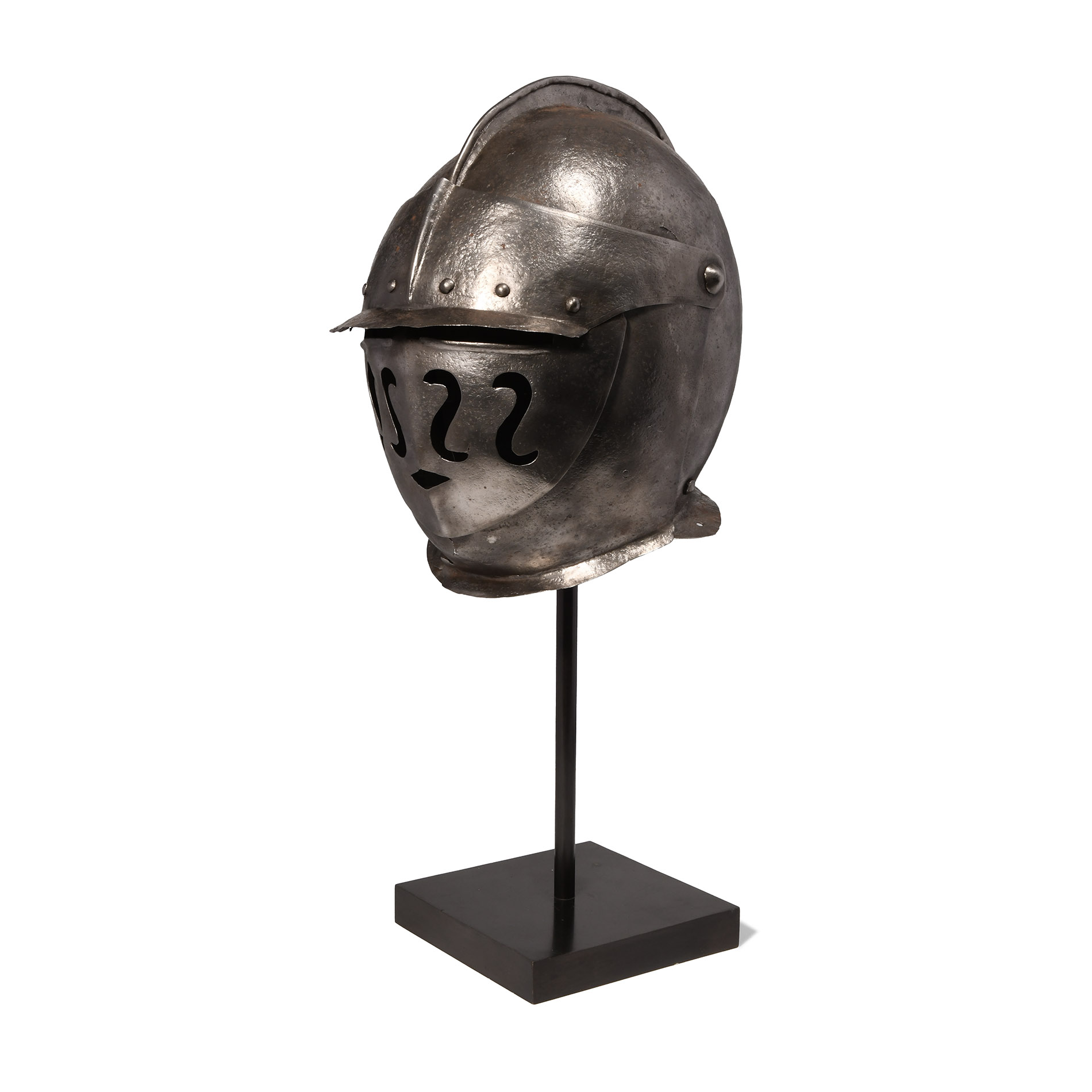
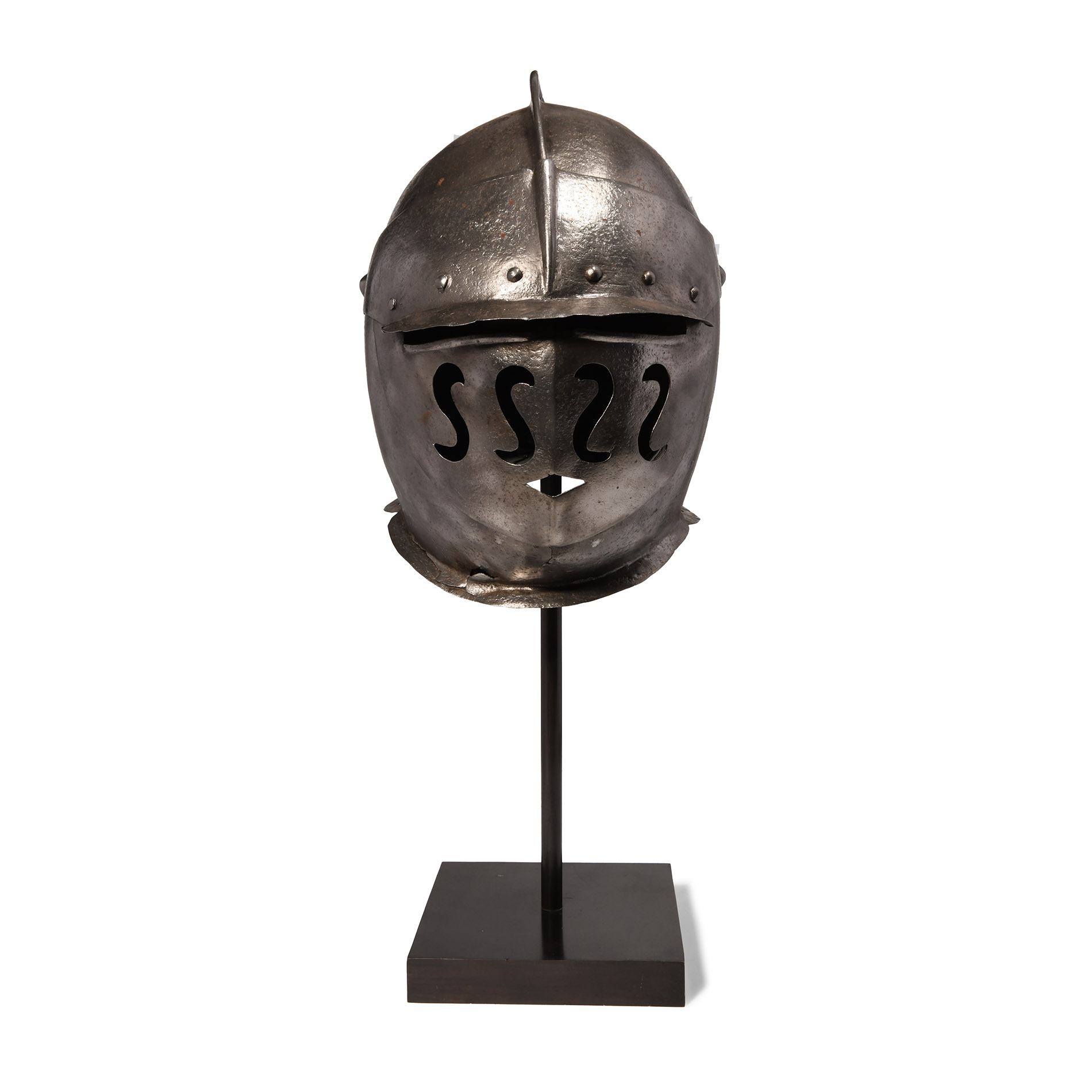
European Savoyard Burgonet
CIRCA 1620 A.D.
10 in. (1.14 kg, 25 cm high).
Comprising a full face shield with broad wavy bars and a small mouth opening, a wide hinged visor; the visor and the front section of the helmet secured by large hook-and-eye closures on the right-hand side; the crown with a tall ridge running from front to back, small collar for protecting the neck.
ProvenanceAcquired from Andrew Bennett in 2016.
The Kusmirek Collection, UK.
Accompanied by a copy of a payment confirmation from Andrew Bennett, dated 1st June 2016.
Accompanied by an academic report by Dr Raffaele D'Amato.
This lot has been checked against the Interpol Database of stolen works of art and is accompanied by search certificate number no. 11768-203986.
Cf. Pyhrr, S.W., European Helmets, 1450-1650, Treasures from the Reserve Collection, New York, 2000, cat.nos.61-62.
FootnotesThis variation of the burgonet helmet is thought to have originated in the Savoy region of southeast France, and was very popular with heavy cavalry (Reiters) serving with a variety of Continental armies of the period. The term Savoyard is a reference to a large number of these helmets that the Swiss captured from the troops of the Duke of Savoy during an unsuccessful assault on the city of Genoa in 1602. The undulated bars and the small mouth of the visor are all indicative of the Savoyard style. The hinges on the side allowed the front of the helmet as a whole to be lifted away from the rear, aiding the wearer to place it over his head.
CONDITIONTimeLine Auctions follows a vetting process to ensure the authenticity and legality of all items, reinforcing our commitment to integrity and responsible trading. Each antiquity, antique, and coin lot undergoes thorough examination by a vetting committee of at least ten external specialists, professional trade association members, scientists, and archaeologists: Our Vetting Process
AUCTIONS:
TimeLine is a leading auction house specialising in antiquities, ancient art, collectables, natural history, coins, medals, and books. Our auctions offer museums, collectors, historians, and enthusiasts the opportunity to acquire unique and historically significant pieces.
-
Byzantine Iron Horse Bit
14th-16th century A.D.Estimate: £200 - 300 (+bp*)
Opening Bid: £111
Composed of arched openwork shanks with looped terminals; one end fitted with large hoops and bar between; one end with a tripartite mouthpiece comprising two collared bars connected by a central hoop; Byzantine or early Ottoman. 340 grams, 19.5 cm
Fine condition.
Collection of Dr. Hanns-Ulrich Haedeke (1928-2017), author of ‘Schmuck Aus Drei Jahrtausenden’ and who became the director of the Museum of Klingenmuseum in Solingen, Germany, in 1968; the collection was formed in the early 1960s. From an important private Dutch collection.
This type of horse bit is visible on one of the most important equestrian artworks of the 15th century - the Cappella dei Magi by Benozzo Gozzoli, a painting representing the Three Kings visiting Christ, depicted in costumes belonging to the early quarter of 15th century. All the cavalrymen in the artwork had heavy curb-bits (with short and curved shanks, as in our specimen) and heavy, single reins. -
Viking Iron Sword with Cross Guard Surmounted by Interlaced Dragons
9th-11th century A.D.Sold for (Inc. bp): £8,450
Comprising a double-edged cutting blade with tapering fullers and hefty tang; the bronze cross guard in Jellinge style with dragon head finials and a central human face to the lower edge; the pommel with seven lobes; accompanied by a bronze openwork chape with central bird motif decorated with stamped ring-and-dot design. 900 grams, 89.5 cm
From the private collection of a London gentleman, from his grandfather's collection formed before the early 1970s. Accompanied by an academic report by Dr Raffaele D’Amato. This lot has been checked against the Interpol Database of stolen works of art and is accompanied by search certificate number no.11821-206859.
The blade of the sword is very similar to Petersen Type K; the hilt is a typical Type K, but having seven rather than five lobes to the pommel. The chape, the parallels of which are mostly of late 10th and early 11th centuries, is probably a later addition, possibly reworked to be fitted to the sword. -
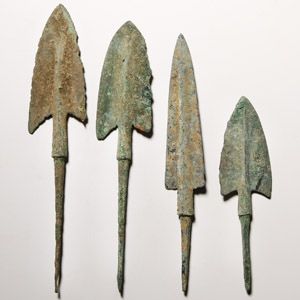
Marlik Bronze Arrowhead Group
12th-10th century B.C.Sold for (Inc. bp): £156
Comprising four tanged arrowheads, with large bronze elongated triangular blades and raised midrib, sharp central groove, cylindrical stem with handle for the shaft; three with barbed shoulders and convex sides. 106 grams total, 10.2-15.2 cm
Acquired 1980-2015. Ex Abelita family collection.
Some of these arrowheads seem to belong to the type V, subcategory type C, according to the classification of Khorasani and Negahban. In the four categories of triangular bronze arrowheads from Luristan, Marlik and Northern Iran individuated by Negahban, subtypes C and D of type V are larger arrow or javelin heads, C with barbed shoulders and D with round shoulders.
