
Loading, please wait...
_900x900.jpg "Etrusco-Italic Bronze Warrior or Laran, God of War")
_200x200.jpg "Etrusco-Italic Bronze Warrior or Laran, God of War")
_900x900.jpg "Etrusco-Italic Bronze Warrior or Laran, God of War")
_200x200.jpg "Etrusco-Italic Bronze Warrior or Laran, God of War")
.jpg "Etrusco-Italic Bronze Warrior or Laran, God of War")
.jpg "Etrusco-Italic Bronze Warrior or Laran, God of War")
LOT 0047
Etrusco-Italic Bronze Warrior or Laran, God of War
ARCHAIC, 6TH CENTURY B.C.
6 3/8 in. (326 grams total, 16.2 cm high including stand).
The warrior (Roman Mars) modelled in the round, representing a young muscular hero with long torso and rounded shoulders, wearing a high-crested Illyrian helmet with grooved perimeter, a hole above each ear for attaching an ornament; mounted on a custom-made display stand.
ProvenanceEx N. Koutoulakis, Geneva.
Ex Gorny & Mosch, Munich, 17 June 1999, no.2051.
with Sotheby's, New York, 12 June 2001, no.16.
with Chrisitie's, New York, 7 December 2007, no.82.
with Christie's, London, 2 April 2014, no.125.
Accompanied by an academic report by Dr Raffaele D'Amato.
This lot has been checked against the Interpol Database of stolen works of art and is accompanied by search certificate number no.11803-206793.
This lot has been cleared against the Art Loss Register database, and is accompanied by an illustrated lot declaration signed by the Head of the Antiquities Department, Dr Raffaele D’Amato.
Cf. De Ridder, A., Bronzes Antiques du Louvre, Paris, I-II, 1913-1915, nos.277, 281; Giglioli, G.Q., Arte Etrusca, Milan, 1935, pl.CCXXI; Boucher, S., Inventaire des Collections Publiques Françaises - 17 Vienne: Bronzes Antiques, Paris, 1971, pp.38-39, no.5bis, for similar; Boucher, S., Recherches sur les bronzes figures de Gaule pré-romaine et romaine, Rome, 1976, no.14.
FootnotesThe statuette assumes the position of the 'warring Mars', which characterises the numerous Etruscan and Italic statues of the god produced as votive offerings to the temples or for private lararia. The god is depicted as taking part in a military march with his left leg advancing, his raised right would have held a spear and the left hand a shield.
CONDITIONTimeLine Auctions follows a vetting process to ensure the authenticity and legality of all items, reinforcing our commitment to integrity and responsible trading. Each antiquity, antique, and coin lot undergoes thorough examination by a vetting committee of at least ten external specialists, professional trade association members, scientists, and archaeologists: Our Vetting Process
AUCTIONS:
TimeLine is a leading auction house specialising in antiquities, ancient art, collectables, natural history, coins, medals, and books. Our auctions offer museums, collectors, historians, and enthusiasts the opportunity to acquire unique and historically significant pieces.
LOT 0047
Etrusco-Italic Bronze Warrior or Laran, God of War
Estimate £5,000 - 7,000€5,800 - 8,120 (for guidance only)$6,750 - 9,450 (for guidance only)
-
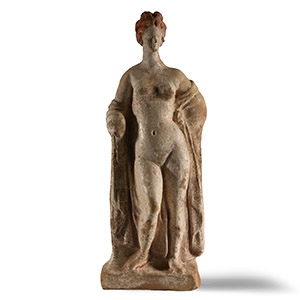
Hellenistic Painted Terracotta Figure of Aphrodite
Mid 4th-mid 3rd century B.C.Estimate: £2,500 - 3,500 (‡+bp*)
Opening Bid: £1,250
Bearing the weight of her body on her left leg, wearing a himation draped over her arms, the right arm bent to grasp a part of the himation that falls behind her, leaving her shoulders uncovered and revealing her naked body; the head turned slightly to the left; the hair arranged in the typical flattering melon coiffure, parted into six large sections and gathered into a low bun; oval face with a small, fleshy mouth and a fine nose; wearing large circular earrings; her right hand resting on top of a small pillar, covered by the cloak; the lower part of the himation embroidered with volutes; the back flat with a square hole for attachment; red-brown pigment on the hair, white coating, traces of pink on the himation and red on the edges of the feet. 493 grams, 22.5 cm high
Collected in the 1950s-1990s. Ex R. Liechti collection (1934-2010), acquired in Geneva. Accompanied by an academic report by Raffaele D'Amato. This lot has been checked against the Interpol Database of stolen works of art and is accompanied by search certificate no.11999-211931. This lot has been cleared against the Art Loss Register database, and is accompanied by an illustrated lot declaration signed by the Head of the Antiquities Department, Dr Raffaele D’Amato.
In particular in South Italy, two types of female statuettes leaning on small pillars were widespread, derived from Tanagra prototypes: the first type dressed in a high-belted chiton with crowned head, the second consisting of partially draped or nude female figures identified as Aphrodite, like our specimen. The Tanagra production ended in about 200 B.C., but the models created by the Boeotian workshops would continue to be produced until the end of the 1st century B.C. The statuette shows extensive traces of the original polychromy, characterised by strongly contrasting hues in keeping with the local style. The Tanagrine elements are mainly identifiable in the ‘melon coiffure’, the intense red colour of the hair and the pose characterised by the turned hip. -
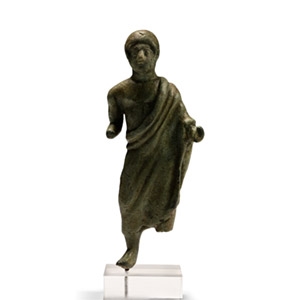
Etruscan Youth Presenting an Offering
Late 5th century B.C.Sold for (Inc. bp): £416
Bronze figure of a youth in contrapposto stance, wrapped in a long mantle revealing his right shoulder and muscular upper body; end of the mantle, with broad hem, draped over the left shoulder, angled right arm supporting an offering or patera (absent); left hand perhaps holding a lance or staff originally; hair worn short with ears exposed but covering the temples; facing straight ahead with wide-open eyes framed by finely drawn eyelids; right hand, left lower leg and foot absent, minor retouching to tip of the nose. 125 grams total, 10.4 cm including stand
Wladimir Rosenbaum, Ascona, before 1984. Accompanied by a copy of an Art Loss Register certificate no.S00092263. This lot is accompanied by an illustrated lot declaration signed by the Head of the Antiquities Department, Dr Raffaele D’Amato.
Wladimir Rosenbaum (1894-1984) was a prominent Swiss lawyer, art dealer, and collector based in Ascona, Switzerland. Renowned for his eclectic taste and intellectual pursuits, Rosenbaum assembled a distinguished collection of antiquities and modern art during his lifetime. His circle included influential artists, intellectuals, and dealers of the 20th century, and his legacy remains significant in the art world. This piece, part of his collection prior to 1984, reflects Rosenbaum's keen eye for rare and historically important objects, embodying his deep appreciation for the cultural and artistic achievements of the past. -
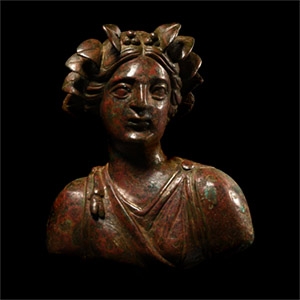
Hellenistic Bronze Protome of a Maenad
3rd-2nd century B.C.Sold for (Inc. bp): £4,420
Modelled in the half-round as a maenad or Artemis, hollow to the reverse with diadem of ivy leaves with clusters of berries at the centre, exaggerated lentoid eyes, peplos dress secured at her left shoulder by a disc brooch and at her right with a cloven hoof. 541 grams, 14 cm
Acquired before 1983. Ex London gallery, 1990s. This lot has been checked against the Interpol Database of stolen works of art and is accompanied by a search certificate number no.12519-231946. This lot has been cleared against the Art Loss Register database, and is accompanied by an illustrated lot declaration signed by the Head of the Antiquities Department, Dr Raffaele D’Amato.
The Greek deity Artemis was the goddess of hunting, associated with wild animals and woodland as well as childbirth. She was often linked with folk magic and witchcraft due to her role as goddess of the moon. She was identified by the Romans with the goddess Diana. Artemis was born, with her twin brother Apollo, on the island of Delos, daughter of Zeus and Leto. Homer refers to her as Artemis Agrotera, Potnia Theron: "Artemis of the wildland, Mistress of Animals". Her best-known cult sites were on the island of Delos, in Attica at Brauron and Mounikhia, and in Sparta. She was often depicted in paintings and statues in a forest setting, carrying a bow and arrows, and accompanied by a deer. In Greek classical art, she is usually portrayed as a maiden huntress: young, tall and slim, clothed in a girl's short skirt, with hunting boots, a quiver, a bow and arrows. When portrayed as a moon goddess, Artemis wore a long robe and sometimes a veil covering her head. Her darker side is revealed in some vase paintings, where she is shown as the death-bringing goddess whose arrows fell young maidens and women, such as the daughters of Niobe. Artemis was also identified with the ancient mother goddess at Ephesus in modern-day Turkey and it was there that a huge temple was built in her honour, long recognised as one of the Seven Wonders of the World.
