
Loading, please wait...
LOT 0250
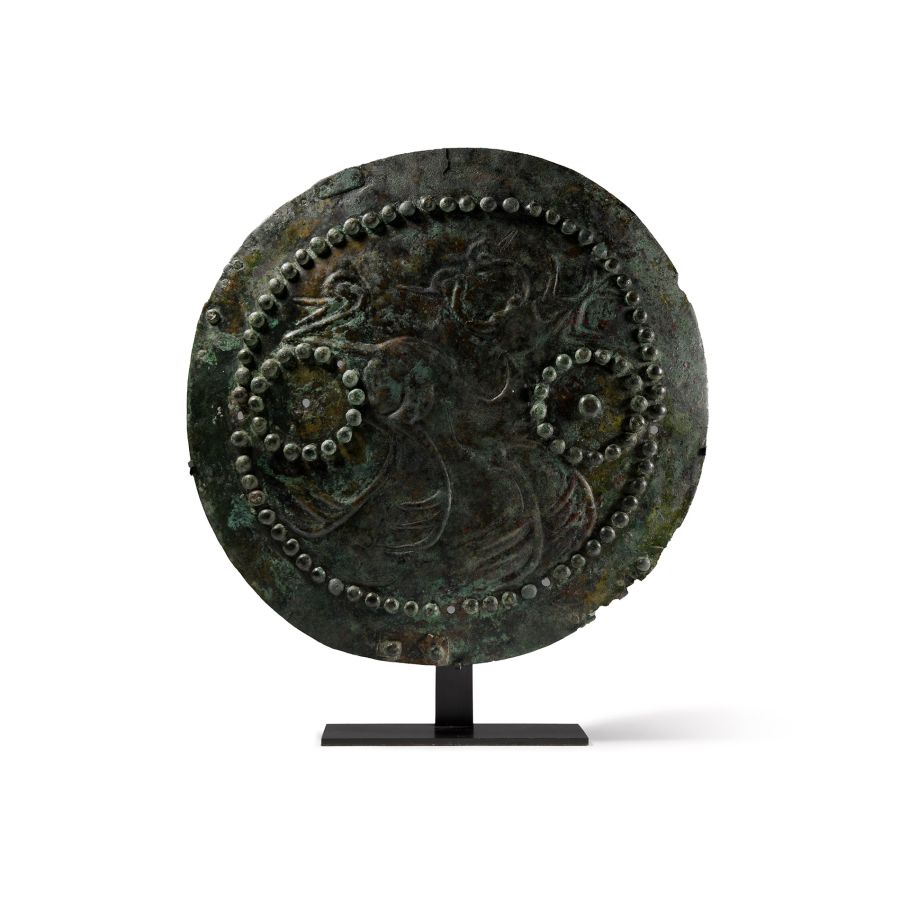
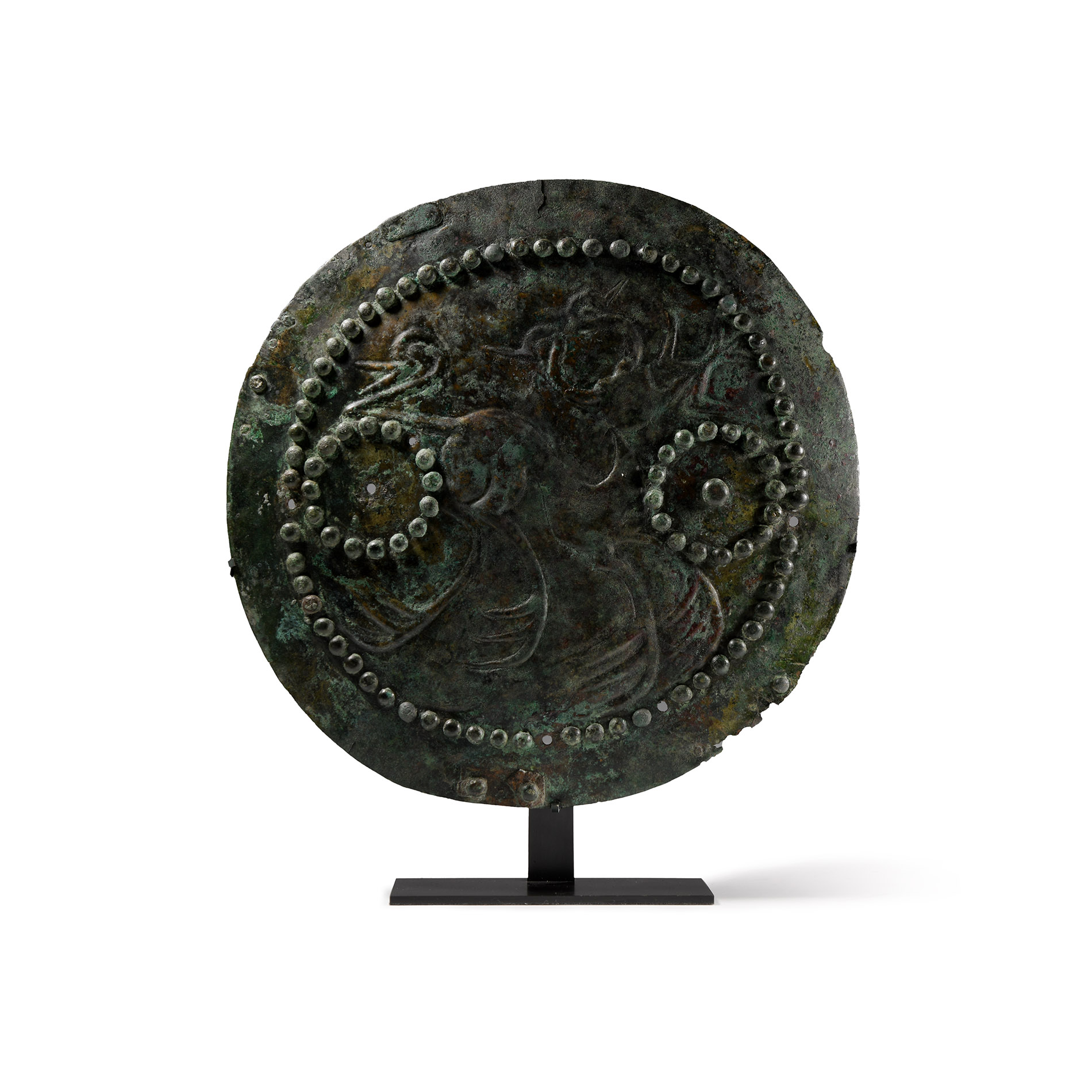
Etrusco-Italic Breastplate with Mythical Animal
5TH CENTURY B.C.
11 1/4 in. (626 grams total, 28.5 cm high including stand).
Displaying a repoussé horned animal advancing right, two roundels composed of bulbous rivets flanking the animal and encircling the central design; accompanied by a custom-made display stand.
ProvenanceCollection of Jacques and Henriette Schumann, formed between 1950 and 1970.
The Schumanns inherited part of their collection from Henriette’s parents, Alice and Fernand Halphen, andjacques’ maternal grandfather, Albert Lehmann.
Collection of Jacques and Henriette Schumann, Christie's, Paris, 30th September 2003, lot 85.
Accompanied by a copy of a French cultural passport no.107322.
This lot has been checked against the Interpol Database of stolen works of art and is accompanied by search certificate number no.11877-207824.
Cf. The Metropolitan Museum, New York, accession number 18.145.23, wrongly classified as shield boss; cf. Connolly, P., Greece and Rome at war, London, 2006, figs.9-14 p.101, for a similar one and the fastening system.
FootnotesThis type of armour, composed from a bronze breast and back plate with hinged shoulder straps, all the parts backed with iron, was used by Etruscans, Hernici, Aequi and Volsci, the feared enemies of early Rome. In particular our item has many parallels with the disc-cuirass (cardiophylax) found in the Necropolis of Alfadena.
CONDITIONTimeLine Auctions follows a vetting process to ensure the authenticity and legality of all items, reinforcing our commitment to integrity and responsible trading. Each antiquity, antique, and coin lot undergoes thorough examination by a vetting committee of at least ten external specialists, professional trade association members, scientists, and archaeologists: Our Vetting Process
AUCTIONS:
TimeLine is a leading auction house specialising in antiquities, ancient art, collectables, natural history, coins, medals, and books. Our auctions offer museums, collectors, historians, and enthusiasts the opportunity to acquire unique and historically significant pieces.
-
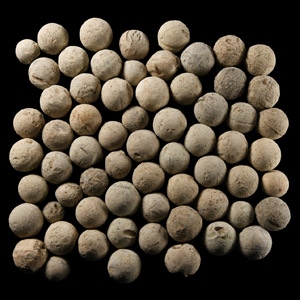
Post Medieval Lead Musket Ball Group
Circa 17th-18th century A.D.Sold for (Inc. bp): £9
Comprising examples with seams and of varying sizes. 1.8 kg total, 11-19 mm
Found Berkshire, UK. -
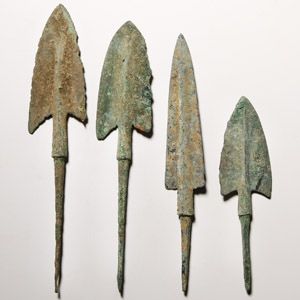
Marlik Bronze Arrowhead Group
12th-10th century B.C.Sold for (Inc. bp): £156
Comprising four tanged arrowheads, with large bronze elongated triangular blades and raised midrib, sharp central groove, cylindrical stem with handle for the shaft; three with barbed shoulders and convex sides. 106 grams total, 10.2-15.2 cm
Acquired 1980-2015. Ex Abelita family collection.
Some of these arrowheads seem to belong to the type V, subcategory type C, according to the classification of Khorasani and Negahban. In the four categories of triangular bronze arrowheads from Luristan, Marlik and Northern Iran individuated by Negahban, subtypes C and D of type V are larger arrow or javelin heads, C with barbed shoulders and D with round shoulders. -
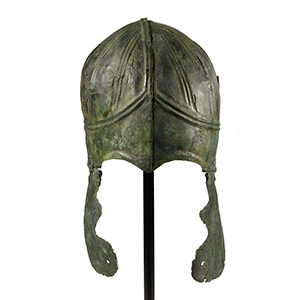
Pseudo-Illyrian Chalcidian Variant Bronze Helmet
4th-1st century B.C.Sold for (Inc. bp): £3,250
Large rounded two-part bowl rivetted beneath the repoussé crest extending across the brow and around the circumference; repoussé arches above the eyes extending to the nasal; lateral D-shaped cheek-pieces with scallop to the forward edge, pierced for a chin-strap; some restoration of the bowl; mounted on a custom-made display stand. 2.9 kg total, 48.5 cm high including stand
Acquired 1971-1972. From the collection of the vendor's father. Property of a London, UK, collector. Accompanied by an academic report by Dr Raffaele D’Amato. This lot has been checked against the Interpol Database of stolen works of art and is accompanied by search certificate number no.11752-202771.
According both to Symonenko and Dedjulkin (2014, p.189, fig.9, nn.4-5-6), this category of helmets derived from the Chalcidian type with elements of pseudo-Illyrian variants. Like the Chalcidian helmets, our specimen shows vertical decorative lines on the bowl and the triangular brow decoration which characterises similar specimens.
