
Loading, please wait...
_900x900.jpg "Etruscan Votive Bronze Hand")
_200x200.jpg "Etruscan Votive Bronze Hand")
.jpg "Etruscan Votive Bronze Hand")
LOT 0100
Etruscan Votive Bronze Hand
CIRCA 7TH-6TH CENTURY B.C.
4 5/8 in. (187 grams total, 11.8 cm high including stand).
Modelled in the half-round with D-section fingers, portion of cuff behind the thumb; mounted on a custom-made display stand.
ProvenanceAcquired on the German art market, before 1992; thence by descent.
This lot has been checked against the Interpol Database of stolen works of art and is accompanied by search certificate number no.13191-249245.
Cf. a similar votive hand in Christie's, Antiquities: Including Ancient Engraved Gems. Formerly in the G.Sangiorgi Collection Part IV, London, 2022, 7th December, lot.33.
FootnotesVotive offerings gained increasing popularity throughout Etruria, southern Latium and later northern Campania from the 7th century B.C. onwards. Most gods were thought to possess the power to heal, and the sick flocked to their sanctuaries for a cure or to pray for future health. Usually, these dedications depicted the parts of the human anatomy that needed healing. The area of Vulci offered many graves in which pairs of hands cut from a sheet of bronze, rolled up at the base to form the wrist, have been found.
CONDITIONTimeLine Auctions follows a vetting process to ensure the authenticity and legality of all items, reinforcing our commitment to integrity and responsible trading. Each antiquity, antique, and coin lot undergoes thorough examination by a vetting committee of at least ten external specialists, professional trade association members, scientists, and archaeologists: Our Vetting Process
AUCTIONS:
TimeLine is a leading auction house specialising in antiquities, ancient art, collectables, natural history, coins, medals, and books. Our auctions offer museums, collectors, historians, and enthusiasts the opportunity to acquire unique and historically significant pieces.
-
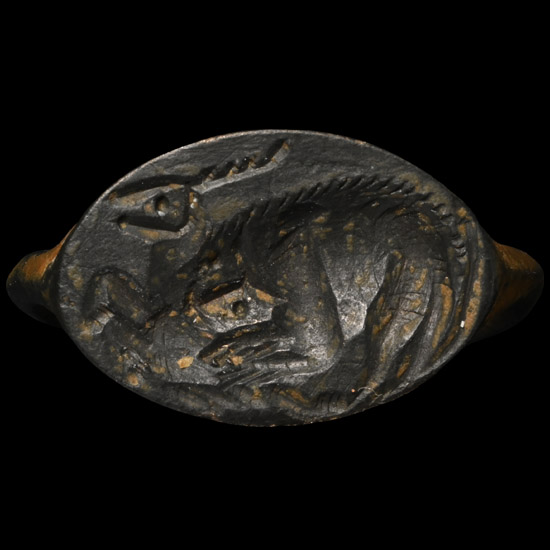
Greek Bronze Ring with Recumbent Stag
5th-4th century B.C.Estimate: £300 - 400 (+bp*)
Opening Bid: £150
Ellipsoid bezel with intaglio motif of a fallen stag attacked by a predator. 6.07 grams, 25.89 mm overall, 20.88 x 17.71 mm internal diameter (approximate size British R, USA 8 1/2, Europe 18 3/4, Japan 18)
UK private collection before 2000. Acquired on the UK art market. Private collection, London, UK. -
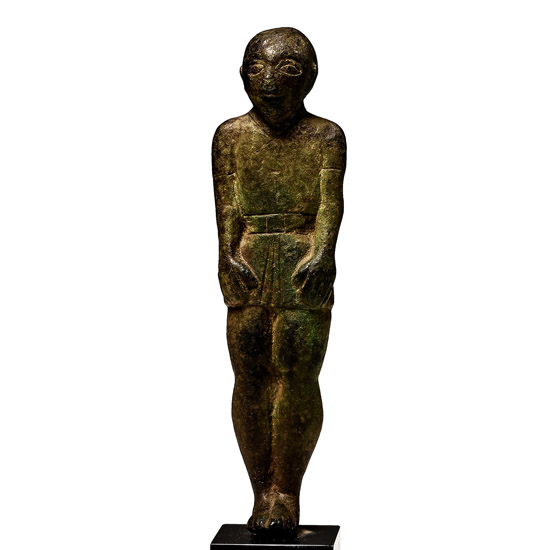
Iberian Bronze Figurine of a Man in Egyptianizing Dress
4th-2nd century B.C.Estimate: £2,500 - 3,500 (‡+bp*)
Opening Bid: £1,250
Standing with arms held straight at the sides, short hair with neck-ring to rear, short-sleeved tunic with pleats to centre-front and rear, wide belt; perhaps a monumental fitting; gas permeation to rear right leg; mounted on a custom-made stand. 77.8 grams total, 10 cm including stand
Private collection, Paris, France, assembled in the 1950s-1960s. with Tessier-Sarrou & Associés, Paris, 2015. European private collection. Accompanied by a copy of an Art Loss Register certificate, no.S00107108. Accompanied by a copy of French cultural export passport no.167803. This lot has been checked against the Interpol Database of stolen works of art and is accompanied by a search certificate number no.12651-234613. -
.jpg)
Scythian Gold Ibex Plaque Pair
Circa 7th century B.C.Estimate: £7,000 - 9,000 (+bp*)
Opening Bid: £3,500
Each a profile ibex with head reversed, horn returned to attach at the neck, pellet eye, beaded ring-and-dot motif to the shoulder and hip; thick attachment loop to the reverse. 15.6 grams total, 34-34.2 mm
Acquired in the 1980s. Private collection, London, UK. Accompanied by an academic report by Dr Raffaele D'Amato. This lot has been checked against the Interpol Database of stolen works of art and is accompanied by search certificate number no.13253-252971.
It is possible to hypothesise that these two elements were bridle plaques, like the two wolf-shaped bridle plaques, in a similar position and style, found in the Kurgan of Pazyrik (Piotrowskij, 1987, p.107, no.137). Belt plaques with zoomorphic motifs illustrate not only the recognised unity of the zoomorphic art of the Steppes, but also the links between the Scythians and the eastern nomadic groups.
