
Loading, please wait...
_900x900.jpg "Etruscan Silver Ring with Amethyst Scarab Seal")
_200x200.jpg "Etruscan Silver Ring with Amethyst Scarab Seal")
.jpg "Etruscan Silver Ring with Amethyst Scarab Seal")
LOT 0091
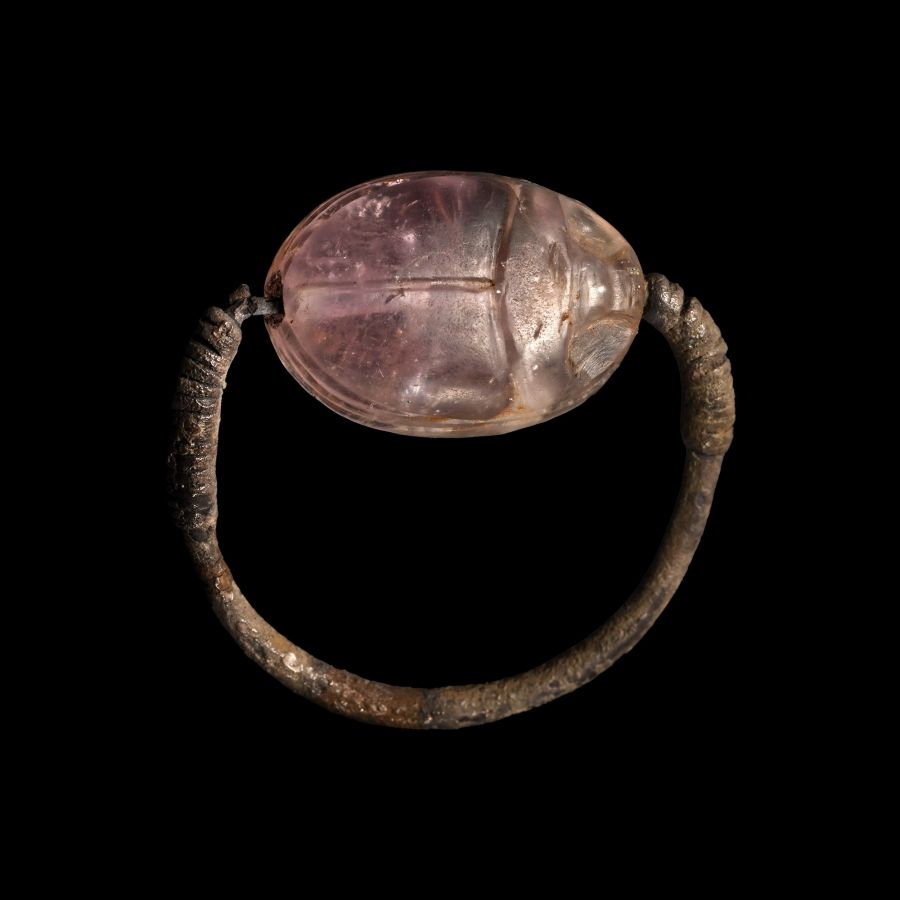
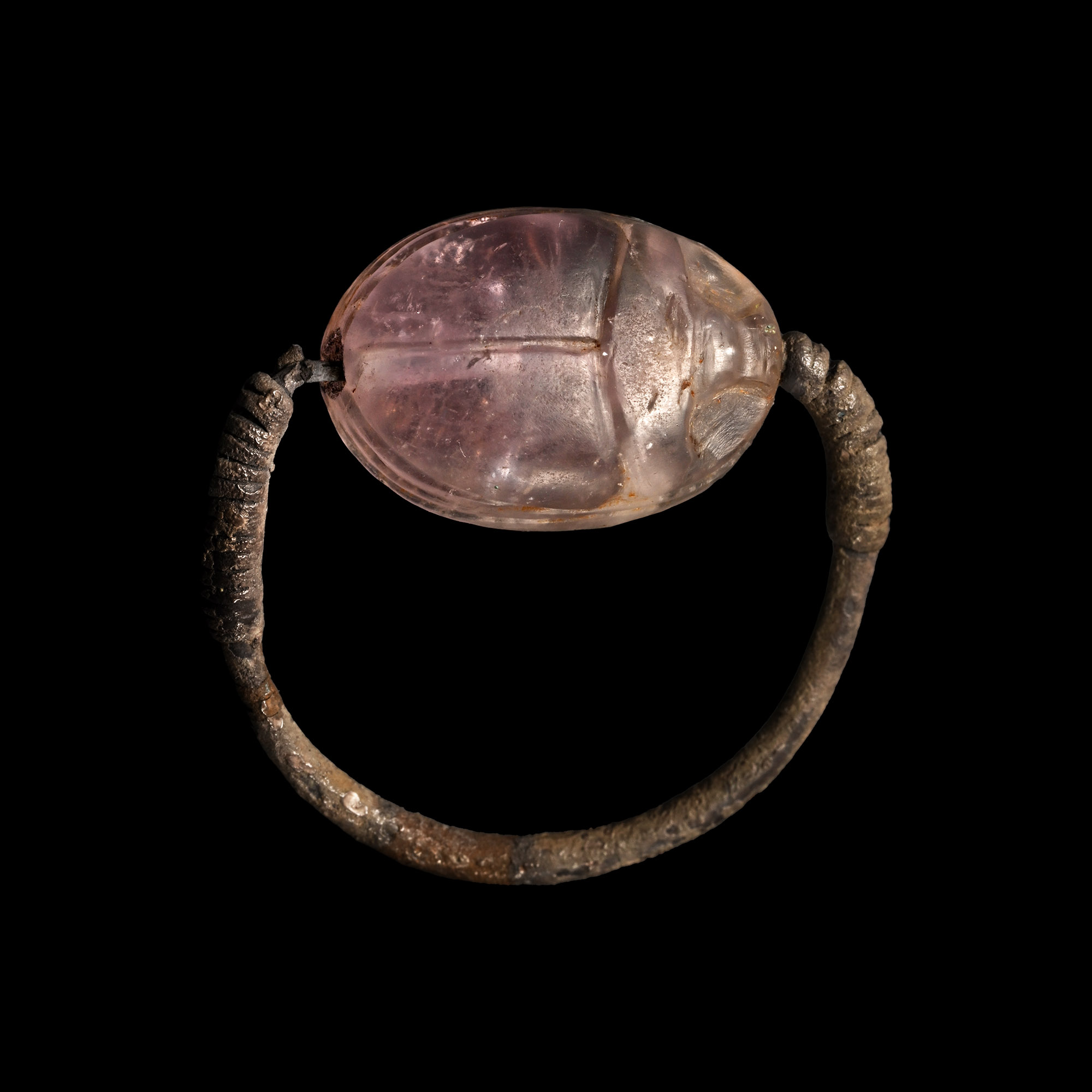
Etruscan Silver Ring with Amethyst Scarab Seal
4TH CENTURY B.C.
1 1/8 in. (5.44 grams, 30.77 mm overall, 25.27 mm internal diameter (approximate size British W, USA 11, Europe 25, Japan 24)).
Wire hoop with ends wound round the shank at each shoulder with one end detached, swivel-mounted amethyst scarab seal with flat underside, segmented border around a dolphin with putto mounted on its back.
ProvenanceFrom the private collection of Mr K.A., acquired in the 1990s-early 2000s.
This lot is accompanied by an illustrated lot declaration signed by the Head of the Antiquities Department, Dr Raffaele D'Amato.
Cf. Chadour, A.B., Rings. The Alice and Louis Koch Collection, volume I, Leeds, 1994, item 43, for type; cf. also Torelli, M., Gli Etruschi, Monza, 2000, p.455, for similar.
FootnotesEgyptian-style scarabs and scaraboids were characteristic of Etruscan art from the 8th century B.C. Originally made in Phoenicia, Cyprus or Rhodes, these objects were made of faience, blue paste, glass paste and bone, or semi-precious stones of varying hardness, from steatite to quartz, onyx and jasper. Mounted in settings on revolving pendants of precious metal, which were later imitated by Etruscan goldsmiths, these Egyptianising items performed prophylactic-religious functions, through the use of sacred or magical imagery taken from hieroglyphic language: royal names or titles, theonyms, sacred symbols, and auspicious formulas.
CONDITIONTimeLine Auctions follows a vetting process to ensure the authenticity and legality of all items, reinforcing our commitment to integrity and responsible trading. Each antiquity, antique, and coin lot undergoes thorough examination by a vetting committee of at least ten external specialists, professional trade association members, scientists, and archaeologists: Our Vetting Process
AUCTIONS:
TimeLine is a leading auction house specialising in antiquities, ancient art, collectables, natural history, coins, medals, and books. Our auctions offer museums, collectors, historians, and enthusiasts the opportunity to acquire unique and historically significant pieces.
-
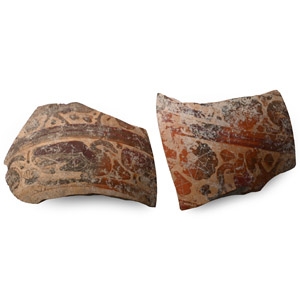
Greek Corinthian Shard Group
6th century B.C.Sold for (Inc. bp): £416
Comprising of two polychrome shards with painted floral, bull and swan motifs. 132 grams total, 9.2-10.8 cm
From the private family collection of Ersula Barter-Hemmerich, the longest serving member of staff working at the United Nations, her private collection formed in the 1950s and 1960s; thence by descent to her grandson. This lot is accompanied by an illustrated lot declaration signed by the Head of the Antiquities Department, Dr Raffaele D'Amato. -
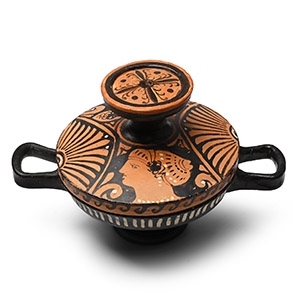
Greek Apulian Red-Figure Lekanis with Ladies of Fashion
South Italic, circa 4th century B.C.Sold for (Inc. bp): £845
With black-glazed body and matching lid decorated with two heads of ladies of fashion, palmettes between, radial lines on the knob handle and a wave-band around the rim; square strap handles at the shoulder. 249 grams, 16.5 cm wide
From the private collection of a Canadian gentleman living in Essex, UK, formed since the 1920s-circa 1990. Property of an Essex lady until the late 1990s; thence by descent. From the private collection of an Essex gentleman since the late 1990s. This lot is accompanied by an illustrated lot declaration signed by the Head of the Antiquities Department, Dr Raffaele D'Amato. -
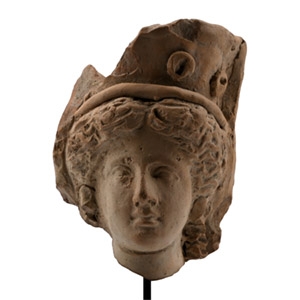
Greek Terracotta Head of a Goddess
5th-3rd century B.C.Sold for (Inc. bp): £910
Hollow-formed female head with flared headdress, applied collar and annulets; mounted on a custom-made stand. 228 grams total, 18.8 cm including stand
Acquired on the European art market in the early 2000s. with Galerie Rhéa, Zurich, Switzerland. This lot is accompanied by an illustrated lot declaration signed by the Head of the Antiquities Department, Dr Raffaele D'Amato.
