
Loading, please wait...

LOT 0521
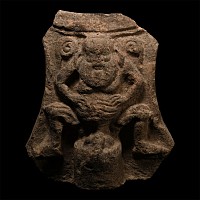
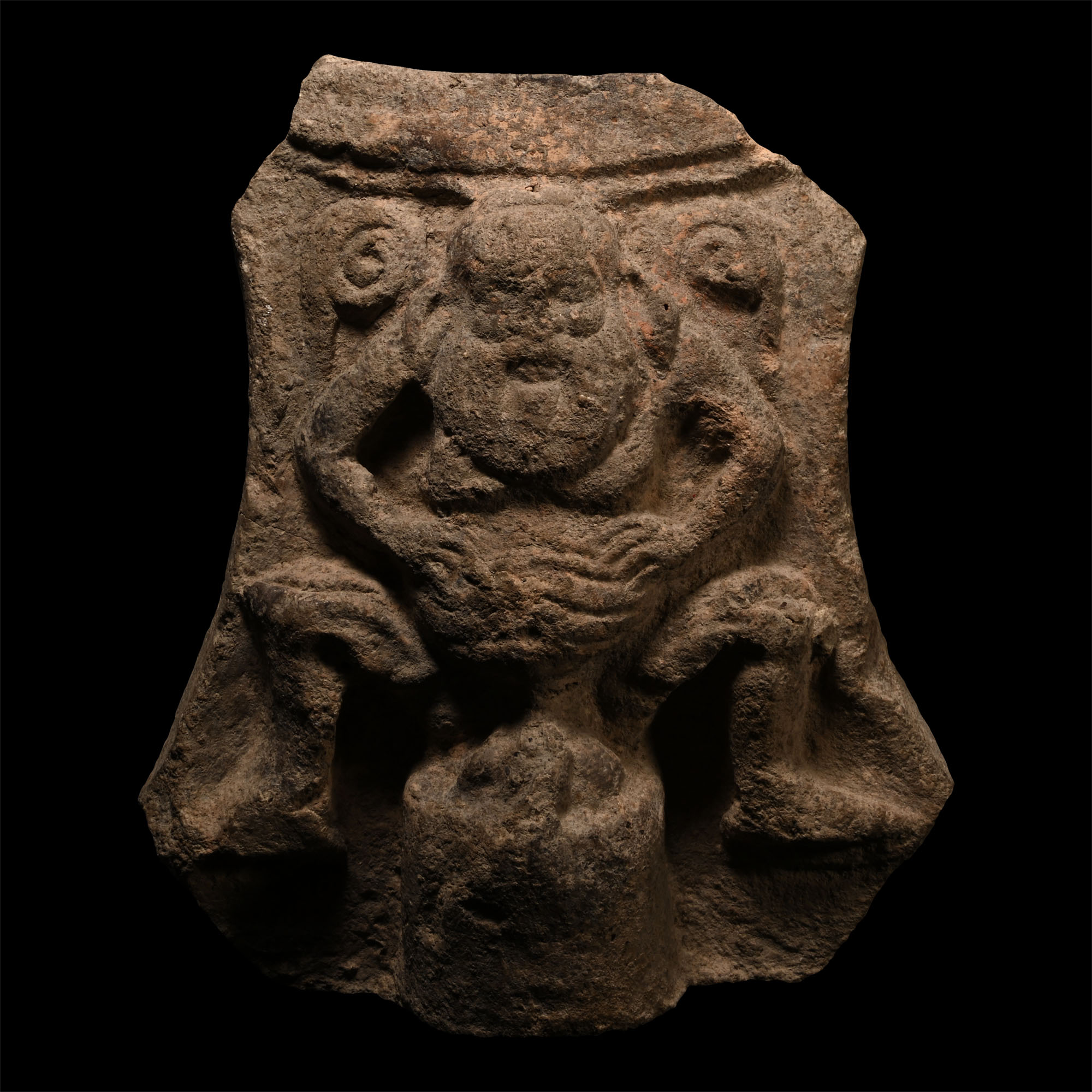
Etruscan Relief Fragment with Papposilenus
CIRCA 5TH CENTURY B.C.
7 1/8 in. (1.53 kg, 18 cm).
Roughly bell-shaped in profile with scooped rear face and socket to base; rim to upper edge above facing image of a grotesque bearded male with arms angled and hands on his wrinkled abdomen. legs bent to each side, genitals resting on a stele; old collector's label 'L-16434' to top; Etruscan or Italic.
ProvenanceThe Erotica Collection Christian von Faber-Castell, Küsnacht ZH, Switzerland, since the late 1970s.
This lot is accompanied by an illustrated lot declaration signed by the Head of the Antiquities Department, Dr Raffaele D’Amato.
'Kunst und Handwerk der Antike', Auction 15, Basel, 2 December 1983, no.197.
FootnotesChristian von Faber-Castell (born 1950) is a renowned German entrepreneur and art collector, best known as a member of the prominent Faber-Castell family, famed for their iconic writing instruments. A passionate advocate for art and culture, Christian von Faber-Castell curated an extensive and diverse private collection of erotica, spanning centuries and cultures. His collection reflects a deep appreciation for the interplay of beauty, sensuality, and artistic expression, bringing together rare and unique works that explore themes of intimacy and human connection. Pieces from this collection have been featured in notable exhibitions and are celebrated for their artistic and historical significance. This offering represents a rare opportunity to acquire works from one of the most fascinating and eclectic private collections of its kind.
CONDITIONTimeLine Auctions follows a vetting process to ensure the authenticity and legality of all items, reinforcing our commitment to integrity and responsible trading. Each antiquity, antique, and coin lot undergoes thorough examination by a vetting committee of at least ten external specialists, professional trade association members, scientists, and archaeologists: Our Vetting Process
AUCTIONS:
TimeLine is a leading auction house specialising in antiquities, ancient art, collectables, natural history, coins, medals, and books. Our auctions offer museums, collectors, historians, and enthusiasts the opportunity to acquire unique and historically significant pieces.
-
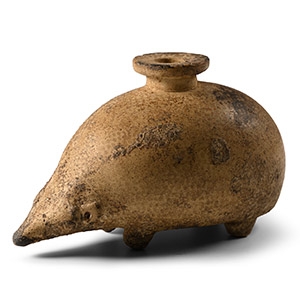
Greek Corinthian Hedgehog Aryballos
6th century B.C.Estimate: £1,500 - 2,000 (‡+bp*)
Opening Bid: £750
Hollow-formed with textured body and four stub legs, conical nose and lateral flanges with impressed point eyes; discoid flange rim to the neck with incised petal detailing. 55 grams, 98 mm
Ex Mrs IM, nr 18 (widow of Leo Mildenberg), formed in Zurich, gift from her husband between 1975-2000. Acquired by the present owner from the above. This lot has been checked against the Interpol Database of stolen works of art and is accompanied by search certificate number no.12208-222174. This lot has been cleared against the Art Loss Register database, and is accompanied by an illustrated lot declaration signed by the Head of the Antiquities Department, Dr Raffaele D’Amato. -
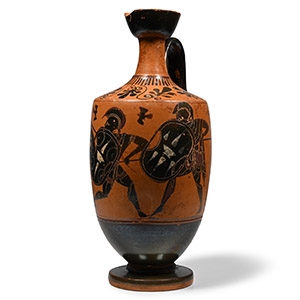
Greek Attic Black-Figure Lekythos with Combat Scene
Circa 520 B.C.Estimate: £20,000 - 30,000 (‡+bp*)
Opening Bid: £10,000
The ovoid body decorated with a combat scene, band of tendrils and leaves to the shoulder and vertical bands to the slender neck, trumpet-shaped mouth, strap handle and discoid foot; the scene comprising three Hoplites, the first in tall-crested Corinthian helmet, cuirass and greaves, xiphos hanging on his right side, thrusting with his long spear over his ellipsoid shield towards the middle figure, running forwards but with his helmetted head turned towards his attacker, using his Boeotian shield to ward off the blow while manoeuvring his own spear which is blocked by the third figure advancing against him, with spear held underarm, with birds in flight above. 481 grams, 26.5 cm
Private collection, Southern Germany, acquired in 1960s. with Paul-Francis Jacquier, Numismatique Antique, Münzen und Kunst der Antique, 13 September 2013. Acquired by the present owner at the above sale. This lot has been checked against the Interpol Database of stolen works of art and is accompanied by search certificate number no.12189-222313. This lot has been cleared against the Art Loss Register database, and is accompanied by an illustrated lot declaration signed by the Head of the Antiquities Department, Dr Raffaele D’Amato.
The clothing and weapons of the hoplites are detailed copies of hoplites of late decades of 6th century B.C. The left warrior wears a Corinthian helmet with a high crest, a richly decorated robe and greaves. His round Attic shield, from which a richly pleated chlamys hangs down, is decorated with large circles. The middle and the right hoplite wear Corinthian helmets with a lower crest, and also beautifully decorated robes and greaves. They hold very large, Boeotian-shaped shields with striking bundles of lightning and 'flames'. As a beautiful counterpart to the left fighter, the right warrior carries a chlamys with long folds over his shoulder. -
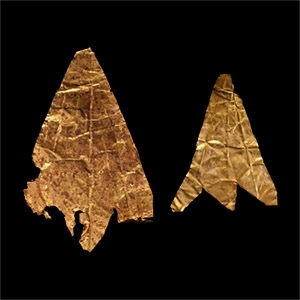
Hellenistic Gold Wreath Leaves
2nd-1st century B.C.Sold for (Inc. bp): £117
Comprising two sheet-gold leaf elements from a diadem, teach with dentilled end and impressed divergent bands. 0.31 grams total, 24-35 mm
Acquired from Brigantia Antiques, York, UK, in the early 1990s. Ian Wilkinson collection, Nottinghamshire, UK, formed since 1985. This lot is accompanied by an illustrated lot declaration signed by the Head of the Antiquities Department, Dr Raffaele D’Amato.
