
Loading, please wait...


LOT 0082
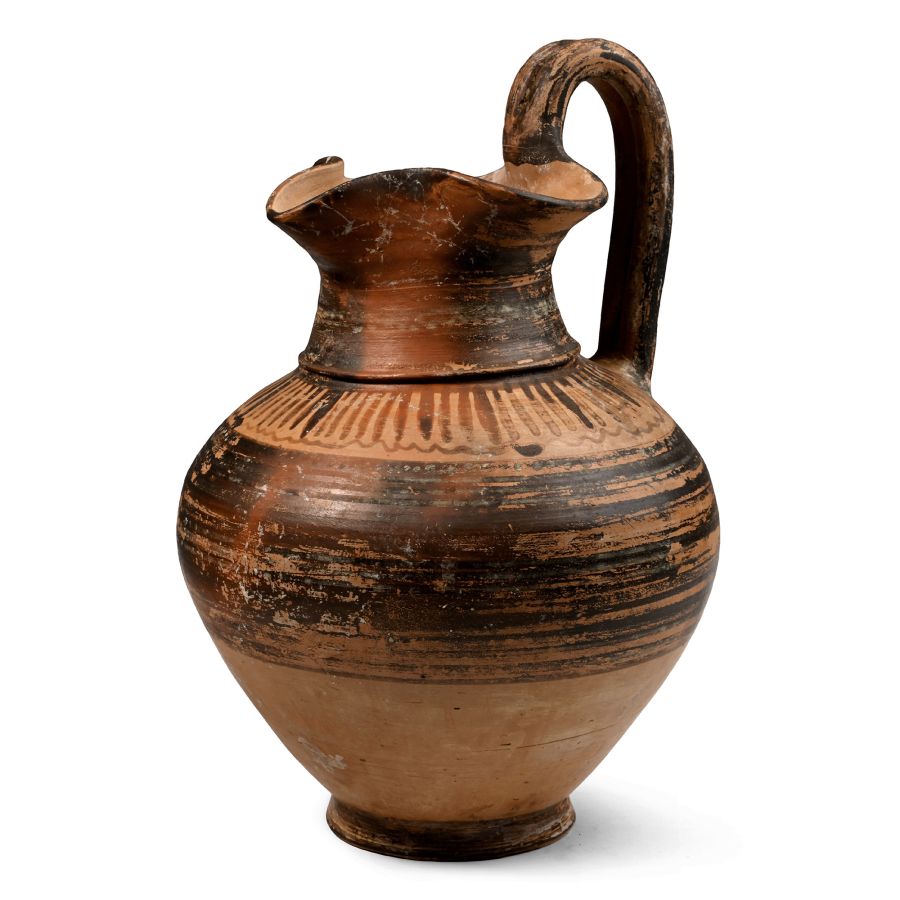
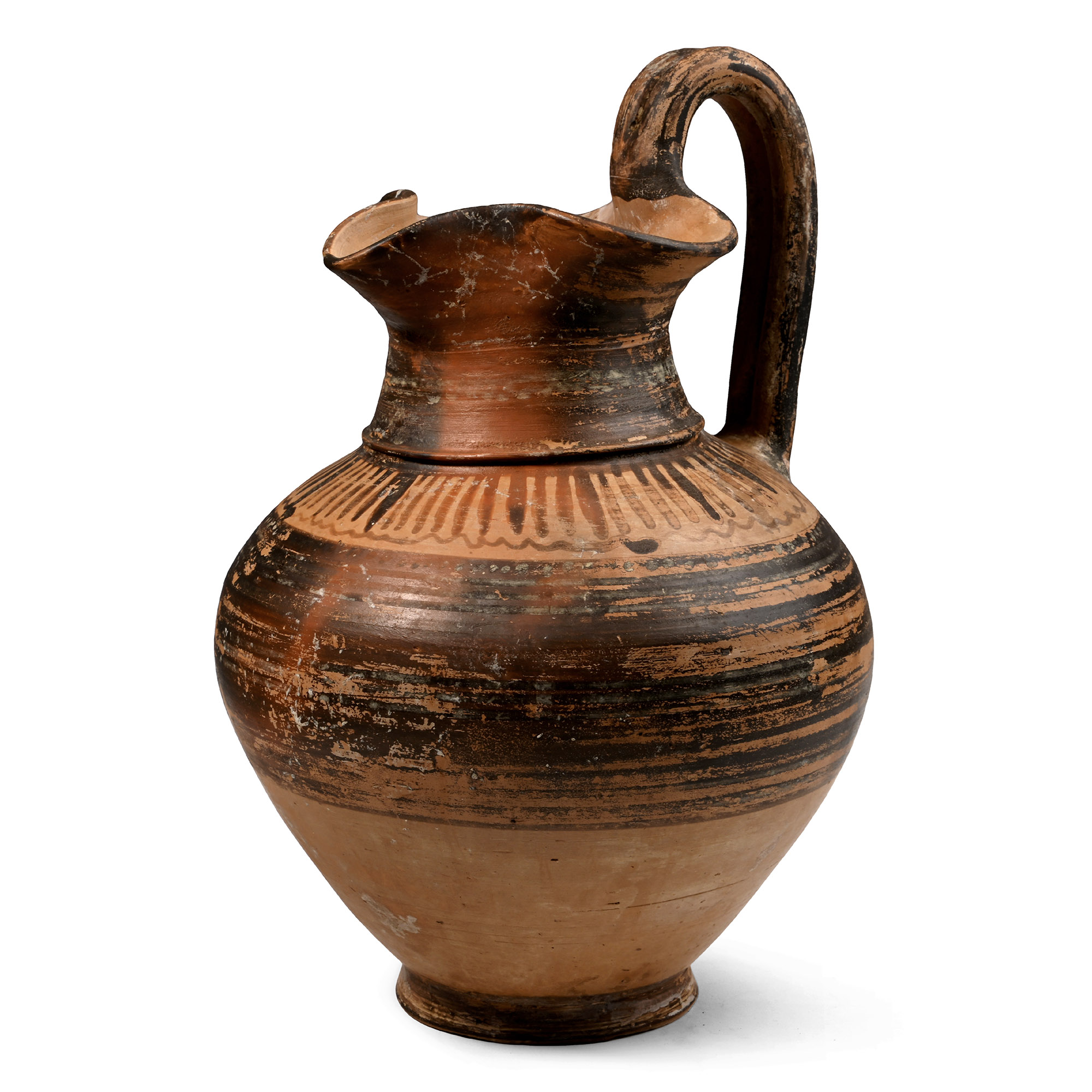
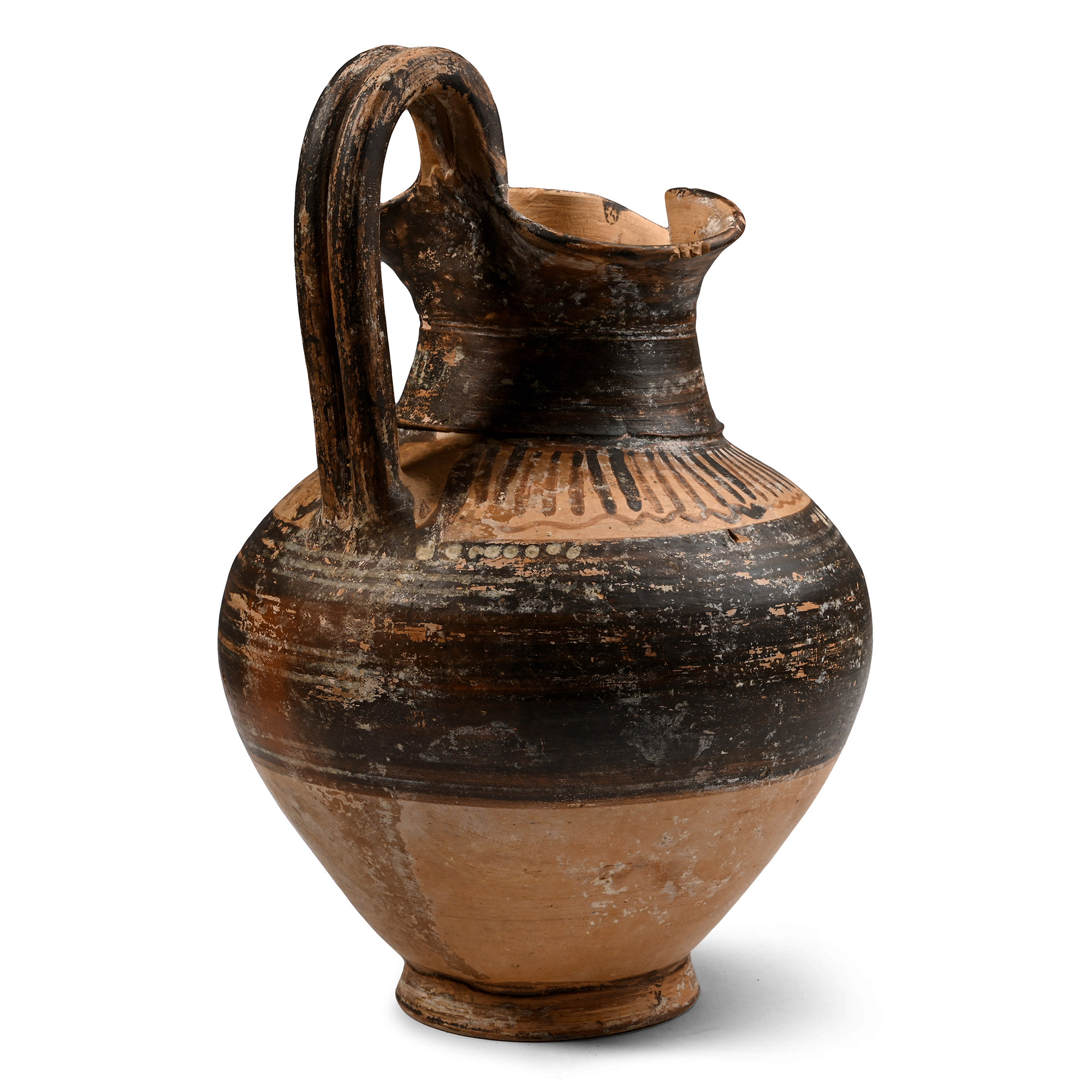
Etruscan Oinochoe with Tongue Frieze
7TH-6TH CENTURY B.C.
11 in. (1.04 kg, 28 cm).
Bulbous in profile with a high, double-ribbed handle from the trefoil mouth to the shoulder; carinated collar above frieze of radiating tongues in glaze on the shoulder; two wavy bands on the neck, lines on the belly in opaque white.
ProvenanceEx Prof. A., Basel, Switzerland; thence by descent.
This lot has been checked against the Interpol Database of stolen works of art and is accompanied by search certificate no.13535-263127.
Cf. similar oinochoe in the Metropolitan Museum of Art, New York, accession no. 96.9.93.
FootnotesGreek influence in the Etruscan world emerged during the Orientalizing period with the introduction of wine, likely an Eastern variety, following the tradition of spiced Syro-Phoenician wines that had been significant in the preceding era. This involved not merely the importation of the product itself, but also the introduction and subsequent local production of the associated ceramic vessels used for its consumption, such as this oinochoe. This is significant, given that the banquet custom and the ritual of the symposium,in which participants reclined while dining, would not emerge in Etruria until later.
CONDITIONTimeLine Auctions follows a vetting process to ensure the authenticity and legality of all items, reinforcing our commitment to integrity and responsible trading. Each antiquity, antique, and coin lot undergoes thorough examination by a vetting committee of at least ten external specialists, professional trade association members, scientists, and archaeologists: Our Vetting Process
AUCTIONS:
TimeLine is a leading auction house specialising in antiquities, ancient art, collectables, natural history, coins, medals, and books. Our auctions offer museums, collectors, historians, and enthusiasts the opportunity to acquire unique and historically significant pieces.
LOT 0082
Etruscan Oinochoe with Tongue Frieze
Estimate £1,800 - 2,400€2,090 - 2,780 (for guidance only)$2,430 - 3,240 (for guidance only)
Opening Bid
£825 (EUR 957; USD 1,114) ‡+BP*
-
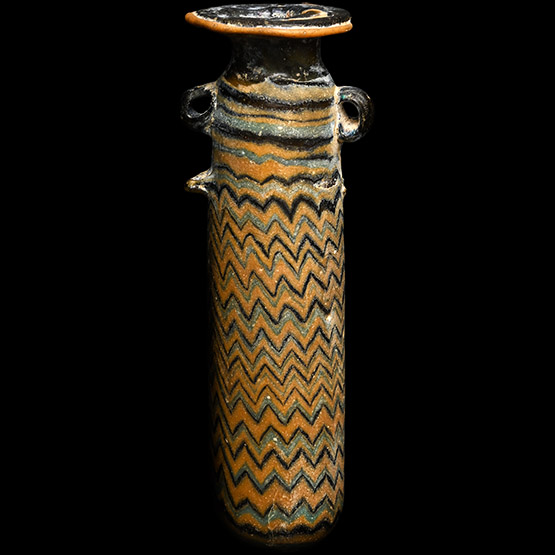
Greek Core-Formed Tall Glass Alabastron
6th-5th century B.C.Estimate: £3,500 - 4,500 (‡+bp*)
Opening Bid: £1,750
With a fusiform body, slender neck and broad flange rim, decorated with marvered feathering and spiralling trails; two lateral loop handles and a pinched lateral lug. 36.69 grams, 91 mm
Anonymous sale, Binoche & Giquello, Paris, 30th May 2012, no.124. Private collection, Switzerland. Accompanied by a copy of French passport no.0150269. This lot has been checked against the Interpol Database of stolen works of art and is accompanied by search certificate number no.13188-249220.
Alabastra of this typology, core-formed, trail-decorated and tooled, are typical of the Eastern Mediterranean. They were diminutive examples of a shape popularly produced for perfumed oils in the Greek world. Larger forms are known in both glass and ceramics. -
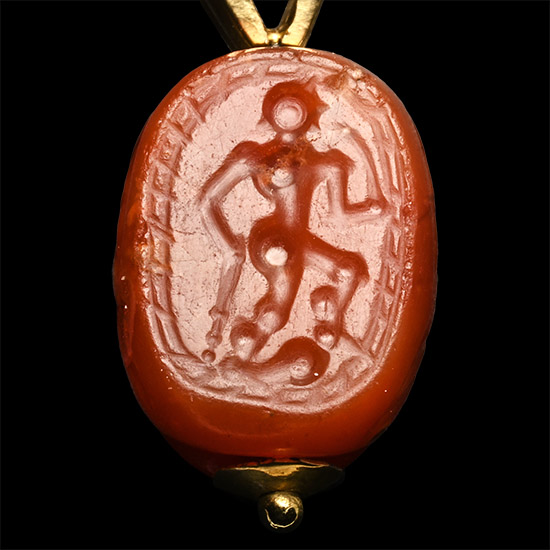
Greek Carnelian Scarab Engraved with Hercules with Later Gold Setting
Etruscan, 3rd century B.C.Estimate: £1,200 - 1,700 (+bp*)
Opening Bid: £625
With incised anatomical detailing, underside with a standing figure of Hercules, resting his hand on his club; with a later gold bar and suspension loop. 4.08 grams, 25 mm
Private collection, London. -
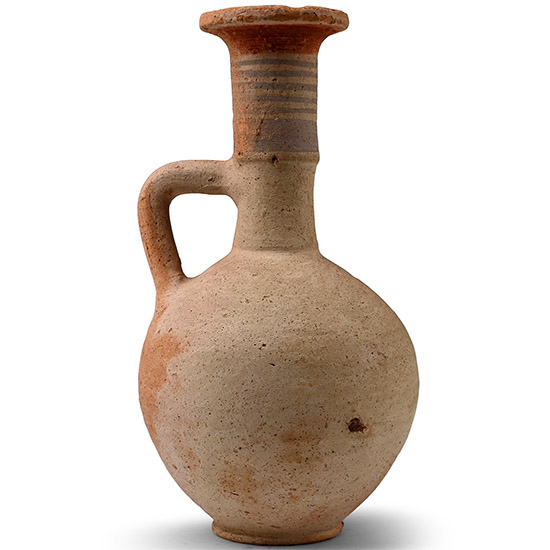
Cypro-Archaic Terracotta Jug
Cyprus, 7th century B.C.Estimate: £400 - 600 (‡+bp*)
Opening Bid: £180
Spherical body on a low ring foot, long tubular neck and wide rim, painted horizontal lines on the neck, and an applied round-section handle 365 grams, 18 cm
From the Swedish Painter Lasse Johnson (1899-1992), aquired 1972. Thereafter, offered by Maud Johnson-Vuilleumier to her cousin M.N.F.Pellation (1921-2005) in 1992; thence by descent.
