
Loading, please wait...
LOT 0530
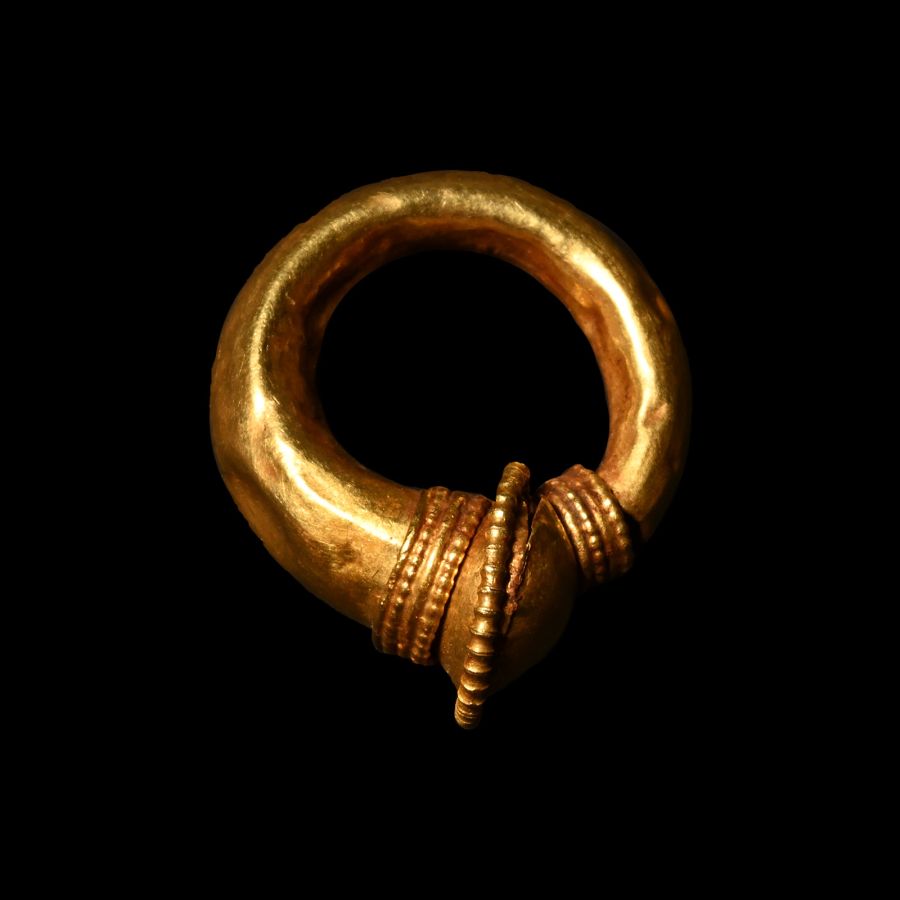
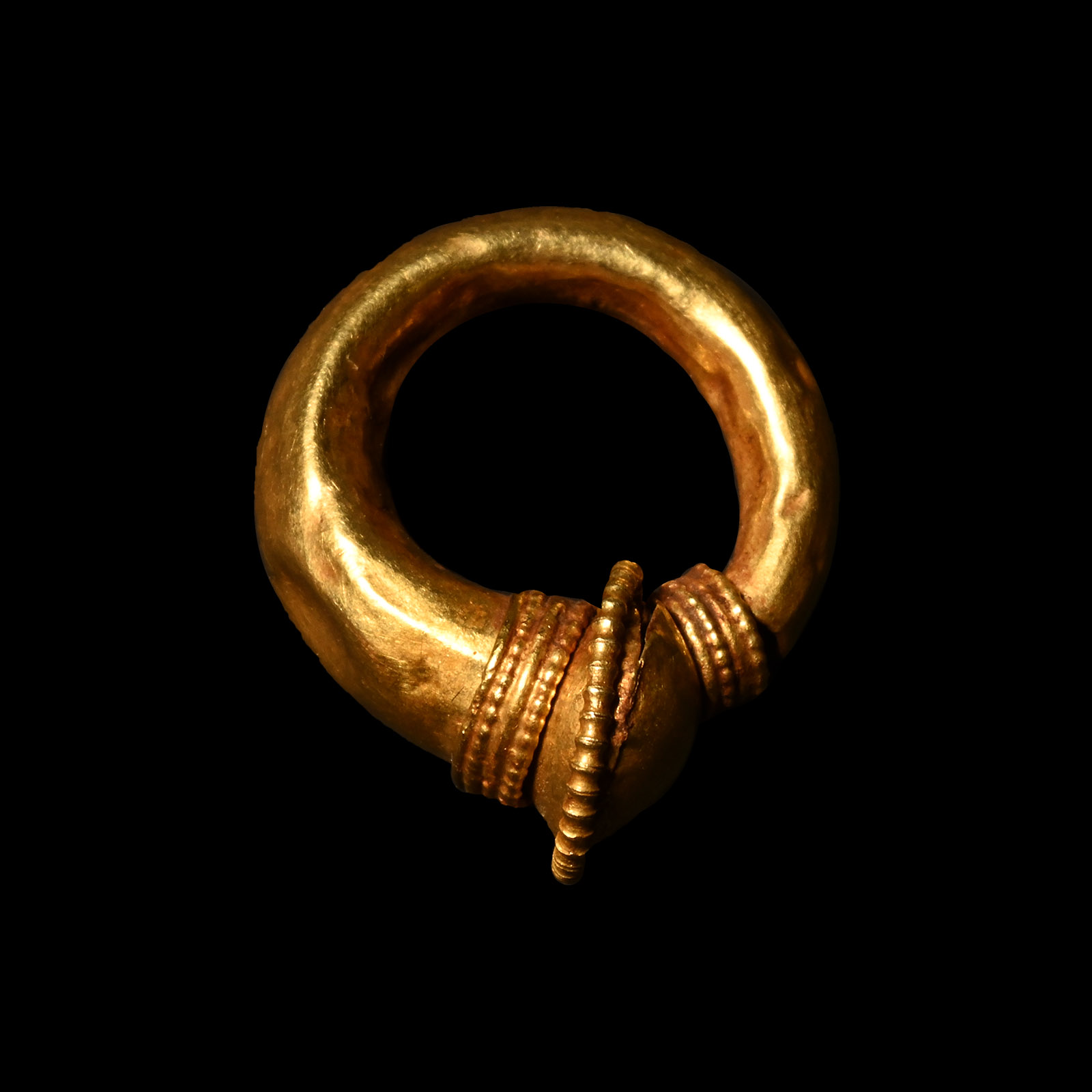
Etruscan Gold Trumpet-Shaped Earring
CIRCA 350 B.C.
3/4 in. (1.34 grams, 20 mm).
Hollow-formed sheet-gold earring with applied trumpet-shaped finial, filigree collars and beaded wire fillet to the rim. [No Reserve]
ProvenanceEx Parisian dealers including Jean-Phillipe Mariaud de Serres; subsequently dispersed with other pieces at auction.
French private collection of a French lady, acquired in the 1980s.
Accompanied by a copy of an illustrated three page collector's cataloguing document.
Cf. Marshall, F.H., Catalogue of the Jewellery, Greek, Etruscan and Roman, in the Department of Antiquities, British Museum, London, 1911, p.XL.
CONDITIONTimeLine Auctions follows a vetting process to ensure the authenticity and legality of all items, reinforcing our commitment to integrity and responsible trading. Each antiquity, antique, and coin lot undergoes thorough examination by a vetting committee of at least ten external specialists, professional trade association members, scientists, and archaeologists: Our Vetting Process
AUCTIONS:
TimeLine is a leading auction house specialising in antiquities, ancient art, collectables, natural history, coins, medals, and books. Our auctions offer museums, collectors, historians, and enthusiasts the opportunity to acquire unique and historically significant pieces.
-
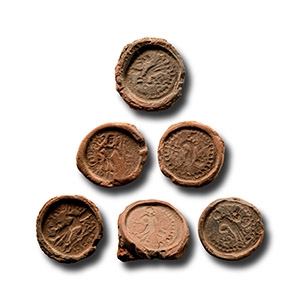
Indo-Greek Terracotta Forger's Mold Group
Circa 2nd-1st century B.C.Sold for (Inc. bp): £520
Group of discoid clay moulds for casting contemporary counterfeit coins. 40 grams total, 27-32 mm
Private collection formed in the 1990s. Acquired from a central London gallery. Property of an Essex gentleman. -
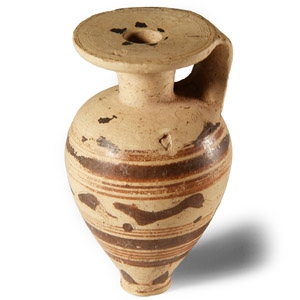
Etruscan Buffware Aryballos
8th-7th century B.C.Sold for (Inc. bp): £169
With a piriform body and narrow foot, deep shoulder and flange rim, strap handle to the rear; the rim and shoulder with radiating strokes, concentric bands to the body and foot, frieze of stylised running hounds below the shoulder. 34 grams, 63 mm high
Acquired 1980-1990s. From the private collection of H.N., Milton Keynes, Bedfordshire, UK.
Proto-Corinthian aryballoi of the same type, probably of Etruscan manufacture, in buff-ware decorated with dark metallic, purple-maroon and red-brown bands have been found in the Veii excavations. John Boardman noted that the shape in Corinth barely survives the 7th century, but these small pots are still found in Etruscan graves of the first half, or at least the first quarter, of the 6th century B.C. -
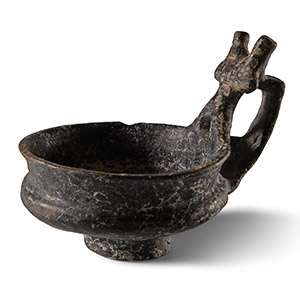
Villanovan Terracotta Kyathos with Zoomorphic Handle
Circa 7th century B.C.Sold for (Inc. bp): £312
Small impasto kyathos with carinated profile, basal ring, zoomorphic handle with spurs above. 113 grams, 10 cm wide
Belgium (Uccle) – Haynault Ventes Publiques, Collectibles Auction, 21 September 2021, lot 15. Property of a South Australian private collector, with collection reference 21.100. Accompanied by a detailed collector's catalogue page including description and photograph.
Villanovan culture is often regarded as the earliest phase of Etruscan civilisation in the Iron Age.
