
Loading, please wait...
LOT 0109
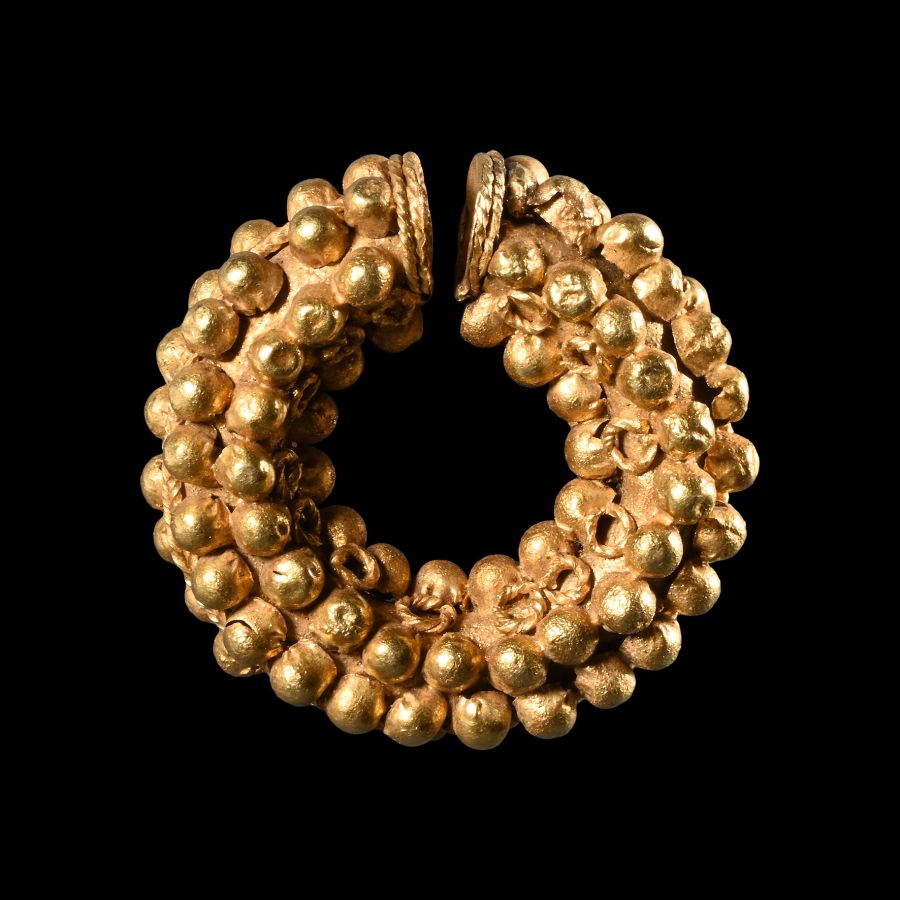
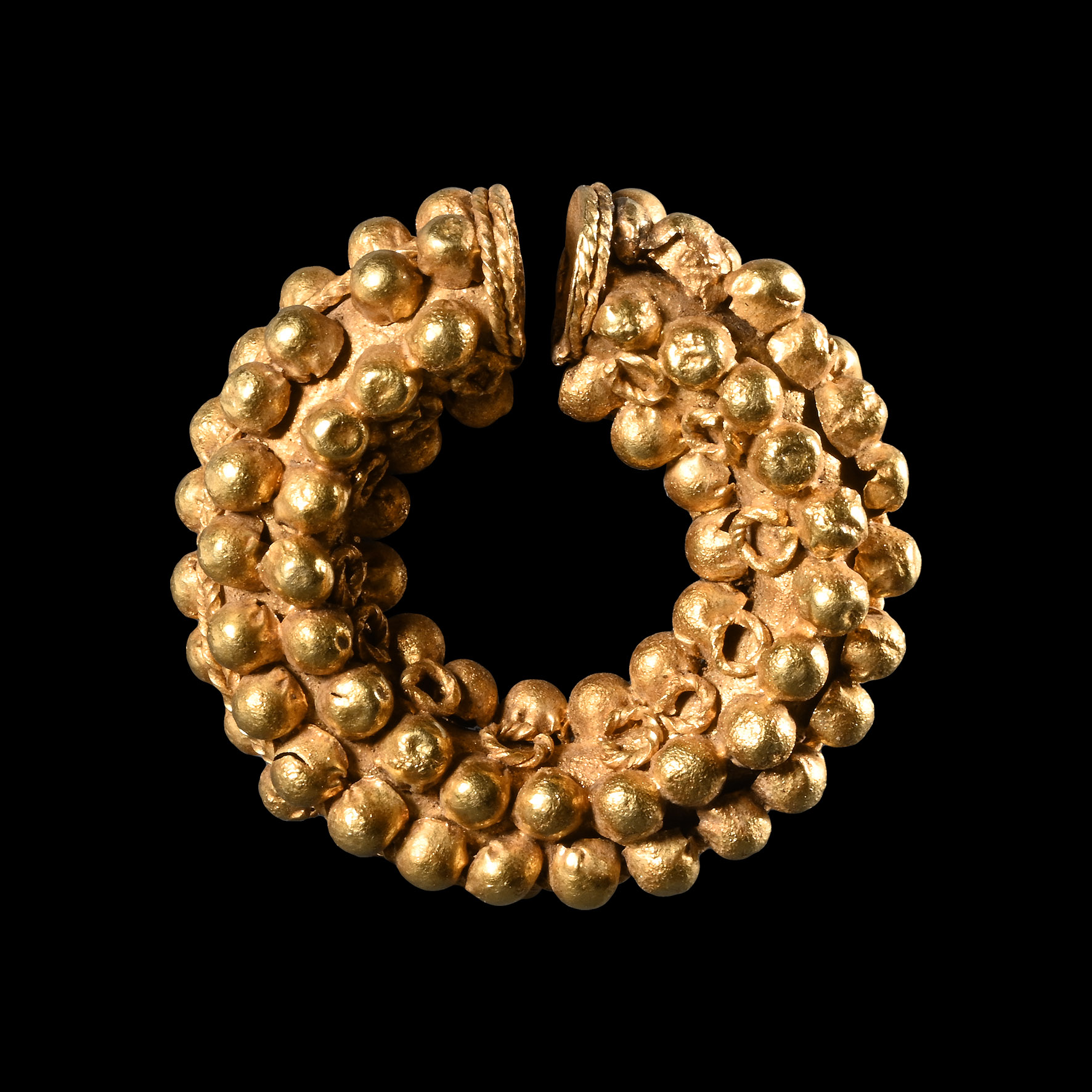
Etruscan Gold Leech Earring
3RD CENTURY B.C.
1 1/8 in. (7.61 grams, 30 mm).
Formed with a hollow c-shaped body adorned with five rows of hollow spheres and a double filigree ropework band, two rows of filigree hoops to the inner face.
ProvenanceFrom the collection of a North American gentleman, formed in the 1990s.
LiteratureCf. Marshall, F.H., Catalogue of the Jewellery Greek, Etruscan & Roman in the Departments of Antiquities, British Museum, item 2265, for construction.
CONDITIONTimeLine Auctions follows a vetting process to ensure the authenticity and legality of all items, reinforcing our commitment to integrity and responsible trading. Each antiquity, antique, and coin lot undergoes thorough examination by a vetting committee of at least ten external specialists, professional trade association members, scientists, and archaeologists: Our Vetting Process
AUCTIONS:
TimeLine is a leading auction house specialising in antiquities, ancient art, collectables, natural history, coins, medals, and books. Our auctions offer museums, collectors, historians, and enthusiasts the opportunity to acquire unique and historically significant pieces.
LOT 0109
Etruscan Gold Leech Earring
Estimate £800 - 1,000€930 - 1,160 (for guidance only)$1,080 - 1,350 (for guidance only)
-
.jpg)
Cypriot Terracotta Figurine
6th-5th century B.C.Sold for (Inc. bp): £780
Modelled in the half-round, the figure wearing a conical hood with open front, detailed facial features and ribbed beard, left arm bent, right arm drawn across the body in the folds of a mantle, vertical border to the left chest; mounted on a custom-made stand. 48 grams, 83 mm (69 grams total, 10.9 cm high including stand)
Ex Julien Gréau (1810–1895) who was an omnivorous French collector with a predilection for antiquities. Collection of Louis-Gabriel Bellon (1819-1899), Saint-Nicolas-lez-Arras and Rouen, thence by descent. with Millon & Associes Auctions, Paris, 6th December 2021, lot 41 [Part]. Accompanied by a copy of Collection J. Gréau, Terres Cuites Grecques, by H. Hoffmann, 1891, where this piece is published. -
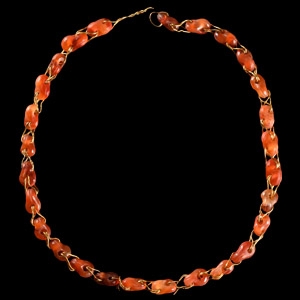
Greek Gold and Carnelian Necklace
1st century B.C.-1st century A.D.Estimate: £2,000 - 3,000 (‡+bp*)
Opening Bid: £1,000
A section of a necklace of carnelian drop-shaped beads, each pierced in two planes and linked loop-in-loop with thin twisted gold wires, possibly later. 8.16 grams, 26 cm long
The Gans collection, Hebling Dec, Berlin, 1929. with Christie's, New York, 8 December 1999, lot 51. Accompanied by a copy of the relevant Christie's catalogue pages. This lot has been checked against the Interpol Database of stolen works of art and is accompanied by search certificate no.11608-198969. -
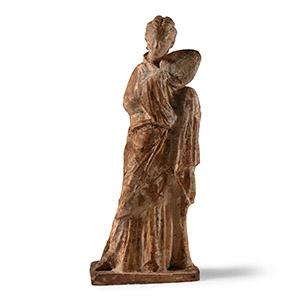
Greek Tanagra Female Figure with Fan
4th-3rd century B.C.Sold for (Inc. bp): £1,690
Modelled robed with a palmette fan; rectangular slot to reverse, hollow underside; with traces of white engobe and polychromy; recomposed from fragments. 189 grams, 16 cm high
Private collection Adry de Carbuccia, Sainte-Maxime, France, acquired prior to 1975. with Eurl Eve, Paris, 11 December 2013, lot 30. Accompanied by a copy of an Art Loss Register certificate number S00085753, dated 26 March 2014. Accompanied by a copy of a French cultural passport no.1537836. Accompanied by a copy of an original thermoluminescence analysis report no.QED1340/FG-0404 from QED Laboratoire. Accompanied by a copy of the relevant Eurl Eve catalogue pages.
