
Loading, please wait...
_900x900.jpg "Etruscan Gold Filigree Leech Brooch")
_200x200.jpg "Etruscan Gold Filigree Leech Brooch")
_900x900.jpg "Etruscan Gold Filigree Leech Brooch")
_200x200.jpg "Etruscan Gold Filigree Leech Brooch")
.jpg "Etruscan Gold Filigree Leech Brooch")
.jpg "Etruscan Gold Filigree Leech Brooch")
LOT 0094
Etruscan Gold Filigree Leech Brooch
7TH CENTURY B.C.
2 3/4 in. (13.86 grams, 69 mm).
Hollow-formed bow with applied floral detailing, filigree and granules, double-coiled spring and pin; tongue-shaped foot with dense granule detailing, globe finial with rosette above.
ProvenanceAcquired in the 1970s.
Property of a London lady, part of her family's collection.
This lot has been checked against the Interpol Database of stolen works of art and is accompanied by search certificate no.12112-213116.
Cf. A similar though less impressive item in the collection of the British Museum under accession no.1978,1002.121.
CONDITIONTimeLine Auctions follows a vetting process to ensure the authenticity and legality of all items, reinforcing our commitment to integrity and responsible trading. Each antiquity, antique, and coin lot undergoes thorough examination by a vetting committee of at least ten external specialists, professional trade association members, scientists, and archaeologists: Our Vetting Process
AUCTIONS:
TimeLine is a leading auction house specialising in antiquities, ancient art, collectables, natural history, coins, medals, and books. Our auctions offer museums, collectors, historians, and enthusiasts the opportunity to acquire unique and historically significant pieces.
LOT 0094
Etruscan Gold Filigree Leech Brooch
Estimate £2,000 - 3,000€2,320 - 3,480 (for guidance only)$2,700 - 4,050 (for guidance only)
-
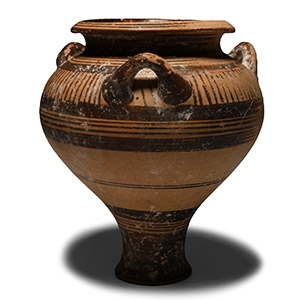
Greek Geometric Terracotta Piriform Jar with Handles
Late Helladic IIIB, 1300-1200 B.C.Sold for (Inc. bp): £1,300
With small flared foot, broad body and rounded shoulder, everted rim and two loop handles to the shoulder; painted bands of linear ornament. 280 grams, 15 cm
Acquired from Gallery Gryphos, Munich, 2000s. European private collection.
Deposits from Mycenae, Korakou and Nichoria are relatively rich in painted jugs, small stirrup and piriform jars. The pattern usually employed on piriform jars preserves a rim decoration of short strokes, neck being solidly painted. Following an usual syntax, a line group appears on the upper shoulder below the neck. Bases are solidly painted, except for an occasional thin reserved area on the lower base edge. -
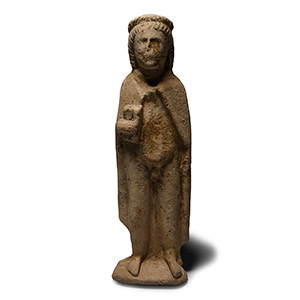
Cypro-Archaic Standing Limestone Male Scribe
Circa 4th-3rd century B.C.Sold for (Inc. bp): £780
Modelled in the half-round, standing nude male with mantle to the shoulders, clutching a codex in the right hand; with carefully dressed hair and diadem; D-shaped base. 536 grams, 27 cm
Acquired Bonhams, London, UK. From a collection acquired on the UK art market from various auction houses and collections mostly before 2000. From an important Cambridgeshire estate; thence by descent. -
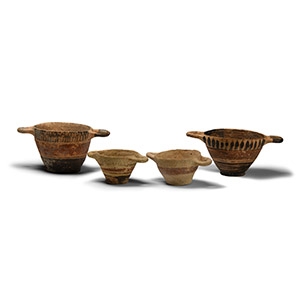
Corinthian Miniature Terracotta Skyphos Collection
6th century B.C.Estimate: £500 - 700 (‡+bp*)
Opening Bid: £250
Group of four graduated ceramic cups, each with two loop handles to the rim and painted detailing to the outer face. 103 grams total, 6.5-10.1 cm
Acquired from Gallery Gryphos, Munich, early 2000s. European private collection.
