
Loading, please wait...
LOT 0091
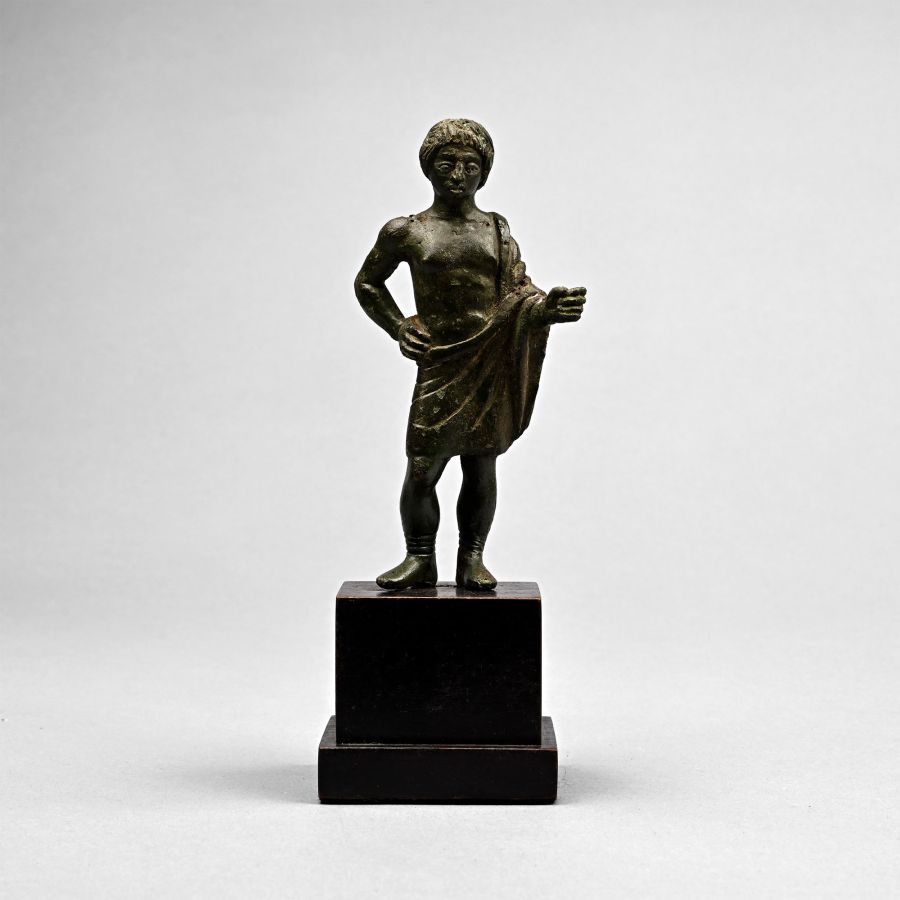
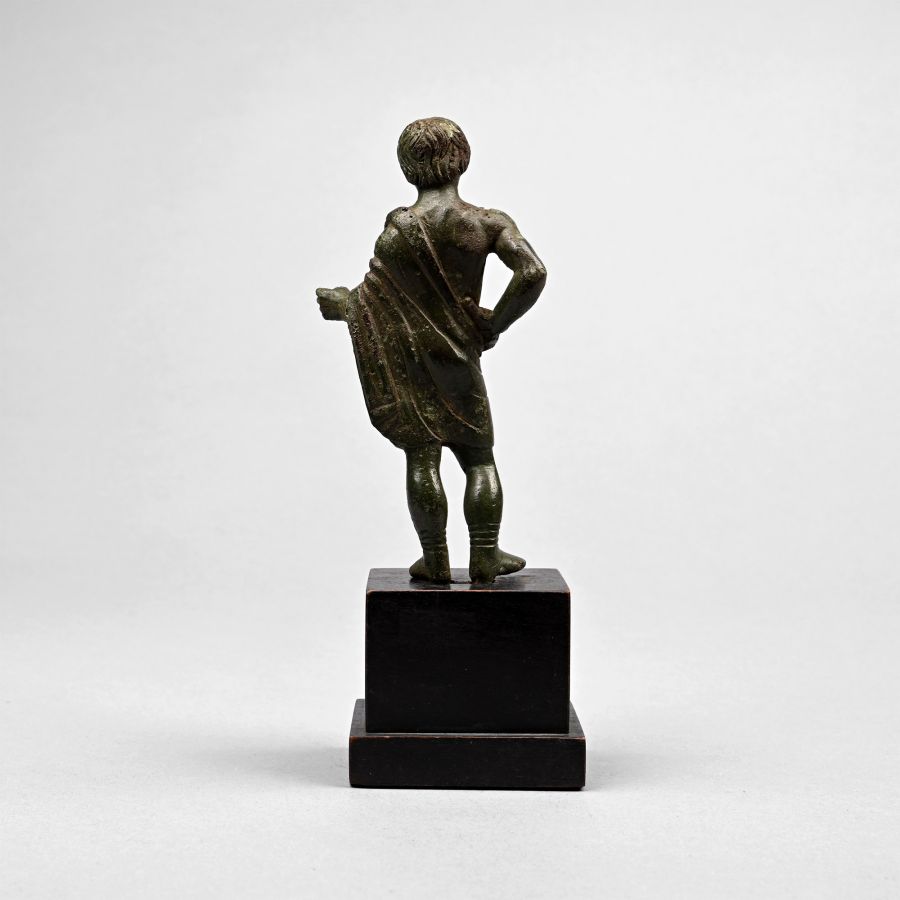
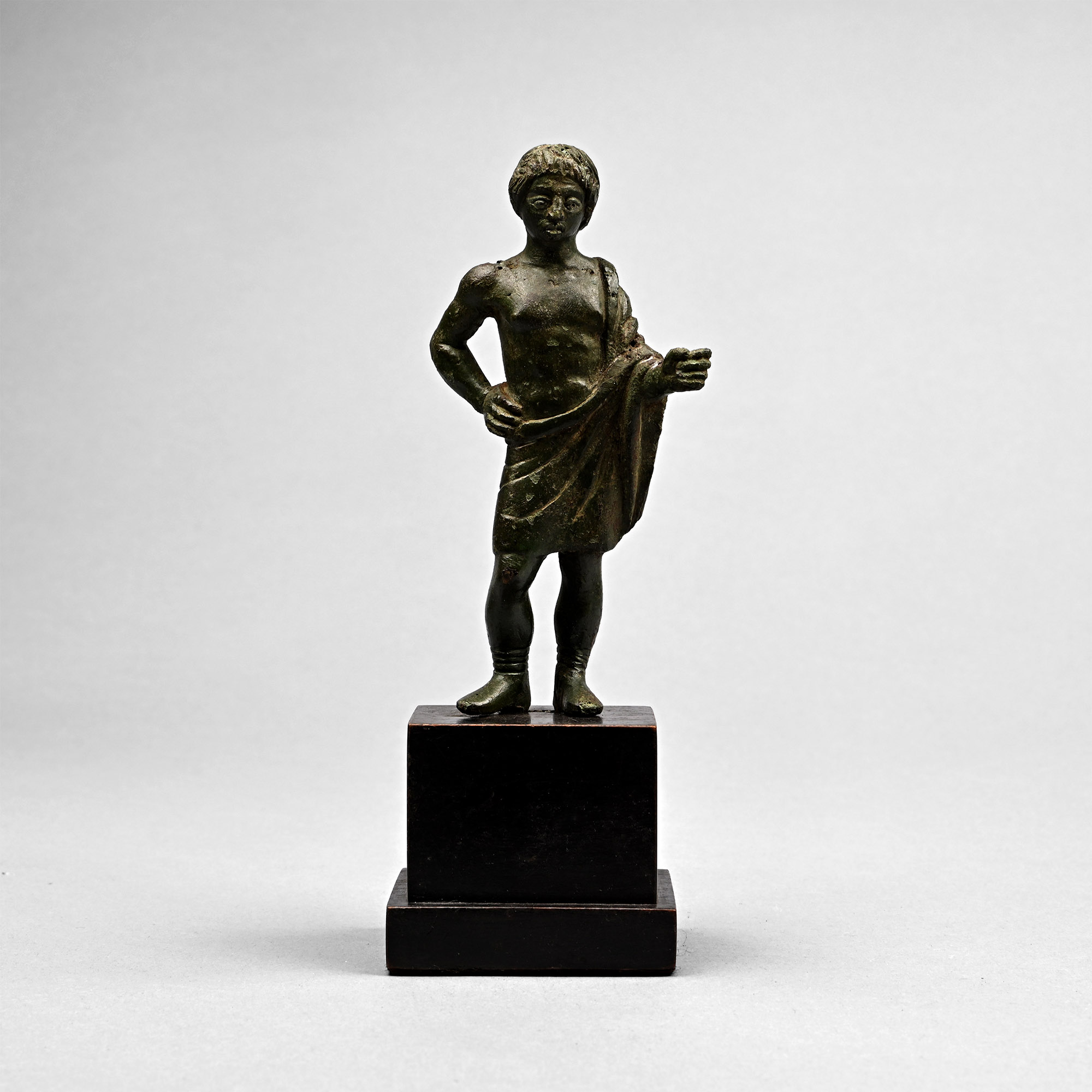
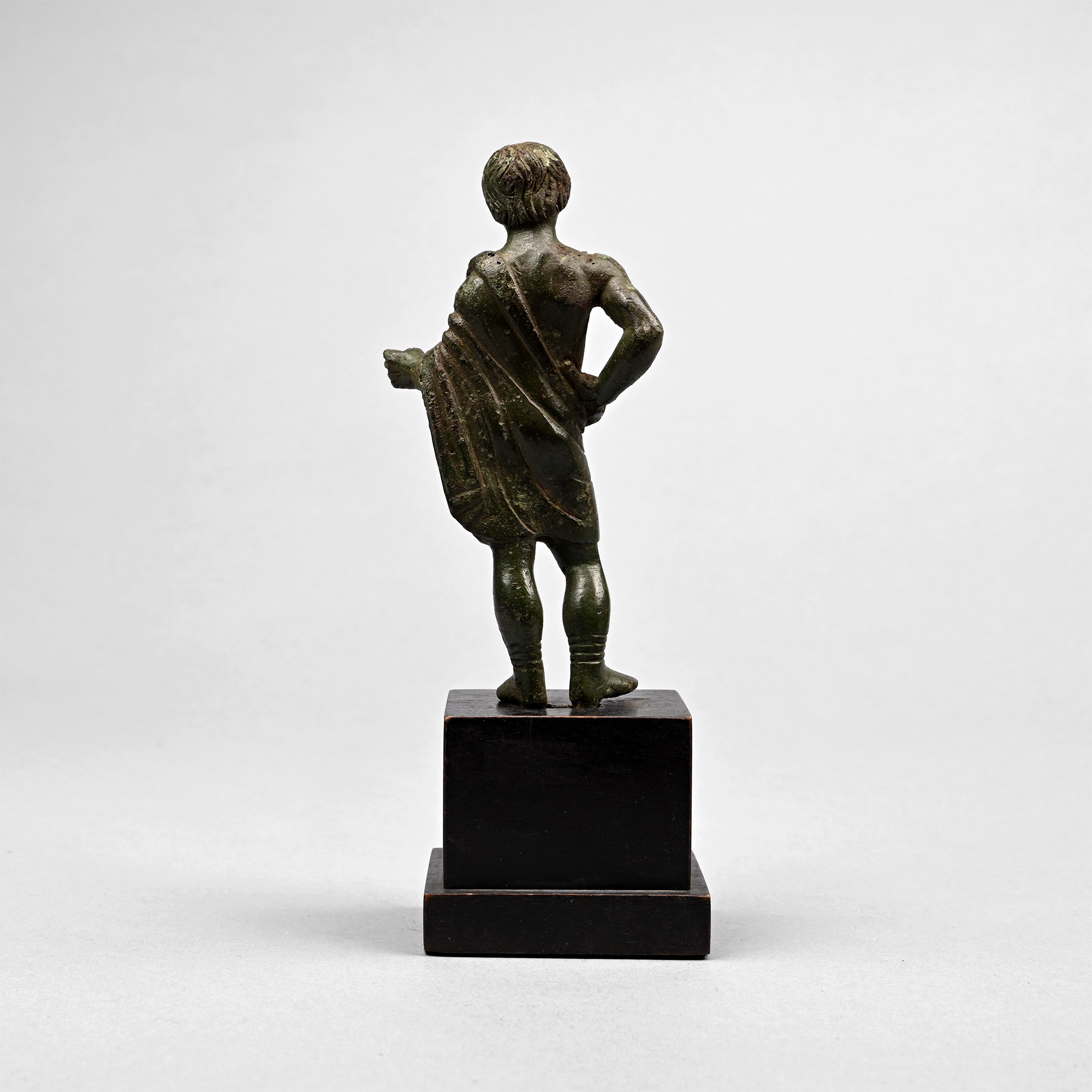
Etruscan Bronze Statuette of a Draped Hero
4TH-3RD CENTURY B.C.
7 3/8 in. (506 grams total, 18.7 cm including stand).
Modelled in the round, standing erect with right hand on his hip and left arm extending from the elbow resting on the left hip and with fingers curled to hold a staff or handle, wearing a loosely draped cloth over the left shoulder and drawn around the body to hang over the arms; ribbed cuffs to the boots; youthful face with tousled hair and slightly exaggerated lentoid eyes; C-shaped staple beneath the feet for attachment; supplied with a custom-made display stand.
Provenancewith Sotheby’s, Antiquities, London, 6 July 1995, no.130.
Acquired by the present owner at the above sale.
This lot has been checked against the Interpol Database of stolen works of art and is accompanied by search certificate number no.12194-222321.
Cf. Reinach, S., Repertoire de la statuaries grecque et romaine, Paris, 1930, p.216, no.1 (same position but naked, Heracles as Herculi Fundanio, see CIL,VI,311); 225 no.8 (Louvre); 506 no.1 (Etruscan Lar, same position but naked); cf. also Rolland, H., Bronzes Antiques de Haute Provence, Paris, 1965, item 176, for a figure in similar costume.
FootnotesThe statue was probably a cult offering and presents an archaic Etruscan hairstyle; it is likely to have been produced as a votive offering or for private lararia. His warrior status can be confirmed by his boots, typical of archaic-era Etruscan and Latin warriors.
CONDITIONTimeLine Auctions follows a vetting process to ensure the authenticity and legality of all items, reinforcing our commitment to integrity and responsible trading. Each antiquity, antique, and coin lot undergoes thorough examination by a vetting committee of at least ten external specialists, professional trade association members, scientists, and archaeologists: Our Vetting Process
AUCTIONS:
TimeLine is a leading auction house specialising in antiquities, ancient art, collectables, natural history, coins, medals, and books. Our auctions offer museums, collectors, historians, and enthusiasts the opportunity to acquire unique and historically significant pieces.
LOT 0091
Etruscan Bronze Statuette of a Draped Hero
Estimate £18,000 - 24,000€20,880 - 27,840 (for guidance only)$24,300 - 32,400 (for guidance only)
-
.jpg)
Greek Attic Red-Figure Kylix Fragment Depicting a Lyre Player
Early 5th century B.C.Sold for (Inc. bp): £234
Irregular fragment depicting a draped figure playing a lyre, possibly Apollo; meander line to the reverse. 7.25 grams, 42 mm
From the stock of a former UK antiquarian, acquired at trade fairs and from private collection formed in the 1980s-1990s. Private collection, Europe. -
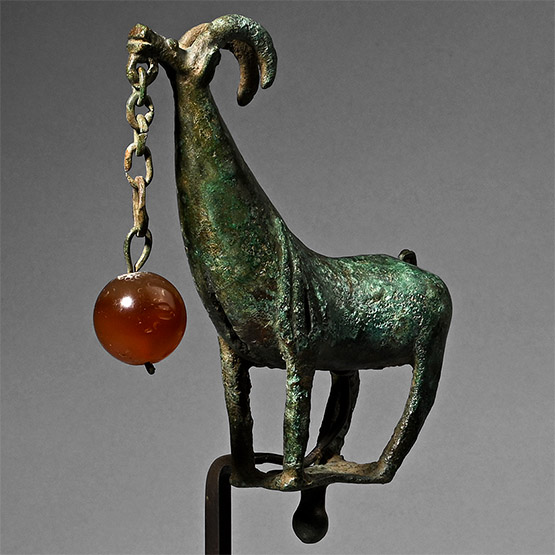
Bronze Military Standard Finial of an Ibex
Transcaucasia, 13th-6th century B.C.Estimate: £8,000 - 10,000 (+bp*)
Opening Bid: £4,000
Wth a rounded body and prominent raised neck, a tubular muzzle with stylised eyes and ears and a small, slightly open mouth; a ring with a chain and a large carnelian sphere beneath the chin; a wide incised groove above the front legs, perhaps intended to represent muscles; a long slit beneath the abdomen; standing on a rectangular platform with a pin for insertion to a wooden shaft; accompanied by a custom-made display stand. 643 grams total, ibex: 15 cm high
Acquired in Vienna, Austria, in the 1990s. Collection of N.M., former Israeli Ambassador to Austria (1998–2000). Private collection, London. Accompanied by an academic report by Dr Raffaele D’Amato. This lot has been checked against the Interpol Database of stolen works of art and is accompanied by search certificate number no.13039-247908.
In Scythian art, the ibex was often depicted in dynamic ‘animal style’ symbolising life, strength, and perhaps cosmic struggles, potentially linked to seasonal cycles or fertility, showing its sacred status as a totem animal alongside mouflons. The realistically depicted posture of the animal testifies to the ancient masters' keenness of observation and of their skill in rendering the character of the animal in metal. The posture recalls more archaic (7th-6th century B.C.) animal style art found in the Tagar finials. -
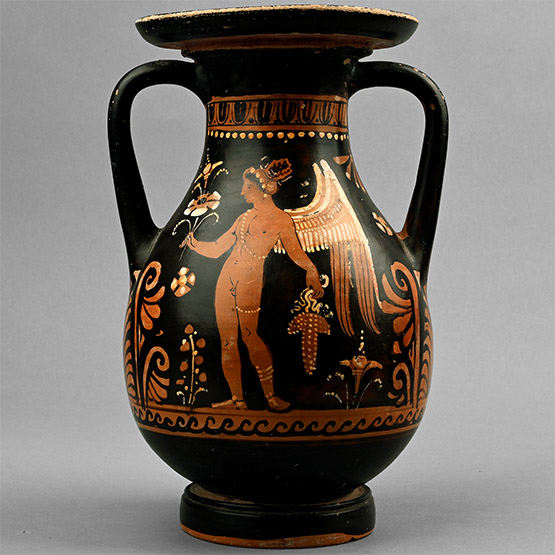
Large Greek Red-Figure Pelike with Nike
Apulian, 3rd-2nd century B.C.Sold for (Inc. bp): £2,860
Comprising a pedestal base, mastoid body, lateral strap handles and funicular neck, broad mouth with stepped rim; the neck decorated with a band of egg-and-dart; palmette below each handle, flanked by tendrils and flowers; Side A: naked Eros (Cupid), hair in a bun and tied with a cloth, right arm outstretched and holding a flower by the stem, left hand holding leaves and tendrils; Side B: Nike standing in himation and stephane, holding up a drum-shaped object and supporting leaves and tendril, flower patterns to the background. 1.19 kg, 26 cm high
Acquired on the art market between the late 1990s and mid-2000s. Estate of the late Barry Paul Buxton (1944–2024), Oakham, Rutland. Acquired on the UK art market, 2025. Accompanied by a thermoluminescence analysis report no.N126a15 from Oxford Authentication. Accompanied by an academic report by Dr Raffaele D'Amato. This lot has been checked against the Interpol Database of stolen works of art and is accompanied by search certificate number no.13089-248952.
The Greek term pelike (pl. pelikai) was used for a number of shapes, and it is not certain what this one-piece vessel with a distinctive sagging belly was called in antiquity. It seems to have been invented after the introduction of the red-figure technique, although there are examples in black-figure. It continued to be produced into the 4th century and in the Roman period. It is shown in use as a container for liquids, especially wine, and in this context was linked with Bacchus, Pan, and Silenus.
