
Loading, please wait...
_900x900.jpg "Etruscan Bronze Statue of a Satyr")
_200x200.jpg "Etruscan Bronze Statue of a Satyr")
_900x900.jpg "Etruscan Bronze Statue of a Satyr")
_200x200.jpg "Etruscan Bronze Statue of a Satyr")
.jpg "Etruscan Bronze Statue of a Satyr")
.jpg "Etruscan Bronze Statue of a Satyr")
LOT 0051
Etruscan Bronze Statue of a Satyr
CIRCA 6TH CENTURY B.C.
8 in. (679 grams total, 20.4 cm including stand).
Modelled in the round in energetic pose with left hand resting on the hip and right arm raised, head tilted slightly upwards, tail curled gracefully over the rump; on a square base with papyrus stalk detailing; on a later gilt-metal stand mounted on a polished stone cube.
ProvenanceIris Cornelia Love (1933–2020), New York, collection primarily formed in the 1950s-1970s.
This lot has been checked against the Interpol Database of stolen works of art and is accompanied by search certificate number no.13335-258241.
Hannegan, B., Classical Antiquities from the Collection of Miss Iris Love, Durham, North Carolina, 1965, no.8, illustrated.
Exhibited: Durham, Duke University, The Art Department Gallery, Classical Antiquities from the Collection of Miss Iris Love, 25 January–24 February 1965.
Cf. similar figure in the Metropolitan Museum of Art, object number: 1972.118.72.
FootnotesMany of the scenes show satyrs in Etruscan art transgressing the limits of accepted behaviour. As symbol of inversion of order, the satyr reflects the rules of the life and culture of the Etruscans and their values. Satyrs in comic, surprising situations indicate the Etruscans' sense of humour. They got their inspiration from Greek art when illustrating myths and narratives, often with a light-hearted approach of their own. The Etruscans were known to be devoted to religious rites and satyrs appear in such scenes too. Satyrs, connected with the Dionysian cortege, appear also on vases in sacrifice scenes and it is suggested here that satyrs dancing and gambolling around a wine vessel are performing a cultic dance in honour of Dionysos.
CONDITIONTimeLine Auctions follows a vetting process to ensure the authenticity and legality of all items, reinforcing our commitment to integrity and responsible trading. Each antiquity, antique, and coin lot undergoes thorough examination by a vetting committee of at least ten external specialists, professional trade association members, scientists, and archaeologists: Our Vetting Process
AUCTIONS:
TimeLine is a leading auction house specialising in antiquities, ancient art, collectables, natural history, coins, medals, and books. Our auctions offer museums, collectors, historians, and enthusiasts the opportunity to acquire unique and historically significant pieces.
-
.jpg)
Large Etruscan Statue of a Priest with Patera
2nd century B.C.Sold for (Inc. bp): £21,320
Modelled in the round standing figure with palla draped over the left shoulder and from the hips, extending to calf-length; the head with aquiline nose and dimpled chin modelled with a wreath of large leaves around the brow forming a corona; exaggerated eyes left blank to accept silver inserts; left arm bent, hand holding an incense-holder with cruciform design; right arm extended at shoulder-height with phiale mesomphalos offering dish; socket beneath left foot and screw-threaded post beneath right, repairs to both lower legs. 1.23 kg, 28.4 cm high
Sotheby's, New York, 17 December 1996, no.79. Private collection, New York, USA. Accompanied by copies of the relevant Sotheby's catalogue pages. This lot has been checked against the Interpol Database of stolen works of art and is accompanied by search certificate number no.13355-255463.
The figure is probably a devotee or priest of Diana preparing to make ritual observances with the offering plate and incense burner. A group of similar figures was recovered from the shallows of Lake Nemi south of Rome, close to the site of the Temple of Diana. -
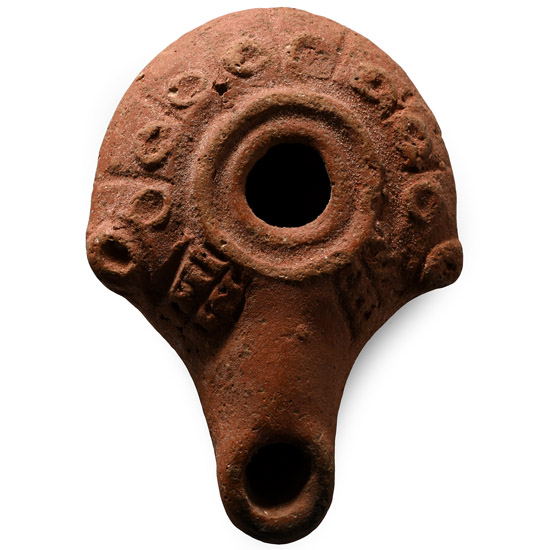
Greek Terracotta Oil Lamp with Annulets
Hellenistic, 3rd century B.C.Sold for (Inc. bp): £104
Low profile and a long nozzle, the body with annulets on the shoulder and two projecting lugs on each side of the nozzle. 49.3 grams, 81 mm
From an important collection of lamps, Germany, 1970s. -
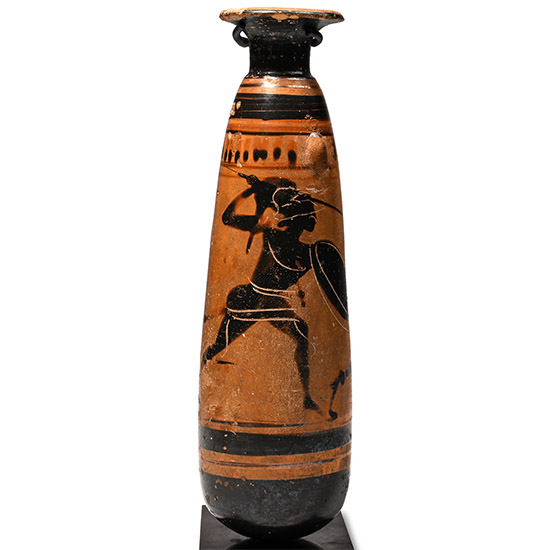
Greek Black-Figure Alabastron with Fighting Warriors
Attic, 500-480 B.C.Sold for (Inc. bp): £13,000
Of ovoid shape, short neck and expanded flat rim; painted in horizontal bands with black vertical strokes the shoulder, ovules in the upper part, the central scene representing a Greek Ekdromos fighting a Scythian archer; the Greek warrior, wearing a light sleeveless chiton, and a crested Corinthian helmet, carrying a wide hoplon shield, and a long spear with which he is slashing his opponent; the Scythian archer is wearing a typical tall cap flowing backwards and his long coat-suit, carrying a gorytos, (quiver) and composite bow with arrow; horizontal black stripes below; accompanied by a custom-made display stand. 262 grams total, 16 cm high including stand
Louis-Gabriel Bellon (1819-1899) collection, France. European private collection, 2009. Accompanied by an academic report by Dr Raffaele D’Amato. This lot has been checked against the Interpol Database of stolen works of art and is accompanied by a search certificate number no.13019-246753.
The importance of this alabastron is linked to its iconography, which represents episodes of the Persian Wars, fought 490-480 B.C. Such alabastra are part of a series realised during the period of the conflict and after, and they are an important source of information on the Persian and Greek armies. Here, the two opponents evoke the Greek victories, with a light-armed Greek ekdromos (hoplite fighting in light equipment) killing a Scythian archer, who formed part of the Persian army. The representation of Scythian costume in vase-painting reached its height of popularity between c. 530 and 490 B.C., and went out of fashion after the Graeco-Persian wars, when these clothes began to be associated with the Persian ethnic identity rather than the original Scythian.
