
Loading, please wait...
_900x900.jpg "Etruscan Bronze Statue of a Satyr")
_200x200.jpg "Etruscan Bronze Statue of a Satyr")
_900x900.jpg "Etruscan Bronze Statue of a Satyr")
_200x200.jpg "Etruscan Bronze Statue of a Satyr")
.jpg "Etruscan Bronze Statue of a Satyr")
.jpg "Etruscan Bronze Statue of a Satyr")
LOT 0101
Etruscan Bronze Statue of a Satyr
CIRCA 6TH CENTURY B.C.
8 in. (679 grams total, 20.4 cm including stand).
Modelled in the round in energetic pose with left hand resting on the hip and right arm raised, head tilted slightly upwards, tail curled gracefully over the rump; on a square base with papyrus stalk detailing; on a later gilt-metal stand mounted on a polished stone cube.
ProvenanceIris Cornelia Love (1933–2020), New York, collection primarily formed in the 1950s-1970s.
PublishedHannegan, B., Classical Antiquities from the Collection of Miss Iris Love, Durham, North Carolina, 1965, no.8, illustrated.
Exhibited: Durham, Duke University, The Art Department Gallery, Classical Antiquities from the Collection of Miss Iris Love, 25 January–24 February 1965.
Cf. similar figure in the Metropolitan Museum of Art, object number: 1972.118.72.
CONDITIONTimeLine Auctions follows a vetting process to ensure the authenticity and legality of all items, reinforcing our commitment to integrity and responsible trading. Each antiquity, antique, and coin lot undergoes thorough examination by a vetting committee of at least ten external specialists, professional trade association members, scientists, and archaeologists: Our Vetting Process
AUCTIONS:
TimeLine is a leading auction house specialising in antiquities, ancient art, collectables, natural history, coins, medals, and books. Our auctions offer museums, collectors, historians, and enthusiasts the opportunity to acquire unique and historically significant pieces.
LOT 0101
Etruscan Bronze Statue of a Satyr
Estimate £4,000 - 6,000€4,640 - 6,960 (for guidance only)$5,400 - 8,100 (for guidance only)
-
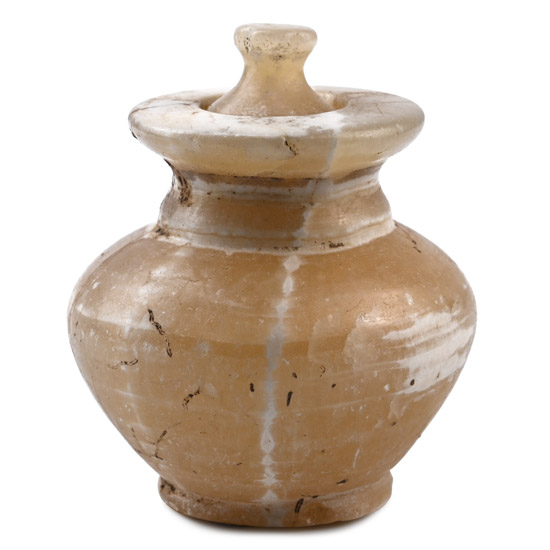
Greek Alabaster Cosmetic Pyxis with Lid
1st millennium B.C.Sold for (Inc. bp): £351
Barrel-shaped in profile with flared foot, broad shoulder and gusseted neck, flange to the mouth; knop handle to lid. 168 grams, 68 mm
Acquired in Switzerland, early 2000. Private collection, 2010. -
.jpg)
Graeco-Persian Gold Ram-Shaped Amulet
3rd-2nd century B.C.Estimate: £15,000 - 20,000 (‡+bp*)
Opening Bid: £7,500
Modelled in the round in the form of a ram lying with its legs folded beneath the body, head turned with hooked horns, collar to the neck with a large pellet pendant; ribbed suspension loop behind the shoulders, mounting lug beneath the trunk. 12.87 grams, 30 mm
Private collection, acquired on the European art market in 2002. Accompanied by a copy of an Art Loss Register certificate, 8 June 2004. This lot has been checked against the Interpol Database of stolen works of art and is accompanied by search certificate number no.13204-249215.
The ram, a male symbol, was associated with various divinities. Turned into a ram as a child by Zeus, and a common sacrifice to the god, the ram was a symbol of Dionysus, which he shared with Aphrodite. Ram heads and pendants frequently occur in jewellery. In the animal kingdom, Eros favours the cockerel and the ram, both of which are indicative of sexual potency. -
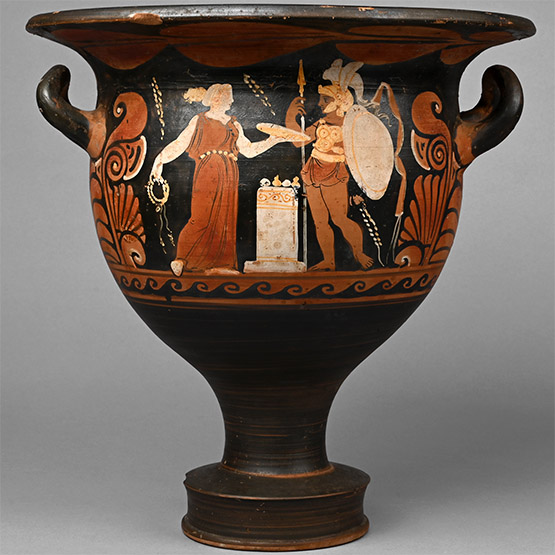
Greek Red-Figure Bell Krater with Warrior Funerary Offering Scene, Attributed to CA Painter
Campanian, 350-300 B.C.Sold for (Inc. bp): £5,980
Comprising a bell-shaped body with narrow stem and stepped pedestal foot, broad rim with square loop handles and palmettes beneath, frieze to sidewall: Side A: Oscan warrior with cuirass, helmet, shield and spear standing beside an altar with a female holding a patera in her extended hand, diadem in the other at her side; Side B: seated female with a patera and wreath facing a standing cloaked figure with thyrsus. 2.38 kg, 29.5 cm high
Private collection, Geneva, acquired in the late 1960s. Private collection, acquired in Geneva in 2000. Accompanied by collector's notes and old images. Accompanied by an original copy thermoluminescence analysis report no.QED1412/.SG-0602 from QED Laboratoire. Accompanied by an academic report by Dr Raffaele D'Amato. This lot has been checked against the Interpol Database of stolen works of art and is accompanied by search certificate number no.13219-249314.
The krater offers an interesting glimpse into the local life of Campania in the 4th century B.C. Particularly noteworthy is the depiction of the Oscan Samnite warrior, fully armed in the style of Campanian, Samnite, or Lucanian mercenaries, performing a funerary sacrifice. The depiction of the Chalcidian helmet, with its central crest and twin lateral plumes (geminae pinnae), dedicated to Mars, is extremely detailed. The style and the way in which the figures are realised, the conformation of the women, the details of the warrior, seem to point to the workshop of the CA Painter, a Campanian red-figure vase-painter whose name is unknown. Nevertheless, consistent individual characteristics of style suggest the existence of a unique artistic personality. Trendall called him the CA Painter because he was the chief painter in the first stage of Cumaean red-figure vase-painting, the initials standing for Cumaean (C), first stage (A).
