
Loading, please wait...
LOT 0492
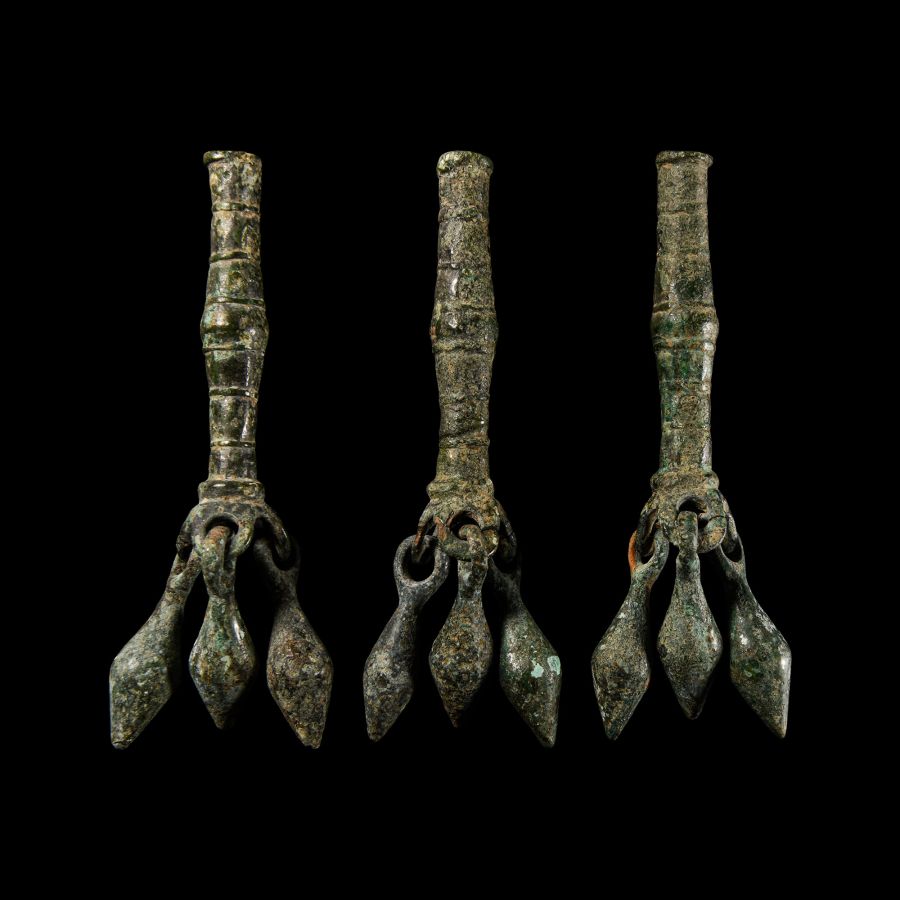
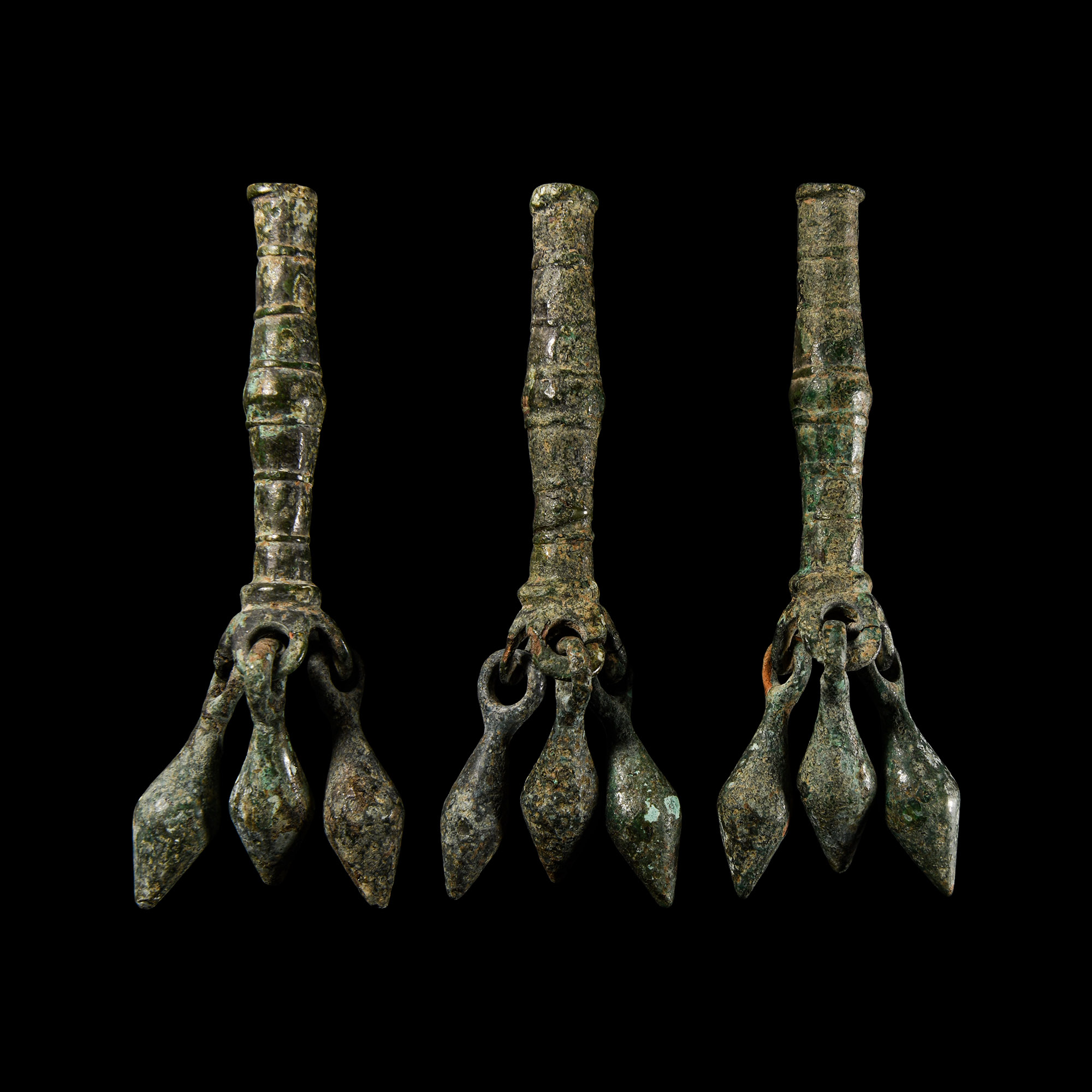
Etruscan Bronze Pendant Group
CIRCA 8TH CENTURY B.C.
3 in. (90 grams total, 78 mm each).
Comprising three pendant clusters, each a tube with balustered middle section and ribs, radiating loops at the lower end with suspended biconvex dangles. [3]
ProvenanceAcquired in the late 1970s.
Ex Herr Bernhard Muller collection.
with Galerie Ostracon, circa 2015.
Accompanied by detailed collector's catalogue pages including description and photograph.
Cf. Turfa, J.M., Catalogue of the Etruscan Gallery of the University of Pennsylvania Museum of Archaeology and Anthropology, Philadelphia, 2005, p.126, no.70.
CONDITIONTimeLine Auctions follows a vetting process to ensure the authenticity and legality of all items, reinforcing our commitment to integrity and responsible trading. Each antiquity, antique, and coin lot undergoes thorough examination by a vetting committee of at least ten external specialists, professional trade association members, scientists, and archaeologists: Our Vetting Process
AUCTIONS:
TimeLine is a leading auction house specialising in antiquities, ancient art, collectables, natural history, coins, medals, and books. Our auctions offer museums, collectors, historians, and enthusiasts the opportunity to acquire unique and historically significant pieces.
-
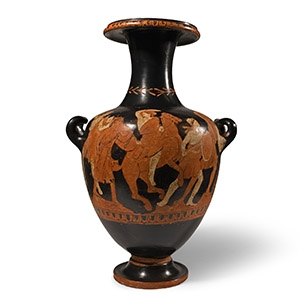
Greek Red-Figure Hydria with Combat Scene Between Amazons and Greek or Trojan Heroes
4th century B.C.Sold for (Inc. bp): £7,800
The vessel with integral round-section upward-facing handles, a third, round-section handle placed vertically between shoulder and upper neck to rear; laurel sprigs to the neck with traces of gilding; combat scene with Amazons (and Trojans?) below, armed with short swords and crescent shields, most wearing an exomis leaving the shoulder and one breast uncovered; volute palmettes below both side-handles, a panel of tiered and swirling volutes to the rear, all on a band of egg-moulding, repeated around the rim; possibly Apulian or Campanian; restored. 3 kg, 46 cm high
Ex collection Woodyat, Rome, Italy, 1912. with Vente Genève, 24 & 25 June 1960. Private European collection. Accompanied by an academic report by Dr Raffaele D’Amato. This lot has been checked against the Interpol Database of stolen works of art and is accompanied by search certificate number no.11581-199028.
The mythological topic of this hydria is fascinating, representing a fight between Amazons and Greek or Trojan heroes (suggested by the central cavalryman wearing a Phrygian cap). During this period, Amazons were no longer represented as Persian or Scythian warriors, as in Attic red-figure ceramics, but depicted as athletic parthenoi and wearing chitons. Rather than oriental costume and armour, the Amazons wear a short exomis with a bare shoulder and breast (Patten, 2013, PI.VI, I, VI,2, 2 and 3). -
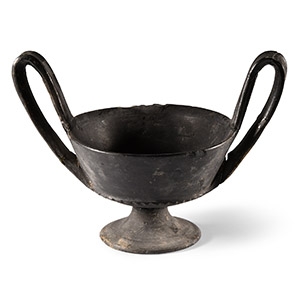
Etruscan Bucchero Kantharos Cup
Circa 7th-6th century B.C.Sold for (Inc. bp): £390
Black ceramic with broad bowl and two loop handles, short stem and trumpet-shaped foot; bowl with fluted carination; repaired. 339 grams, 18.5 cm wide
From the Steel family collection, 1950s-late 1990s. -
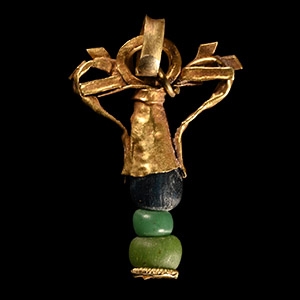
Greek Gold Amphora-Shaped Pendant
Circa 2nd century B.C.Estimate: £300 - 400 (+bp*)
Opening Bid: £150
Composed of a conical upper body with stylised dolphin-shaped handles and central suspension loops, the lower body of the vessel formed from three later coloured glass beads. 1.76 grams, 25 mm
Acquired 1980-2015. Ex Abelita family collection.
