
Loading, please wait...
LOT 0078
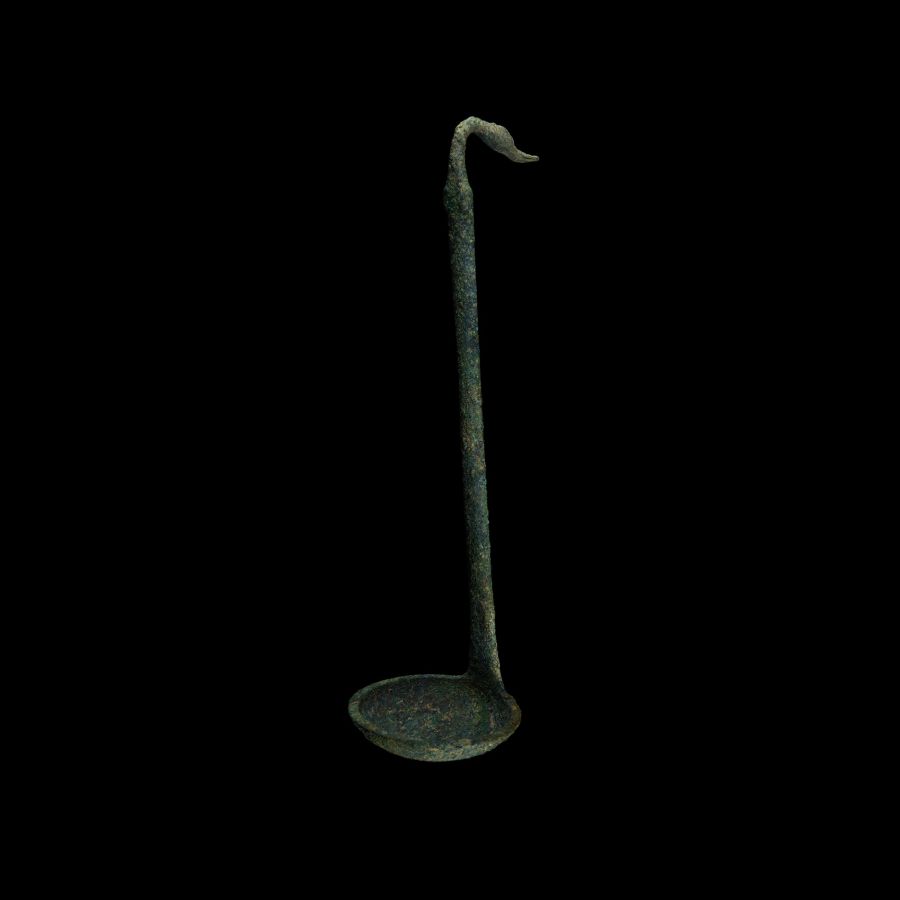
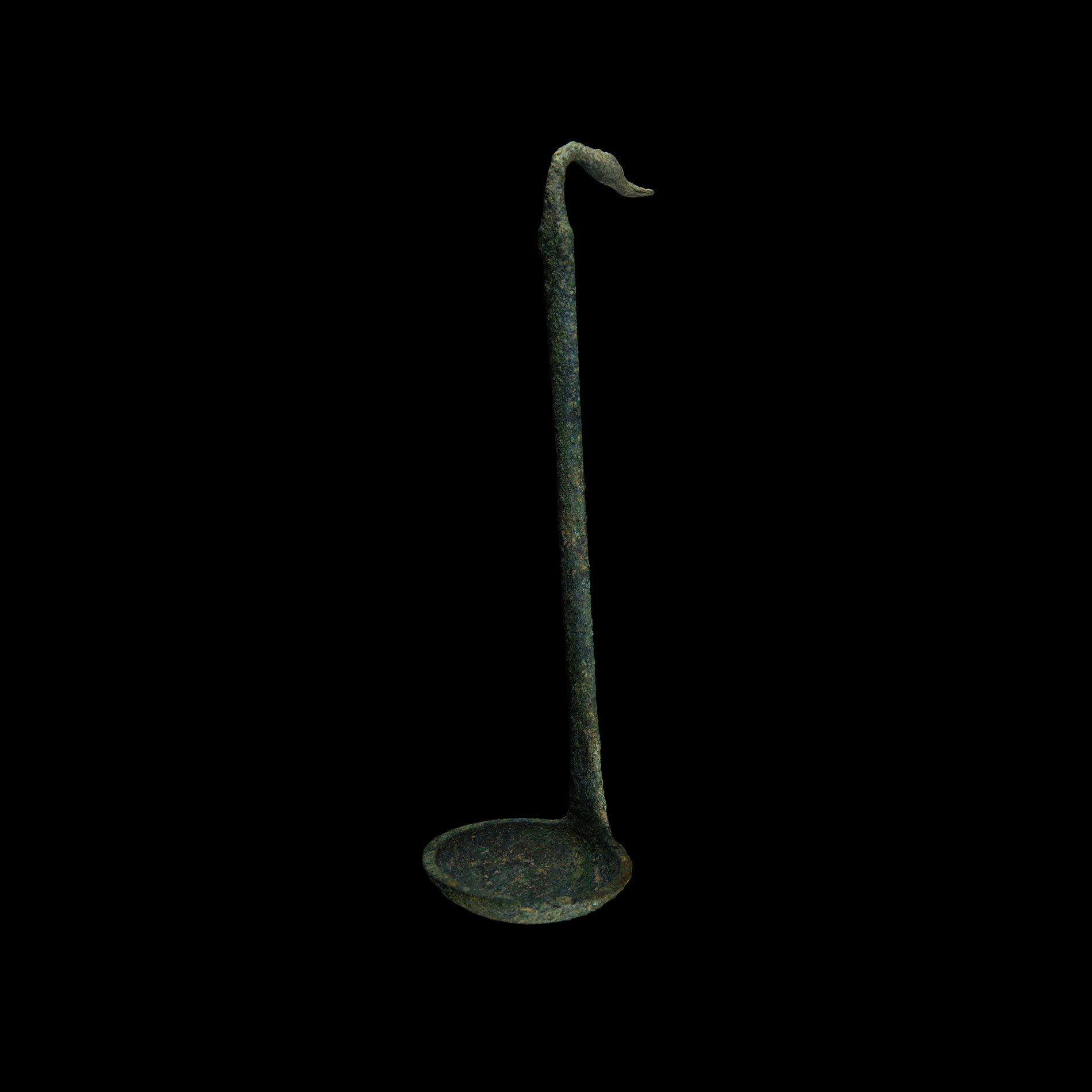
Etruscan Bronze Ladle with Duck's Head Handle
5TH-4TH CENTURY B.C.
93/4 in. (179 grams, 24.7 cm).
With shallow circular bowl and broad rim, stem with slightly domed front face, terminal formed as a duck's head.
ProvenanceAcquired in 1998.
Ex Swiss private collection.
Cf. The Metropolitan Museum, New York, accession number 21.88.130, for similar.
CONDITIONTimeLine Auctions follows a vetting process to ensure the authenticity and legality of all items, reinforcing our commitment to integrity and responsible trading. Each antiquity, antique, and coin lot undergoes thorough examination by a vetting committee of at least ten external specialists, professional trade association members, scientists, and archaeologists: Our Vetting Process
AUCTIONS:
TimeLine is a leading auction house specialising in antiquities, ancient art, collectables, natural history, coins, medals, and books. Our auctions offer museums, collectors, historians, and enthusiasts the opportunity to acquire unique and historically significant pieces.
LOT 0078
Etruscan Bronze Ladle with Duck's Head Handle
Estimate £1,000 - 1,400€1,160 - 1,620 (for guidance only)$1,350 - 1,890 (for guidance only)
-
Mycenaean Terracotta Stirrup Jar
14th-12th century B.C.Sold for (Inc. bp): £234
Carinated with slender cylindrical spout, stirrup-type handle and narrow foot; trace remains of painted geometric decoration. 106 grams, 79 mm high
Acquired in Europe before 1994. -
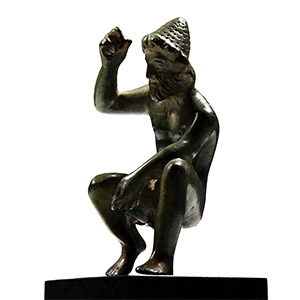
Greek Bronze Hephaistos Statuette
Circa 5th century B.C.Estimate: £20,000 - 30,000 (+bp*)
Opening Bid: £10,000
The elegant figure depicting the Greek god of fire and metalworking seated and nude except for the pilos on his head, lean body with naturalistic detailing, shown bearded and with curly hair emerging beneath the cap; he would have once held a pair of tongs in his left hand and a hammer in his right hand; accompanied by a custom-made display stand. 294 grams total, 13.5 cm high including stand
Fine condition, wonderful state of preservation, very rare.
with Elie Borowski, Basel. Subsequently in the collection of Denys Sutton (1917-1991), London, acquired from the above on 11 October 1963. Thence by descent. with Sotheby's, New York, 6 December 2012, lot 11. Accompanied by an academic report by Dr Raffaele D’Amato. This lot has been checked against the Interpol Database of stolen works of art and is accompanied by search certificate number no. 11827-207739.
According to legend, Hephaistos was thrown into the ocean by his mother Hera and raised by the sea nymph Thetis. Upon his return to Olympus, he took his revenge by imprisoning his mother and obtaining the hand of the most beautiful of the goddesses, Aphrodite. He became the blacksmith of the gods. Sculptural depictions of the god, known as Vulcan to the Romans, are very rare. Hephaistos was the armourer of the heroes, and certainly his greatest artwork was making Achilles' armour. -
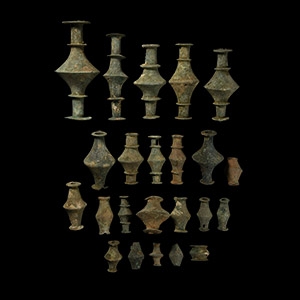
Greek Bronze Furniture Fitting Group
3rd-2nd century B.C.Sold for (Inc. bp): £156
Comprising over 20 hollow-formed bicones. 790 grams total, 21-96 mm
Acquired 1960s-1990s. Late Alison Barker collection, a retired London barrister.
