
Loading, please wait...
LOT 0546
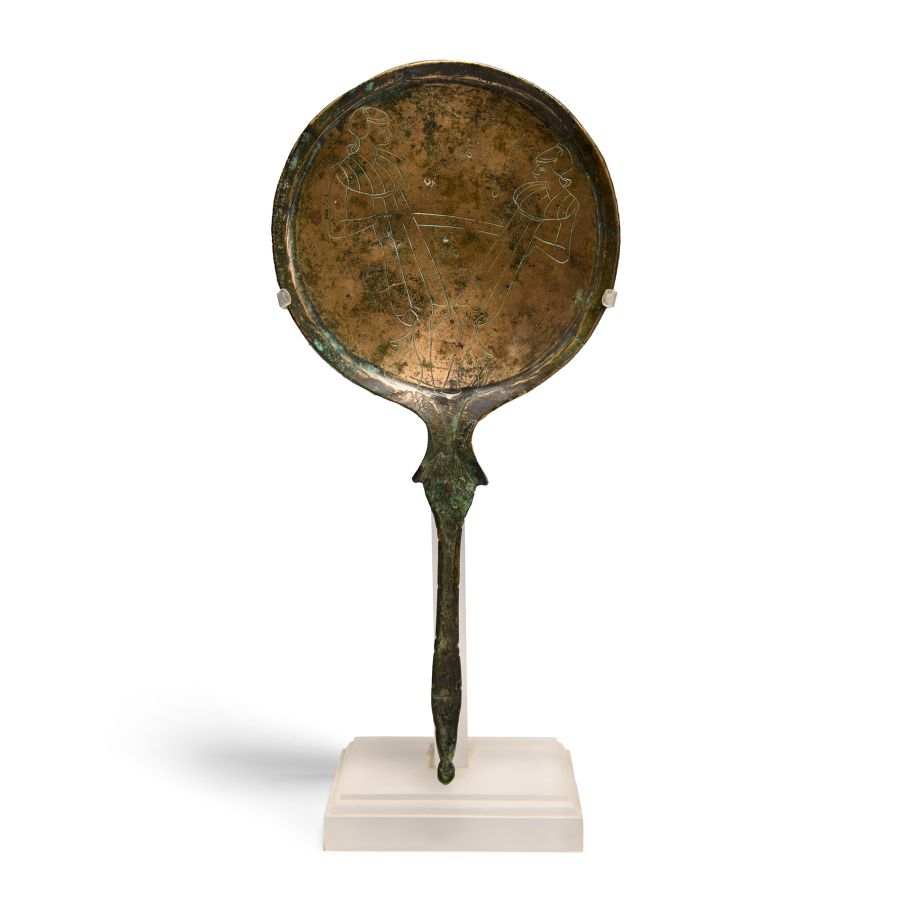
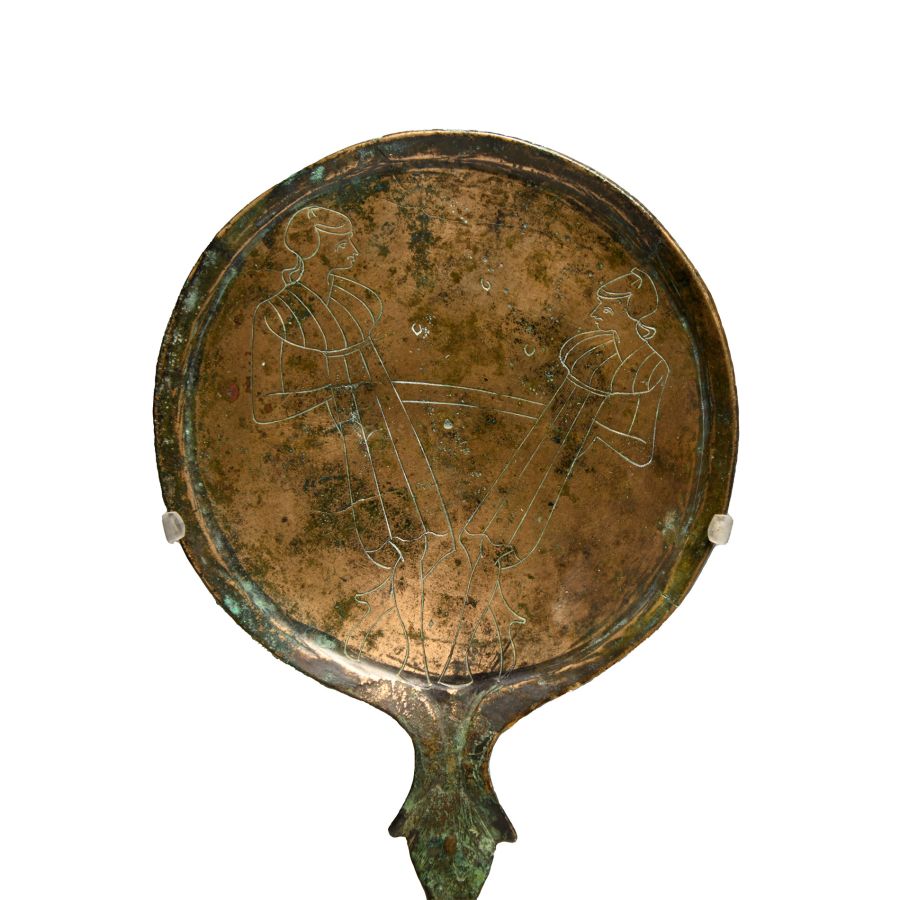
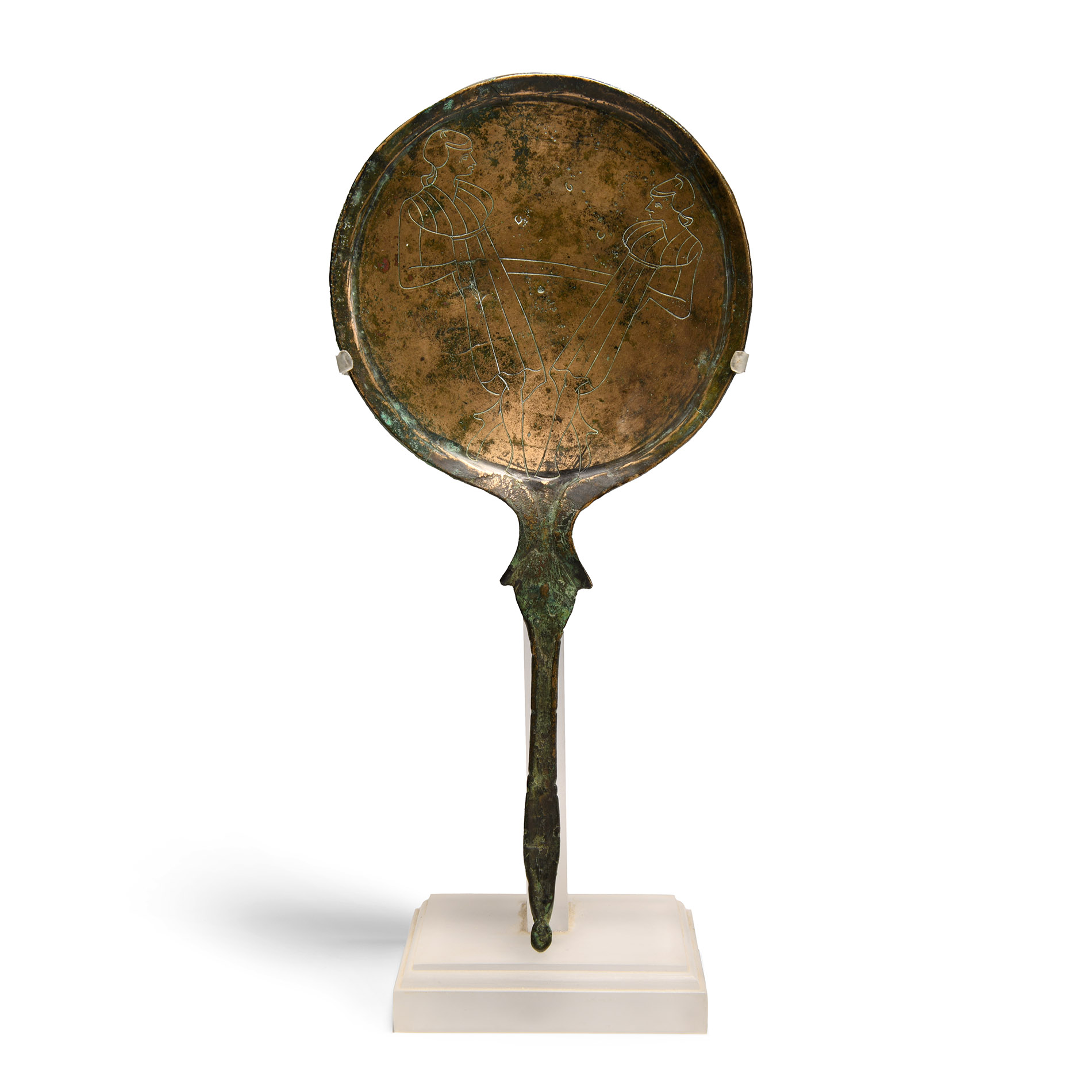
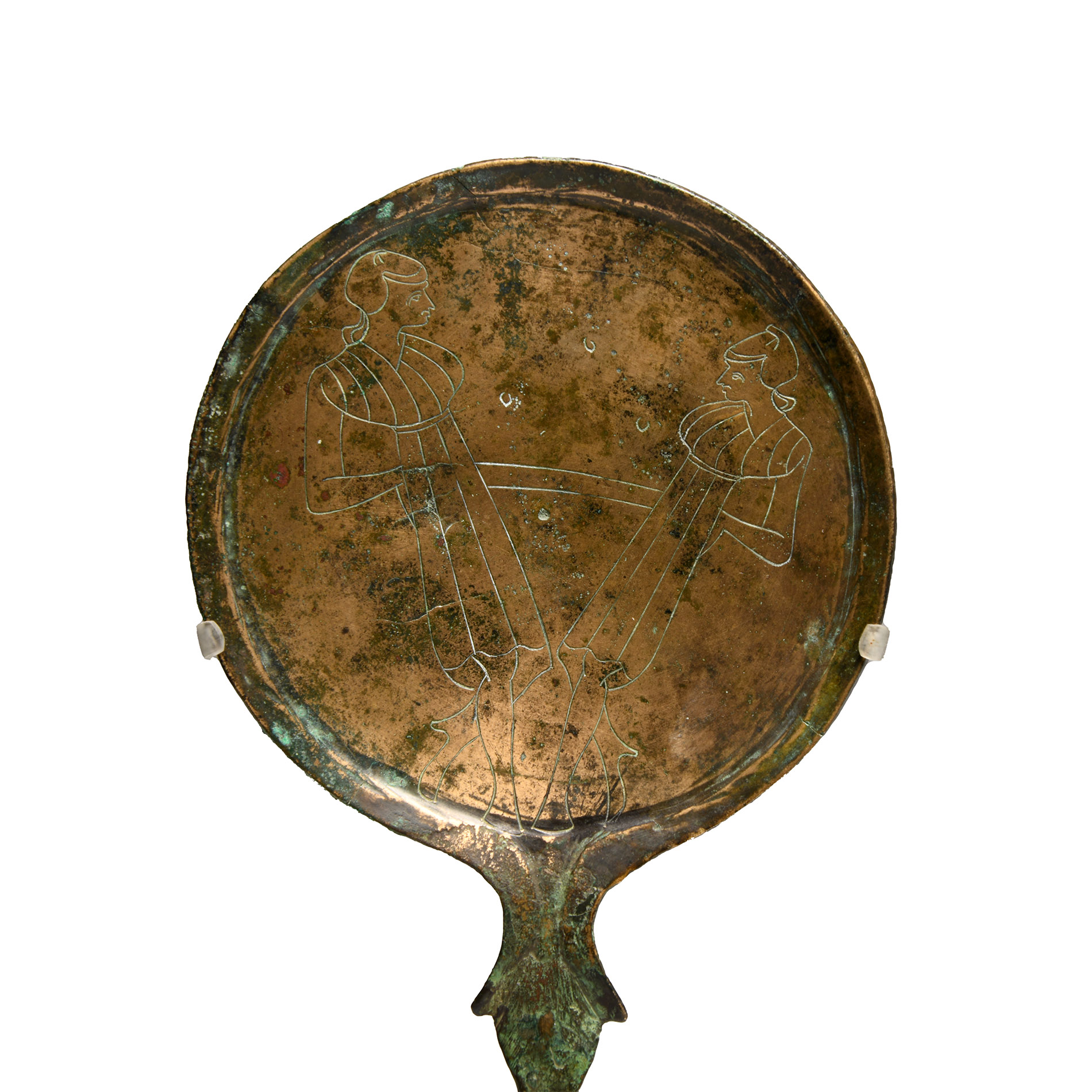
Etruscan Bronze Handled Mirror with Robed Female Dancers
CIRCA 5TH CENTURY B.C.
10 1/4 in. (300 grams, 26 cm including stand).
Disc mirror with handle comprising: slightly dished mirror with thick rim and low-relief image of two females dancing with a sash connecting them; punched crescents in the field; reverse with dentilled border; D-section handle with angled junction and knop finial; provided with a custom-made stand; later engraving.
ProvenanceAcquired Sotheby's, New York, U.S.A., early 1980s.
Private New York City collection.
Acquired from Arte Primitivo, New York City, U.S.A., 7 December 2016, lot 342.
Private collection of Professor Kenneth Graham, London, UK.
Accompanied by the original catalogue page and a print-out of the online listing.
TimeLine Auctions follows a vetting process to ensure the authenticity and legality of all items, reinforcing our commitment to integrity and responsible trading. Each antiquity, antique, and coin lot undergoes thorough examination by a vetting committee of at least ten external specialists, professional trade association members, scientists, and archaeologists: Our Vetting Process
AUCTIONS:
TimeLine is a leading auction house specialising in antiquities, ancient art, collectables, natural history, coins, medals, and books. Our auctions offer museums, collectors, historians, and enthusiasts the opportunity to acquire unique and historically significant pieces.
LOT 0546
Etruscan Bronze Handled Mirror with Robed Female Dancers
Sold for (Inc. bp): £2,080
-
Etruscan Bronze Handled Mirror with Robed Female Dancers
Circa 5th century B.C.Sold for (Inc. bp): £2,080
Disc mirror with handle comprising: slightly dished mirror with thick rim and low-relief image of two females dancing with a sash connecting them; punched crescents in the field; reverse with dentilled border; D-section handle with angled junction and knop finial; provided with a custom-made stand; later engraving. 300 grams, 26 cm including stand
Acquired Sotheby's, New York, U.S.A., early 1980s. Private New York City collection. Acquired from Arte Primitivo, New York City, U.S.A., 7 December 2016, lot 342. Private collection of Professor Kenneth Graham, London, UK. Accompanied by the original catalogue page and a print-out of the online listing. -
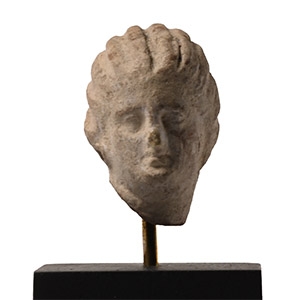
Greek Tanagra Terracotta Head of Aphrodite
Circa 4th-2nd century B.C.Sold for (Inc. bp): £195
With hair divided in vertical arrangements, bound on the back by a fillet, delicate rendering of mouth, nose and eyes; mounted on a custom-made display stand. 38 grams total, 64 mm including stand
Ex P. A., Hertfordshire, UK, specialist collection of Greek art, 1980-1990s.
It seems that half-draped women in sculpture, whatever the pose, are quite rare before the late Hellenistic period; however, they appear as early as the 4th century B.C., on a small scale and in terracotta. North Macedonian terracotta figurines of Aphrodite or mortal girls replicate sculptural trends of the 2nd century B.C. In particular, the the classical sculptural tradition was revived during the latter half of the second century B.C., as evidenced by the figurines. -
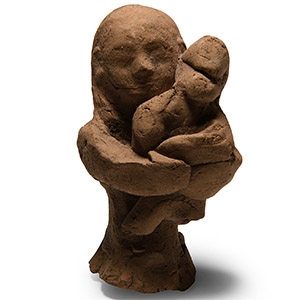
Cypriot Terracotta Female Figurine Holding a Child
650-600 B.C.Sold for (Inc. bp): £468
With flared base, press-moulded facial detail, irregular arms encircling a naïve figure of a swaddled baby; old inked collector's number '113' to reverse and label with same; later drilled hole to underside. 87 grams, 82 mm
Collection of Louis-Gabriel Bellon (1819-1899), Saint-Nicolas-lez-Arras and Rouen, thence by descent. with Millon & Associes Auctions, Paris, 6th December 2021, lot 41 [Part].
