
Loading, please wait...
_900x900.jpg "Etruscan Bronze Handle Pair with Heads of Medusa")
_200x200.jpg "Etruscan Bronze Handle Pair with Heads of Medusa")
.jpg "Etruscan Bronze Handle Pair with Heads of Medusa")
LOT 0061
Etruscan Bronze Handle Pair with Heads of Medusa
6TH-5TH CENTURY B.C.
4 1/4 in. (683 grams total including stand, handle: 10.9-11 cm wide).
Each formed as a D-shaped fluted bar with the finials formed as grotesque Medusa heads (gorgoneia) in Archaic Greek style with protruding tongue and a pair of bearded snakes framing her forehead; mounted on custom-made display stands. [2]
ProvenanceEx private collection of Athos Moretti, Bellinzona, Switzerland, in the 1960s.
with Christie's, London, 14 June 1978, lot 344.
with Sotheby's, New York, 29 May 1987, lot 154.
Accompanied by an academic report by Dr Raffaele D’Amato.
This lot has been checked against the Interpol Database of stolen works of art and is accompanied by search certificate number no.11773-204596.
Cf. Torelli, M., Gli Etruschi, Monza, 2000; Cristofani, M., I bronzi degli Etruschi (Etruscan bronzes, in Italian), Novara, 1985; Cateni, G. (ed.), Etruschi di Volterra, capolavori dei grandi musei Europei, Milano, 2007, fig.9, pp.154-155.
CONDITIONTimeLine Auctions follows a vetting process to ensure the authenticity and legality of all items, reinforcing our commitment to integrity and responsible trading. Each antiquity, antique, and coin lot undergoes thorough examination by a vetting committee of at least ten external specialists, professional trade association members, scientists, and archaeologists: Our Vetting Process
AUCTIONS:
TimeLine is a leading auction house specialising in antiquities, ancient art, collectables, natural history, coins, medals, and books. Our auctions offer museums, collectors, historians, and enthusiasts the opportunity to acquire unique and historically significant pieces.
LOT 0061
Etruscan Bronze Handle Pair with Heads of Medusa
Estimate £10,000 - 14,000€11,600 - 16,240 (for guidance only)$13,500 - 18,900 (for guidance only)
-
.jpg)
Etruscan Agate Talismanic Scarab
Late 4th-early 3rd century B.C.Estimate: £500 - 700 (+bp*)
Opening Bid: £222
Carved from banded orange agate and formed as a flattened scarab with a striated carapace, pierced for suspension. 3.53 grams, 18 mm
UK private collection, acquired on the English market in the 2000s.
The shape of an Etruscan scarab includes: (1) the scarab gem, where the engraving of the curved back of the stone more or less faithfully imitates the anatomical parts of the scarab beetle; (2) the scaraboid, which retains the overall shape of the scarab gem but with little or no engraving on the curved backside; and (3) the pseudo-scarab, which has an image carved in relief on its curved backside instead of a beetle. All three types have a flat, oval underside which carries an engraved miniature image (device) within a decorated border which is usually hatched. -
.jpg)
Etruscan Amber Head Pendant
Etruria, 5th century B.C.Sold for (Inc. bp): £2,210
Carved from translucent red-brown amber as a profile head with stylised Archaic features, large almond eye beneath a defined brow ridge, a softly smiling mouth, and carefully delineated hair arranged in striated bands sweeping back from the face; a drilled perforation at the crown indicates its original function as a suspended ornament; accompanied by a display stand. 23 grams, 50 mm (242 grams total, 81 mm including stand)
Sotheby's, London, 14-15 December 1981, no.206. American private collection; acquired at the above sale. This lot has been checked against the Interpol Database of stolen works of art and is accompanied by search certificate number no.13329-257968.
Amber was a prestigious imported material in Etruria, highly prized for its rarity, colour, and perceived apotropaic power. From the late 6th century B.C. onwards, figured amber pendants appear in elite tombs, particularly those of women, reflecting both personal identity and a protective role within funerary belief systems. The prominent, wide-open eye here may have served as a talismanic motif, thought to ward off malign forces and ensure the wearer’s vigilance and well-being in life and beyond the grave. This piece reflects the distinctive aesthetic of Etruscan amber carving, in which Mediterranean influences are reinterpreted with a locally expressive sculptural style. -
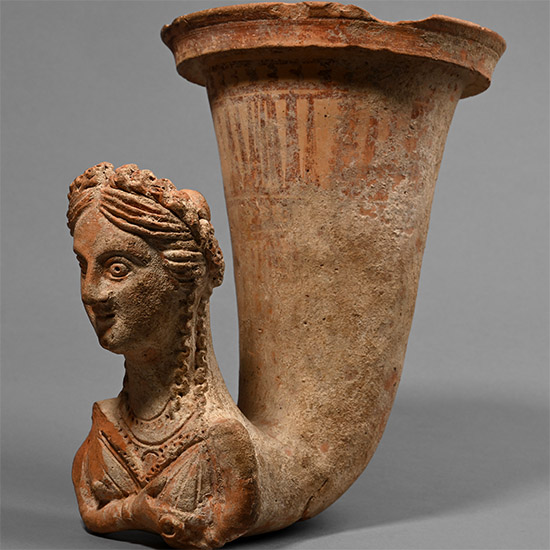
Greek Terracotta Rhyton of a Goddess
3rd-2nd century B.C.Sold for (Inc. bp): £5,720
With flanged and stepped rim, tapering curved body, figural finial of the goddess with diadem; bands of red and cream geometric detail to the rim and upper body, red wave patterns to the inner face; the goddess modelled with carefully dressed hair and floral diadem, ringlets cascading to her collar bone, alert facial expression with almond-shaped eyes and prominent nose, with C-shaped billetted collar and chiton, cupping her left breast in her right hand; mounted on a custom-made stand. 1.25 kg, 24 cm
Private collection, London, UK; formed 1970s-1980s. Accompanied by an academic report by Dr Raffaele D’Amato. This lot has been checked against the Interpol Database of stolen works of art and is accompanied by search certificate number no.13312-258233.
It is challenging to identify the divinity represented on our vessel: it can be associated with Ariadne, wife of the god Dionysus, but also with a Parthian goddess such as Anahita. She was a Zoroastrian goddess associated with water, fertility, and wisdom, widely venerated across the Parthian Empire and often invoked alongside Ahura Mazda in royal and religious inscriptions. Rhyta in her likeness, typically terminating in a zoomorphic or divine protome, were used as ceremonial drinking vessels, reflecting Anahita's close association with libation and purification rites.
