
Loading, please wait...
_900x900.jpg "Etruscan Bronze Handle Pair with Heads of Medusa")
_200x200.jpg "Etruscan Bronze Handle Pair with Heads of Medusa")
_900x900.jpg "Etruscan Bronze Handle Pair with Heads of Medusa")
_200x200.jpg "Etruscan Bronze Handle Pair with Heads of Medusa")
_900x900.jpg "Etruscan Bronze Handle Pair with Heads of Medusa")
_200x200.jpg "Etruscan Bronze Handle Pair with Heads of Medusa")
.jpg "Etruscan Bronze Handle Pair with Heads of Medusa")
.jpg "Etruscan Bronze Handle Pair with Heads of Medusa")
.jpg "Etruscan Bronze Handle Pair with Heads of Medusa")
LOT 0077
Etruscan Bronze Handle Pair with Heads of Medusa
6TH-5TH CENTURY B.C.
4 3/8 in. (695 grams total, 11 cm wide each).
Each formed as a D-shaped fluted bar with the finials formed as grotesque Medusa heads in Archaic Greek style with protruding tongue and a pair of bearded snakes framing her forehead; mounted on custom-made display stands. [2]
ProvenanceEx private collection of Athos Moretti, Bellinzona, Switzerland, in the 1960s.
with Christies, London, 14 June 1978, lot 344.
with Sotheby's, New York, 29 May 1987, lot 154.
Accompanied by an academic report by Dr Raffaele D’Amato.
This lot has been checked against the Interpol Database of stolen works of art and is accompanied by search certificate number no.11773-204596.
Cf. Torelli, M., Gli Etruschi, Monza, 2000; Cristofani, M., I bronzi degli Etruschi (Etruscan bronzes, in Italian), Novara, 1985; Cateni, G. (ed.), Etruschi di Volterra, capolavori dei grandi musei Europei, Milano, 2007, fig.9, pp.154-155.
FootnotesThe handles were possibly once part of a hydria or a stamnos. The workmanship of the nose and eyes of the Medusa recall the head of a gorgoneion from a chariot or cart fragment, today at the Metropolitan Museum (inventory no.29.131.3d1–d3).
CONDITIONTimeLine Auctions follows a vetting process to ensure the authenticity and legality of all items, reinforcing our commitment to integrity and responsible trading. Each antiquity, antique, and coin lot undergoes thorough examination by a vetting committee of at least ten external specialists, professional trade association members, scientists, and archaeologists: Our Vetting Process
AUCTIONS:
TimeLine is a leading auction house specialising in antiquities, ancient art, collectables, natural history, coins, medals, and books. Our auctions offer museums, collectors, historians, and enthusiasts the opportunity to acquire unique and historically significant pieces.
LOT 0077
Etruscan Bronze Handle Pair with Heads of Medusa
Estimate £8,000 - 10,000€9,280 - 11,600 (for guidance only)$10,800 - 13,500 (for guidance only)
-
.jpg)
Greek Archaic Laconian Black-Figure Kylix Fragment Group Attributed to the Rider Painter
550-540 B.C.Estimate: £4,000 - 6,000 (‡+bp*)
Opening Bid: £1,667
Comprising six fragments from a bowl once decorated with concentric circles around a central disc with expanding black rays, remains of palmette to the sides of the handle; the internal base with two facing warriors holding spears and a wreath, the older one depicted with a beard. 67 grams total, 34-89 mm
Acquired in Europe before 1990. Private collection, Europe. Accompanied by an academic report by Dr Raffaele D’Amato. This lot has been checked against the Interpol Database of stolen works of art and is accompanied by search certificate number no.11820-206481.
The Rider Painter was a Laconian vase painter active between 560 and 530 B.C. and is considered to be one of the five great vase painters of Sparta. He painted various forms predominantly kylikes but also lebetes, a form rare in this area. He mainly painted scenes from mythology, such as figures like Cadmos or Heracles, and tales such as the blinding of Polyphemus. In addition, he realised pictures from everyday life. The attribution of these fragments to his workmanship can be supported by the motifs painted on the exterior decoration of the vessel, and by the shape of the birds and figures. The illustrated scene is fitting within the warrior society of Spartan Laconia. -
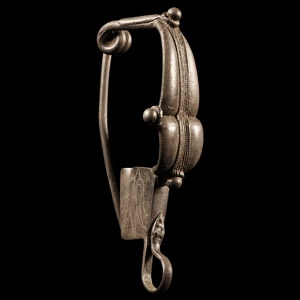
Greek Italic Silver Fibula
5th-4th century B.C.Estimate: £600 - 800 (‡+bp*)
Opening Bid: £300
Segmented body with central filigree wiring, collared knops to three corners, integral coiled pin and trapezoidal catchplate with lotus flower engraved to the outer face, loop with stylised serpentine head to base. 13.5 grams, 63 mm
Acquired in Europe before 1994. European collection. -
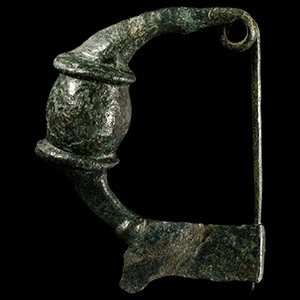
Greek Bronze Bow Brooch
8th-7th century B.C.Sold for (Inc. bp): £130
Deeply arched bow with a central barrel-shaped extension, integral pin and rectangular footplate. 46.8 grams, 60 mm
From the family collection of a Surrey gentleman since before 1960.
The distinctive form of this fibula seems to be an Italic variant of characteristic Geometric period examples from Thessaly that have been discovered in large numbers, for example in the sanctuary of Zeus Thaulios near Pharos. It belongs to the category of Greek catch plate brooches, although the rectangular footplate is substantially reduced than the Greek prototypes, and the two grooves on the bow are narrower than the continental Greek ones.
