
Loading, please wait...
_900x900.jpg "Etruscan Bronze Figure of Warring Mars")
_200x200.jpg "Etruscan Bronze Figure of Warring Mars")
_900x900.jpg "Etruscan Bronze Figure of Warring Mars")
_200x200.jpg "Etruscan Bronze Figure of Warring Mars")
.jpg "Etruscan Bronze Figure of Warring Mars")
.jpg "Etruscan Bronze Figure of Warring Mars")
LOT 0067
Etruscan Bronze Figure of Warring Mars
6TH CENTURY B.C.
6 3/8 in. (326 grams total, 16.2 cm high including stand).
The Etrusco-Italic warrior Laran (Roman Mars) modelled in the round, representing a young muscular hero with long torso and rounded shoulders, wearing a high-crested Illyrian helmet with grooved perimeter, a hole above each ear for attaching an ornament; mounted on a custom-made display stand.
ProvenanceEx collection Koutoulakis.
Ex Gorny & Mosch, Munich, 17 June 1999, lot 2051.
with Sotheby's, New York, 12 June 2001, lot 16.
Accompanied by an academic report by Dr Raffaele D'Amato.
This lot has been checked against the Interpol Database of stolen works of art and is accompanied by search certificate number no.11803-206793.
Cf. De Ridder, A., Bronzes Antiques du Louvre, Paris, I-II, 1913-1915, nos.277, 281; Giglioli, G.Q., Arte Etrusca, Milan, 1935, pl.CCXXI; Boucher, S., Inventaire des Collections Publiques Françaises - 17 Vienne: Bronzes Antiques, Paris, 1971, pp.38-39, no.5bis, for similar; Boucher, S., Recherches sur les bronzes figures de Gaule pré-romaine et romaine, Rome, 1976, no.14.
FootnotesThe statuette assumes the position of the 'warring Mars', which characterises the numerous Etruscan and Italic statues of the god produced as votive offerings to the temples or for private lararia. The god is depicted as taking part on a military march with his left leg advancing, his raised right would have held a spear and the left hand a shield.
CONDITIONTimeLine Auctions follows a vetting process to ensure the authenticity and legality of all items, reinforcing our commitment to integrity and responsible trading. Each antiquity, antique, and coin lot undergoes thorough examination by a vetting committee of at least ten external specialists, professional trade association members, scientists, and archaeologists: Our Vetting Process
AUCTIONS:
TimeLine is a leading auction house specialising in antiquities, ancient art, collectables, natural history, coins, medals, and books. Our auctions offer museums, collectors, historians, and enthusiasts the opportunity to acquire unique and historically significant pieces.
LOT 0067
Etruscan Bronze Figure of Warring Mars
Estimate £8,000 - 10,000€9,280 - 11,600 (for guidance only)$10,800 - 13,500 (for guidance only)
-
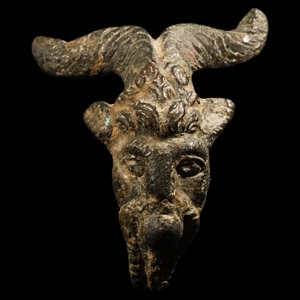
Greek Bronze Handle with Human-Headed Ram
4th-3rd century B.C.Sold for (Inc. bp): £234
Featuring stylised horn and tufted coat detailing, the ram's face with humanesque features; curved profile. 22.2 grams, 39 mm
Collected from 1969-1999. From the collection of the late Mr S.M., London, UK. -
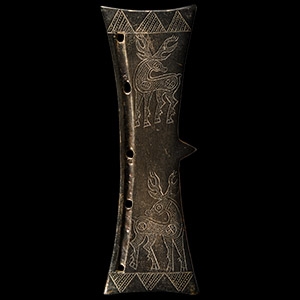
Scythian Bronze Belt Fitting
3rd-2nd century B.C.Sold for (Inc. bp): £416
Composed of a bow-tie-shaped body with a central triangular plaque to one edge forming a hook to reverse; series of piercings to the opposite edge; two regardant stags and bars of hatched triangles engraved to one face. 138 grams, 13.5 cm
Ex old English collection. London art market, 1980s. -
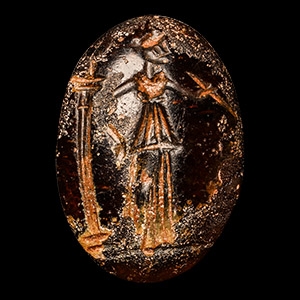
Hellenistic Glass Gem with Goddess
3rd-2nd century B.C.Estimate: £600 - 800 (+bp*)
Opening Bid: £333
Engraved with a goddess (Aphrodite?), facing right, peplos around her hips, her left elbow resting on a column and her left hand behind her body; the right hand outstretched and holding a sceptre; a snake(?) before. 2.52 grams, 22 mm
Acquired in the late 1980s-early 1990s. Important North West London collection.
In the famous Greek myth of the Gorgon, Aphrodite, jealous of their beauty, placed a curse on Medusa and her sisters, transforming their hair into snakes and making their gaze turn anyone into stone.
