
Loading, please wait...
LOT 0049
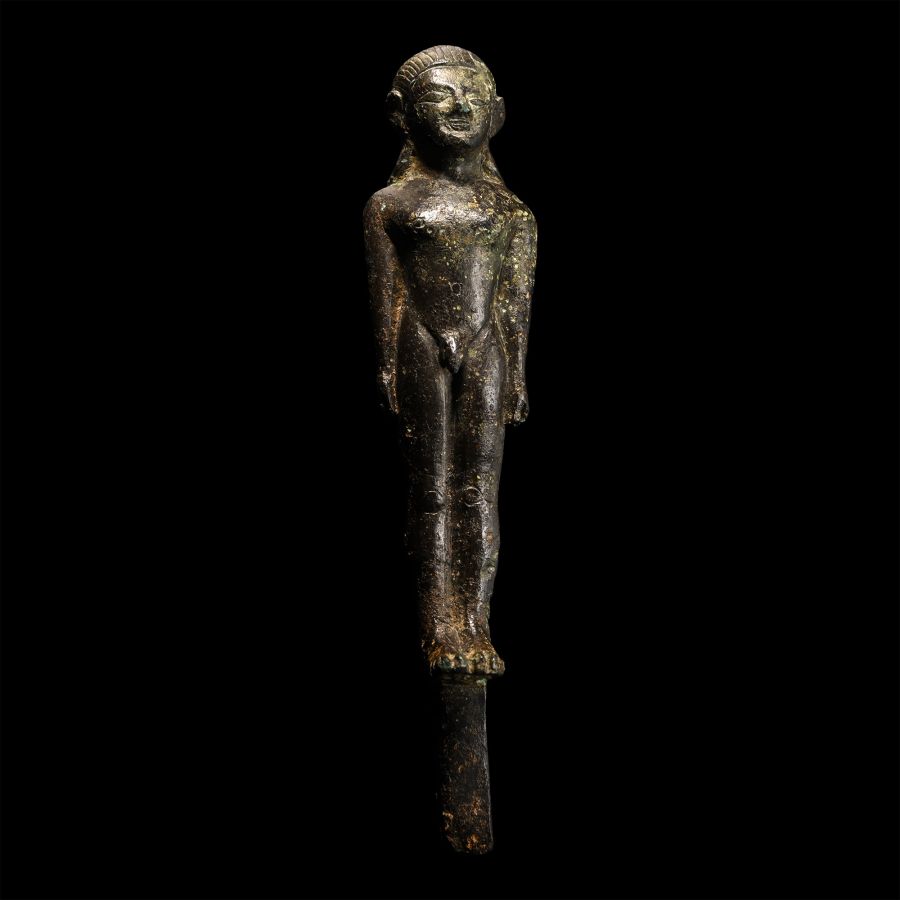
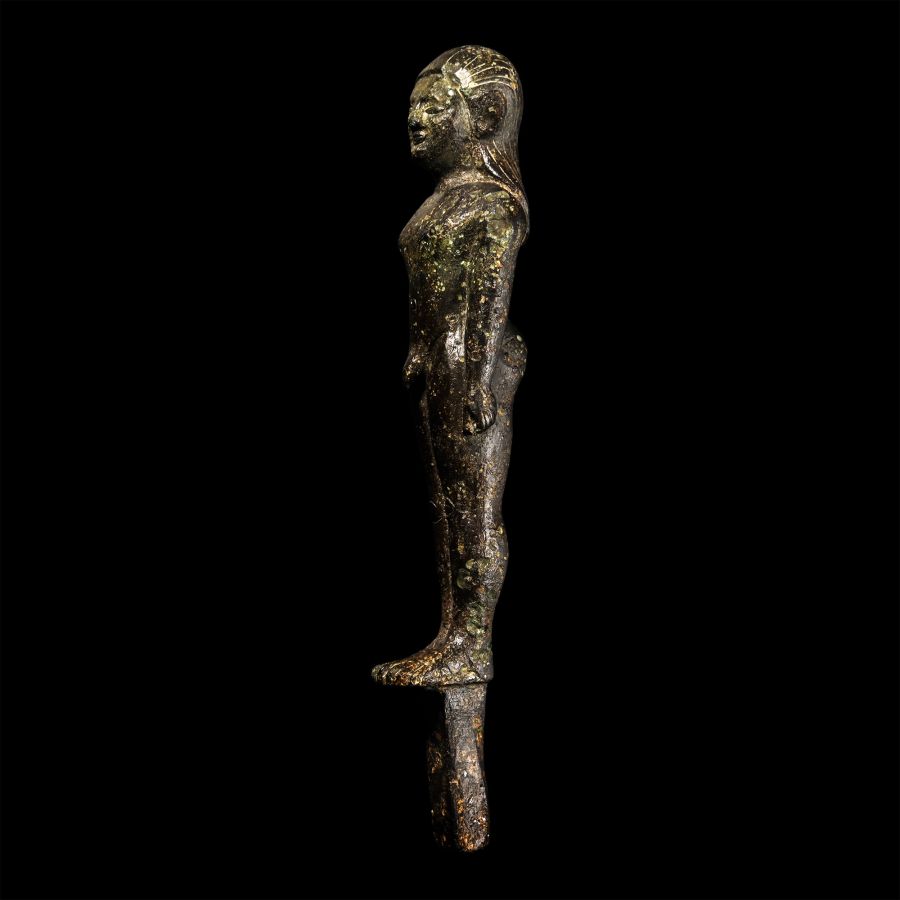
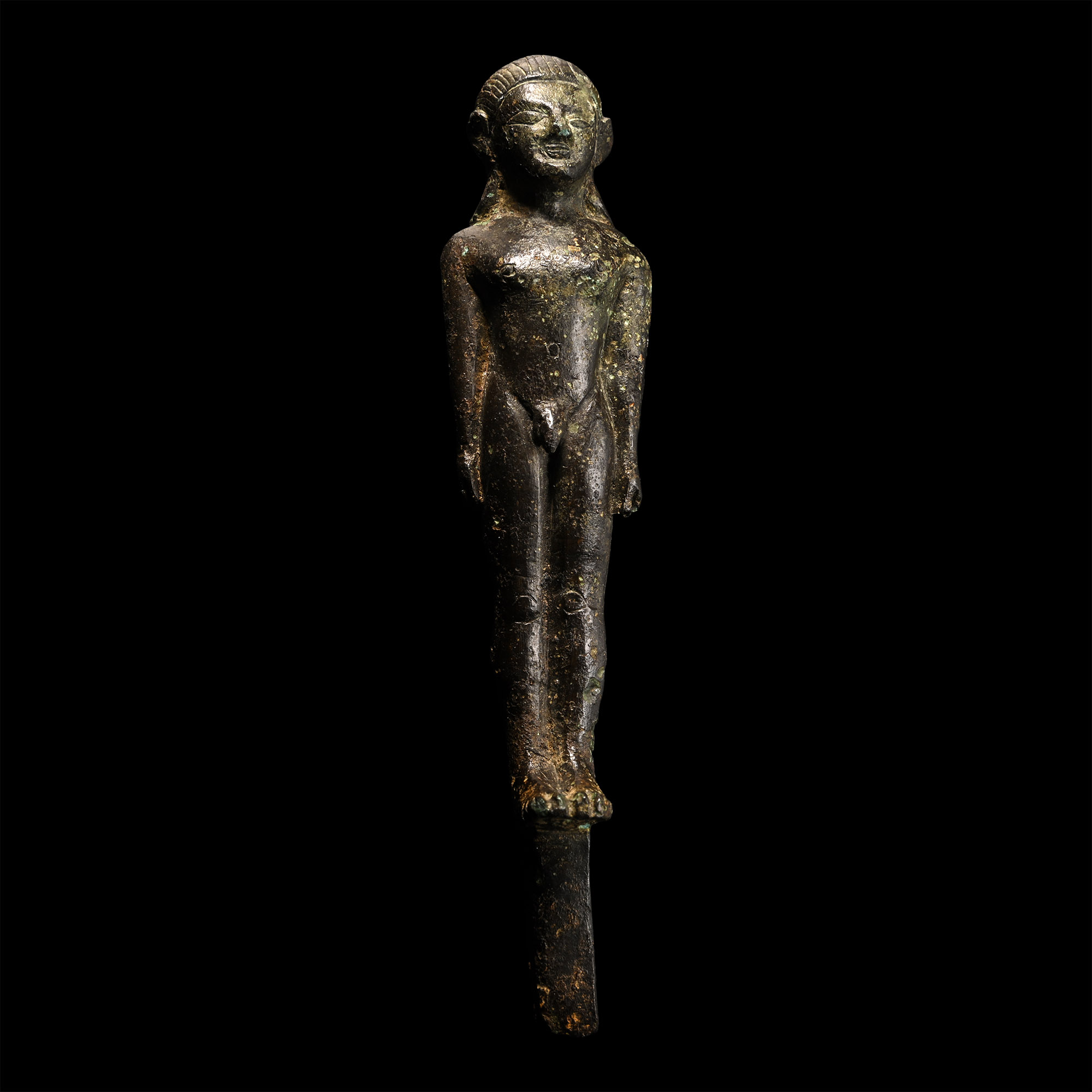
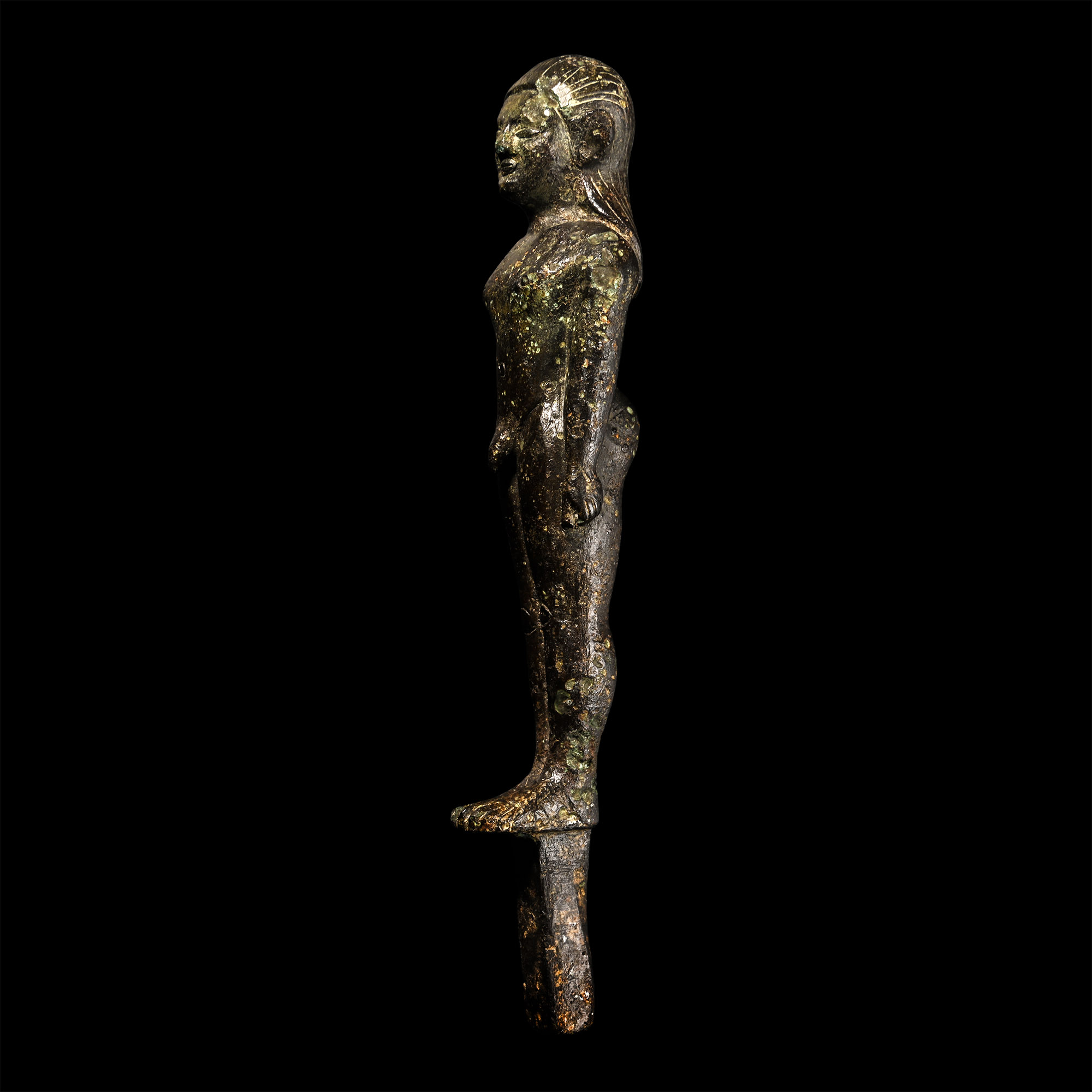
Etruscan Bronze Figure of a Kouros
LATE 6TH CENTURY B.C.
4 3/8 in. (118 grams, 11.2 cm).
Depicting a youthful nude kouros standing frontally, with a long, slender body, broad shoulders, a narrow waist, and arms hanging close to the sides; the head, slightly oversized, characterised by an oval face, large almond-shaped eyes, an Archaic smile, and finely modelled ears, the hair arranged in beaded locks framing the forehead and falling onto the shoulders, reflecting the influence of contemporary Greek Archaic sculpture; standing on an integral rectangular base provided with a long tang for attachment.
ProvenanceAcquired on the European art market between 1960s and 1980s.
English private collection, property of a gentleman.
Bertolami Fine Art, London, Auction 54, 9 November 2018, no.88.
This lot has been checked against the Interpol Database of stolen works of art and is accompanied by search certificate number no.13320-258214.
See for closely comparable examples, including the kouroi from Talamone (circa 540–530 B.C.) and Fonte Veneziana (circa 530–510 B.C.), both preserved in the National Archaeological Museum of Florence; Salskov Roberts, H., Catalogue of the Sardinian, Etruscan and Italic Bronze Statuettes in the Danish National Museum, 2021, cat. 4, inv. no. 4807, for the type.
FootnotesThe elegant proportions and linear modelling place the statuette within the widespread production of Etruscan votive bronzes of the Late Archaic period, probably intended as a sanctuary dedication.
CONDITIONTimeLine Auctions follows a vetting process to ensure the authenticity and legality of all items, reinforcing our commitment to integrity and responsible trading. Each antiquity, antique, and coin lot undergoes thorough examination by a vetting committee of at least ten external specialists, professional trade association members, scientists, and archaeologists: Our Vetting Process
AUCTIONS:
TimeLine is a leading auction house specialising in antiquities, ancient art, collectables, natural history, coins, medals, and books. Our auctions offer museums, collectors, historians, and enthusiasts the opportunity to acquire unique and historically significant pieces.
LOT 0049
Etruscan Bronze Figure of a Kouros
Estimate £2,000 - 3,000€2,320 - 3,480 (for guidance only)$2,700 - 4,050 (for guidance only)
-
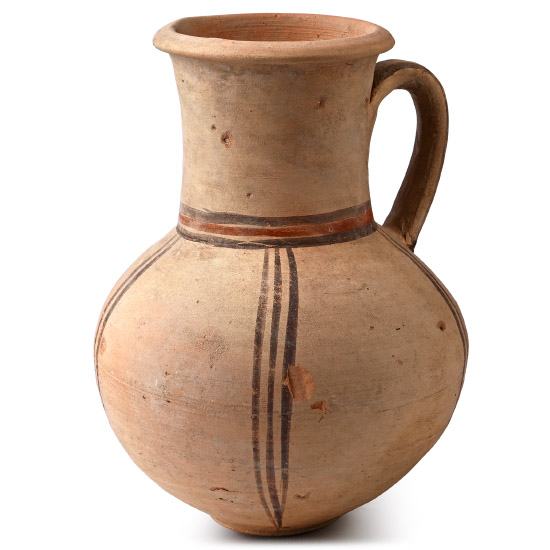
Large Eastern Mediterranean Painted Terracotta Pitcher
1st millennium B.C.Sold for (Inc. bp): £1,105
With a wide mouth, everted rim, and elongated, cylindrical neck, bulbous body with painted polychrome bands, a strap handle with painted linear decoration. 1.03 kg, 22.5 cm
From a 1980s UK collection. Acquired on the UK art market in the early 2000s. Property of a London, UK, antiquarian. -
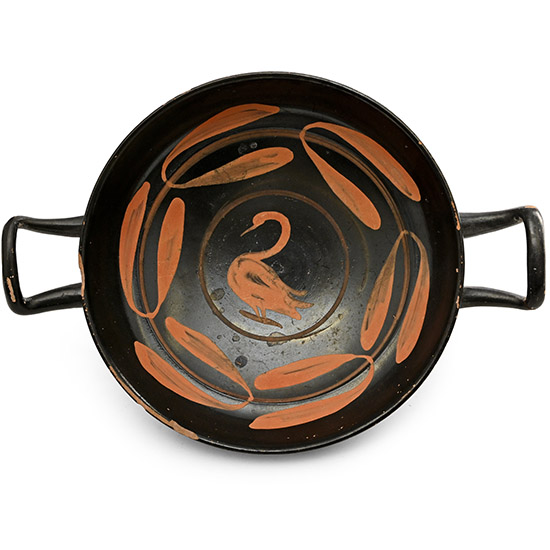
Greek Black-Glazed Twin-Handled Stemless Kylix with Swan
Apulia, 4th century B.C.Sold for (Inc. bp): £4,160
Shallow with arched loop handles below the rim, low stepped foot; tondo with painted wreath of laurel leaves surrounding a standing swan in profile; to the outer face, two horizontal sprigs of laurel leaves; possibly by the Swan painter. 206 grams, 20.6 cm
Bonhams, Knightsbridge, London, 20 October 1994, no.43. Private collection, Suffolk. Accompanied by copies of the relevant Bonhams cataloguing pages. -
.jpg)
Greek Carnelian Bead with Gold End Caps
Hellenistic, 1st century B.C.-1st century A.D.Sold for (Inc. bp): £780
Columnar bead with sheet-gold cap to each end, each with beaded circlets and applied granule clusters, domed end with loop; possibly assembled. 17.44 grams, 60 mm
Acquired in the mid 1980s-1990s. Private collection, Switzerland, thence by descent. Private collection, since the late 1990s.
The very elaborate versions of earrings with large domes and pendants composed of clusters of hollow spheres and granulation are most typically Romano-Syrian, but they begin to be produced in the Late Hellenistic Age. They were diffused in the Levant, Egypt and on the frontier area between the Roman and the Arsacid Empire.
