
Loading, please wait...
LOT 0537
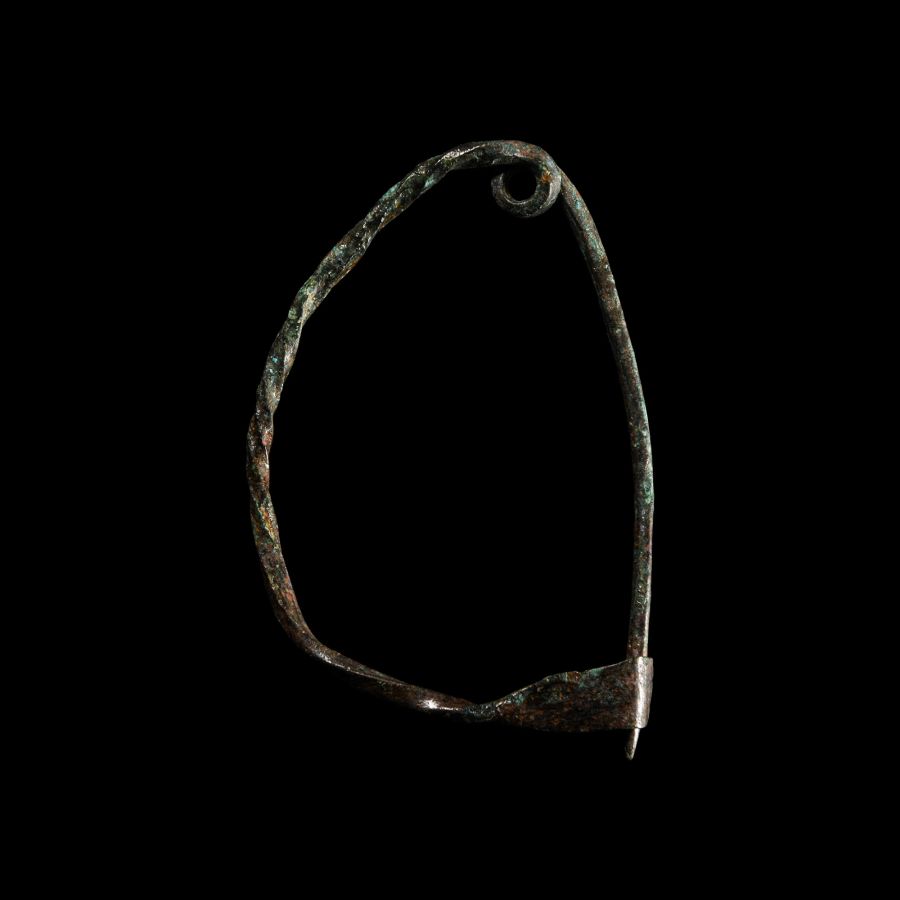
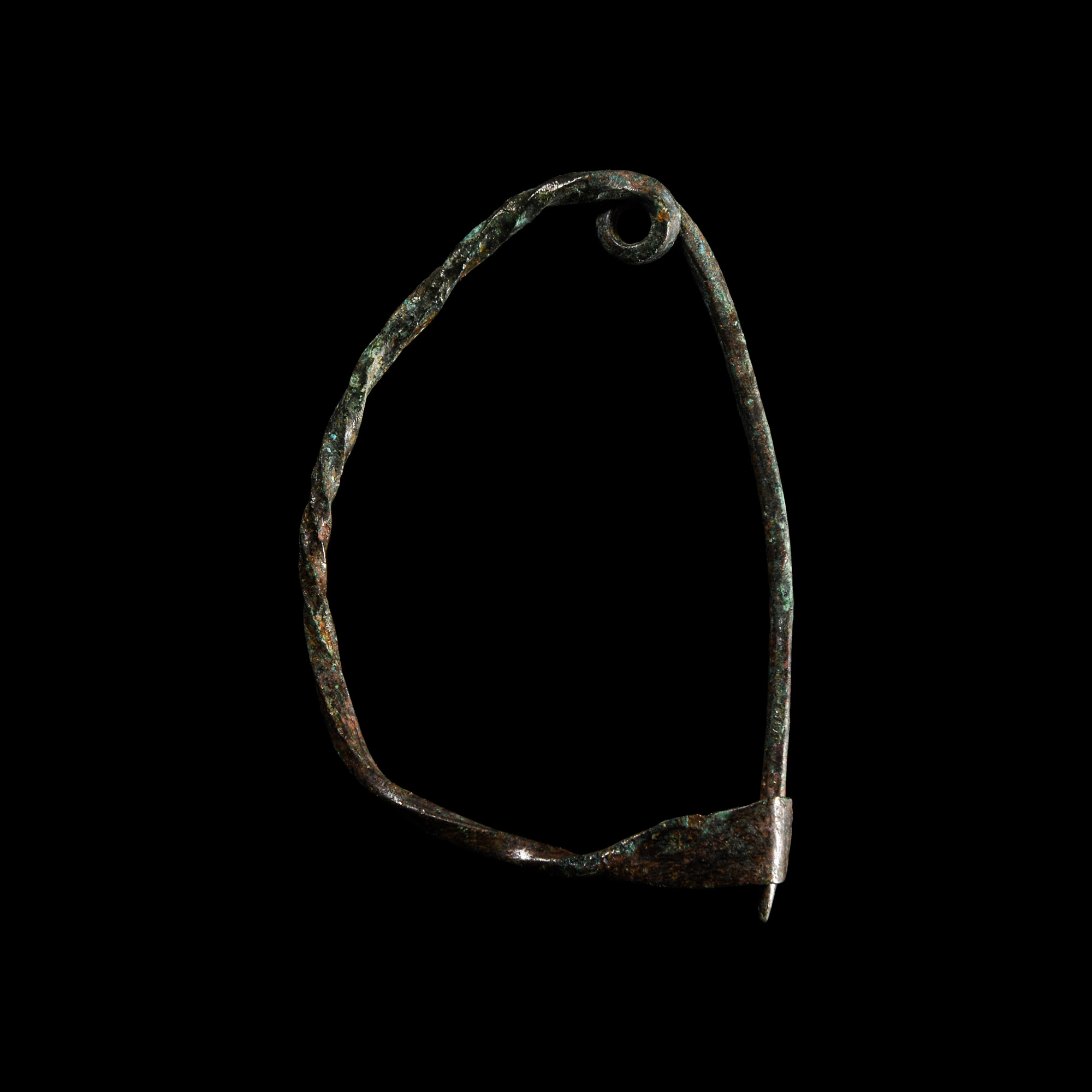
Etruscan Bronze Bow Brooch
9TH CENTURY B.C.
2 3/4 in. (7.69 grams, 70 mm).
With twisted bow and integral pin. [No Reserve]
ProvenanceFrom the family collection of a Surrey gentleman since before 1960.
LiteratureCf. Torelli, M., Gli Etruschi, Monza, 2000, cat. 7, for similar.
FootnotesThese fibulae, often covered with glass paste discs and beads, are typical of female burials. They were part of the standard Villanovan equipment of the time.
CONDITIONTimeLine Auctions follows a vetting process to ensure the authenticity and legality of all items, reinforcing our commitment to integrity and responsible trading. Each antiquity, antique, and coin lot undergoes thorough examination by a vetting committee of at least ten external specialists, professional trade association members, scientists, and archaeologists: Our Vetting Process
AUCTIONS:
TimeLine is a leading auction house specialising in antiquities, ancient art, collectables, natural history, coins, medals, and books. Our auctions offer museums, collectors, historians, and enthusiasts the opportunity to acquire unique and historically significant pieces.
-
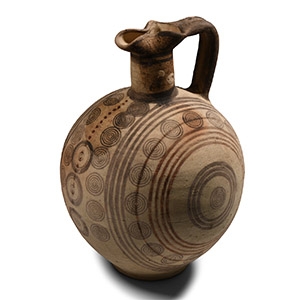
Cypriot Trefoil Jug with Concentric Decorations
700-600 B.C.Sold for (Inc. bp): £3,640
With low basal ring, globular body, cylindrical neck with a pinched trefoil spout and thick ribbed strap-handle from shoulder to rim; decorated on each broad face with concentric rings in black and red paint with vertical bands of smaller concentric rings to the shoulder. 1.7 kg, 32.5 cm high
From the collection of Herbert Henry Marks (1896-1972), acquired 1930s-1940s. Subsequently by descent to his son, Stephen Powys Marks (1932-2020), Bath. This lot has been checked against the Interpol Database of stolen works of art and is accompanied by search certificate number no.11848-207711. -
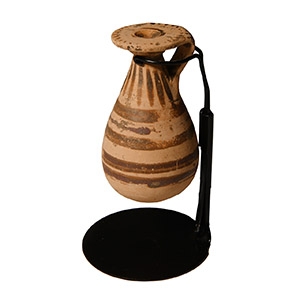
Greek Corinthian Ceramic Alabastron with Geometric Design
Circa 6th century B.C.Sold for (Inc. bp): £221
The piriform bottle with broad everted rim and strap handle, polychrome painted dashes and concentric bands to the upper body and rim; accompanied by a custom-made display stand. 36 grams total, 77 mm high including stand
Acquired 1980s-1990s. From the H.N. collection, Milton Keynes, Bedfordshire, UK.
The alabastron takes its name from the material (alabaster) from which it was originally produced by the people who inhabited Mediterranean Africa from where it spread in the classical world. From an archaeological point of view, our specimen belongs to the first type of alabastrons, a conventional form of Corinthian origin, widespread throughout Greece from the second half of the 7th century BC. to the mid-6th century B.C., characterised by an elongated body with a maximum diameter towards the base, and continuous profile. It seems to be an Etrusco-Corinthian variant. -
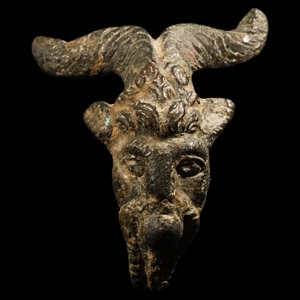
Greek Bronze Handle with Human-Headed Ram
4th-3rd century B.C.Sold for (Inc. bp): £234
Featuring stylised horn and tufted coat detailing, the ram's face with humanesque features; curved profile. 22.2 grams, 39 mm
Collected from 1969-1999. From the collection of the late Mr S.M., London, UK.
