
Loading, please wait...
LOT 0522
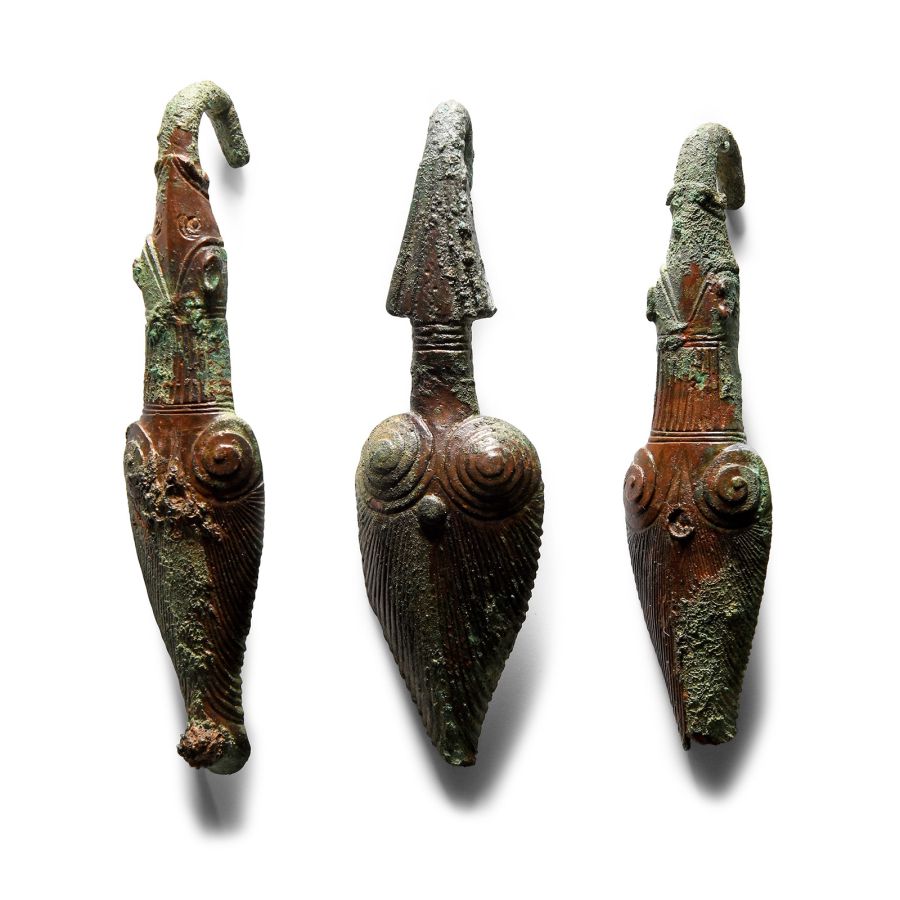
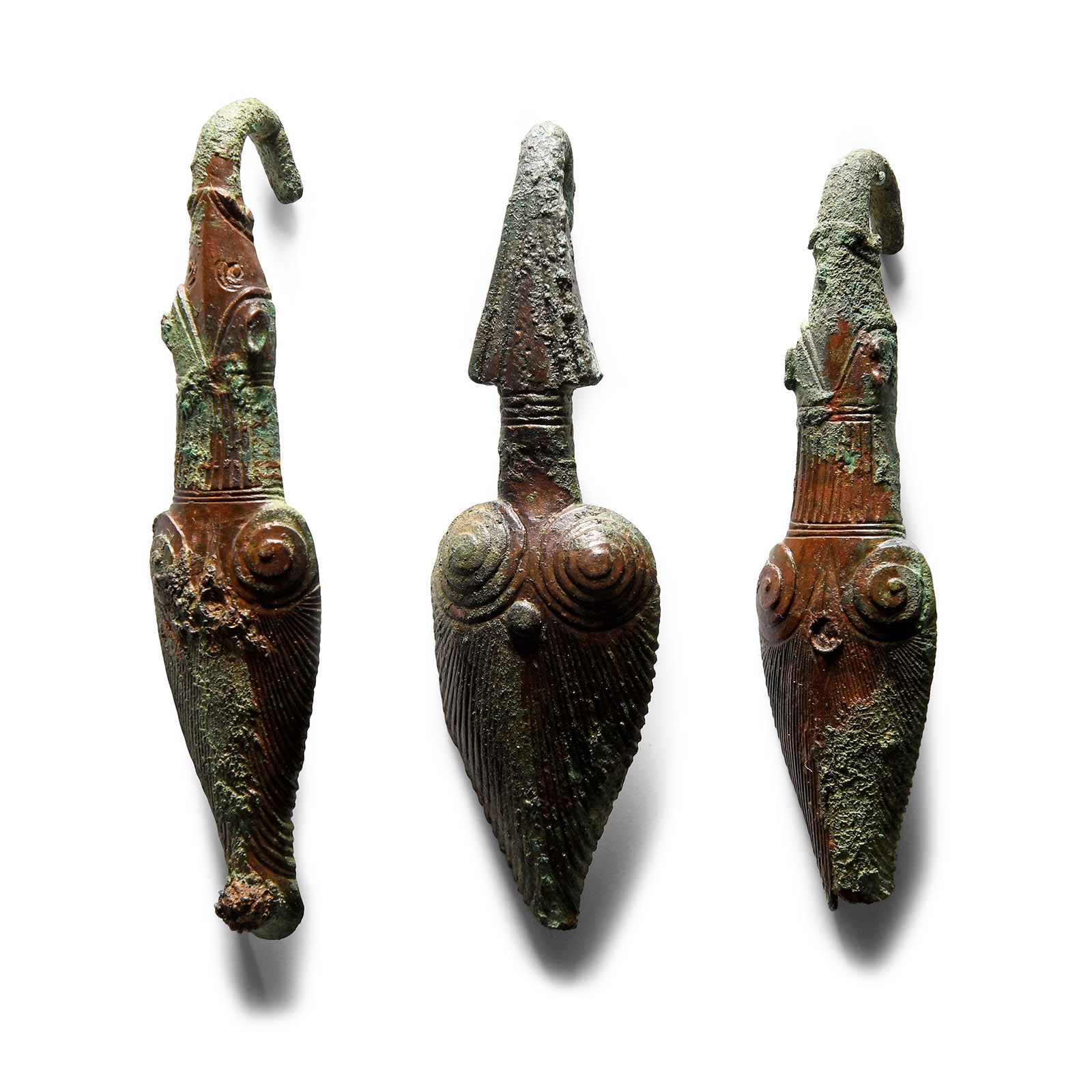
Etruscan Bronze Armoured Belt Hook Collection
6TH CENTURY B.C.
3 1/8 - 3 1/2 in. (59 grams total, 81-88 mm).
Three clasp appliqués from a girdle, each comprising a slightly domed palmette-shaped body with fixing lug to the underside, spirals flanking a narrow neck and triangular hooked finial, two with zoomorphic detailing and one with convergent lines. [3]
ProvenanceOne with Bonham's, London, Knightsbridge, UK, 22 September 1998, lot 405.
Two acquired early 1990s.
Ex private American collection; thence by descent.
Private collection since 1998.
Accompanied by a copy of the relevant Bonhams catalogue pages.
This lot has been checked against the Interpol Database of stolen works of art and is accompanied by search certificate no.11610-198948.
Cf. Mitten, D.G., Master Bronzes from the Classical World, Massachusetts, 1967, item 202.
CONDITIONTimeLine Auctions follows a vetting process to ensure the authenticity and legality of all items, reinforcing our commitment to integrity and responsible trading. Each antiquity, antique, and coin lot undergoes thorough examination by a vetting committee of at least ten external specialists, professional trade association members, scientists, and archaeologists: Our Vetting Process
AUCTIONS:
TimeLine is a leading auction house specialising in antiquities, ancient art, collectables, natural history, coins, medals, and books. Our auctions offer museums, collectors, historians, and enthusiasts the opportunity to acquire unique and historically significant pieces.
LOT 0522
Etruscan Bronze Armoured Belt Hook Collection
Estimate £1,500 - 2,000€1,740 - 2,320 (for guidance only)$2,030 - 2,700 (for guidance only)
-
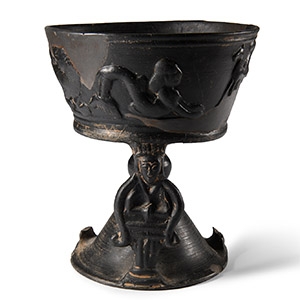
Etruscan Bucchero Chalice with Mythical Beasts, Animals, and Caryatid
Circa 7th-6th century B.C.Sold for (Inc. bp): £650
Blackware vessel comprising a broad bowl with frieze of animals (boar, lion, sphinx, horse); trumpet-shaped base with supporting caryatid; some restoration. 502 grams, 17 cm high
From the Steel family collection, 1950s-late 1990s. -
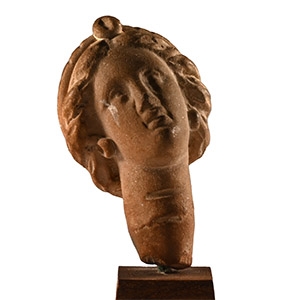
Greek Terracotta Head of a Goddess
4th-3rd century B.C.Sold for (Inc. bp): £390
With a delicately modelled face and full lips, hooped earrings visible from beneath her hair; the hair with central parting and pulled to a chignon at the nape of the neck; wearing a diadem with central embellishment; mounted on a custom-made display stand. 41.3 grams total, 75 mm high including stand
Ex French Sorbonne archaeology professor (deceased); 1960s -2000s.
These figurines were most probably manufactured in Hellenistic cities by craftsmen who used either light yellow or dark brown clay. After the firing, the surface of the clay became reddish, while the core became grey-brown. The majority of the figurines were made from untreated clay with many impurities, such as coarse grain. Due to the quality of the clay the surface of the figurines was often rugged, despite the retouch, but were painted with vivid colours. -
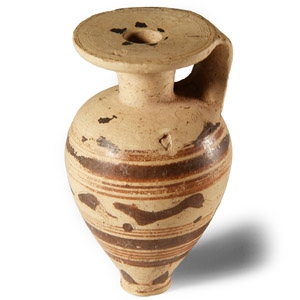
Etruscan Buffware Aryballos
8th-7th century B.C.Sold for (Inc. bp): £169
With a piriform body and narrow foot, deep shoulder and flange rim, strap handle to the rear; the rim and shoulder with radiating strokes, concentric bands to the body and foot, frieze of stylised running hounds below the shoulder. 34 grams, 63 mm high
Acquired 1980-1990s. From the private collection of H.N., Milton Keynes, Bedfordshire, UK.
Proto-Corinthian aryballoi of the same type, probably of Etruscan manufacture, in buff-ware decorated with dark metallic, purple-maroon and red-brown bands have been found in the Veii excavations. John Boardman noted that the shape in Corinth barely survives the 7th century, but these small pots are still found in Etruscan graves of the first half, or at least the first quarter, of the 6th century B.C.
