
Loading, please wait...
LOT 0374
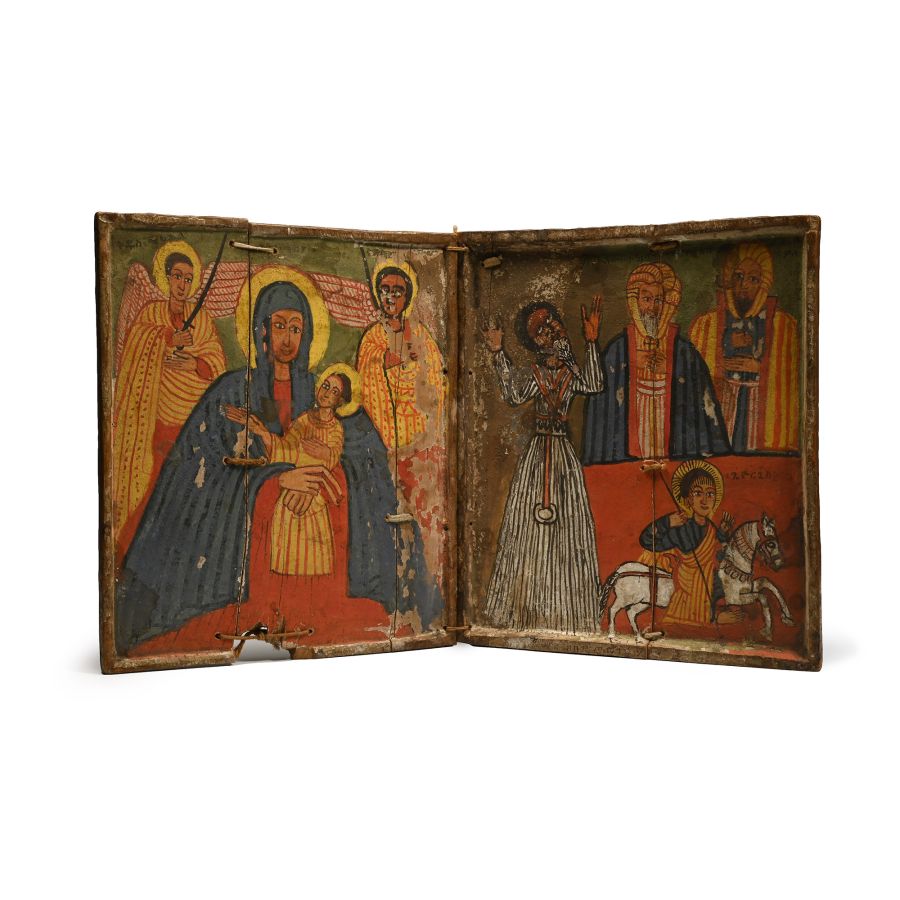
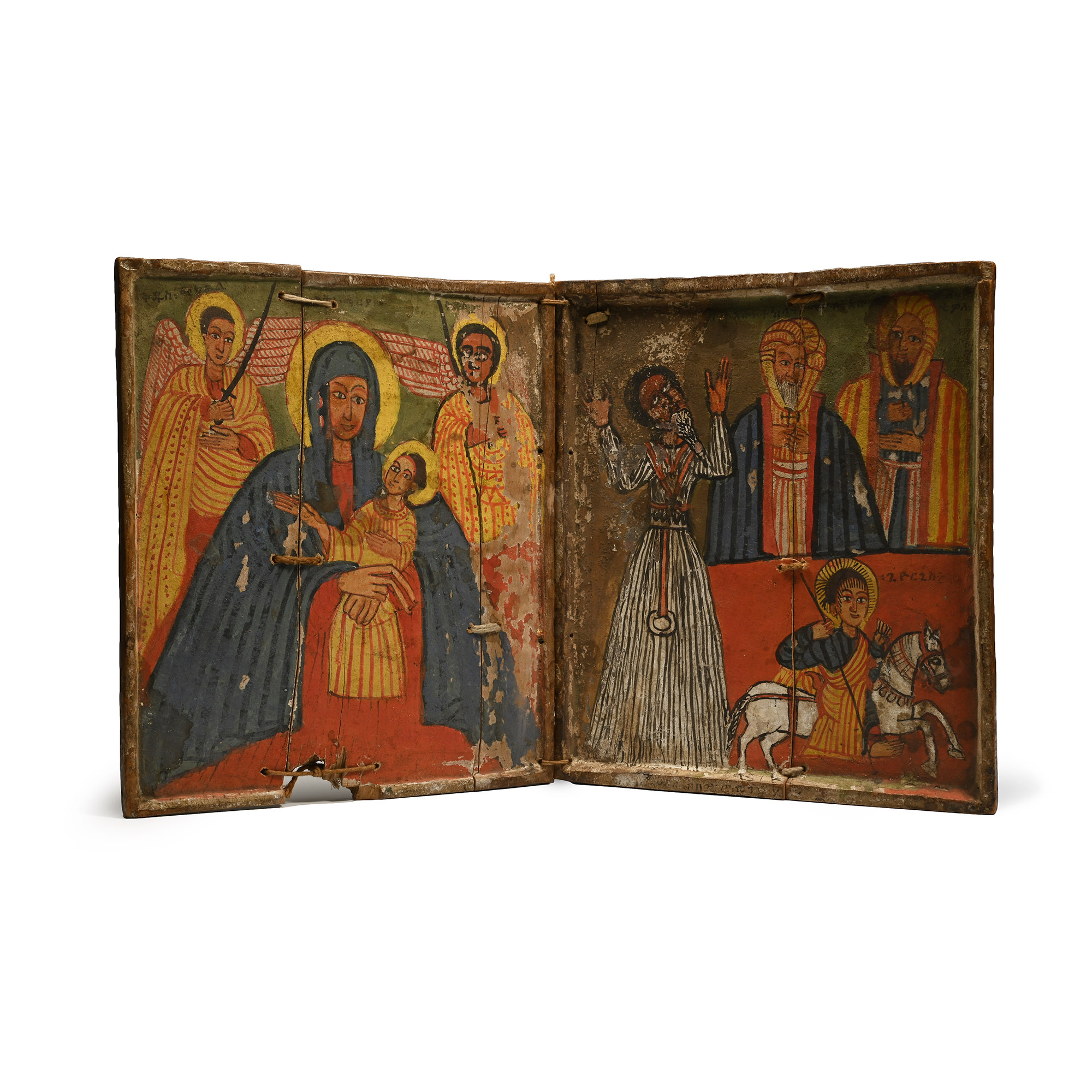
Ethiopian Wooden Diptych Icon of the Virgin and Child with Gabra Manfus Qeddus and Saints
17TH CENTURY A.D.
8 1/2 x 7 1/2 in. (453 grams, 21.8 x 19 cm).
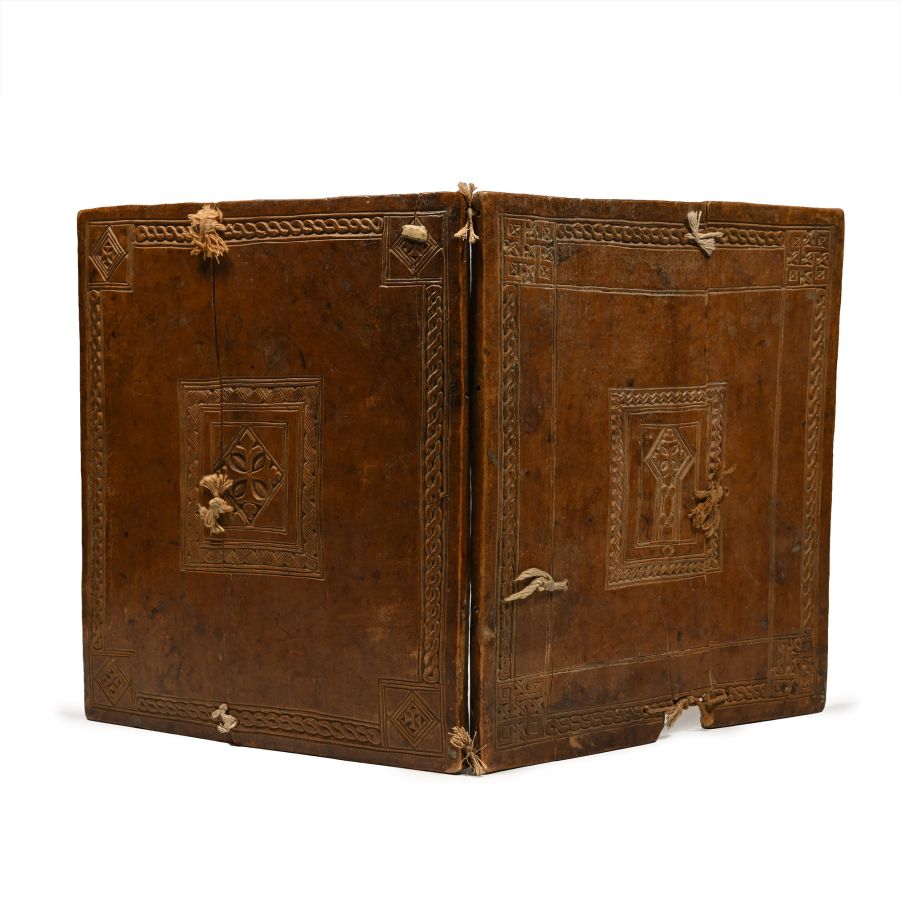
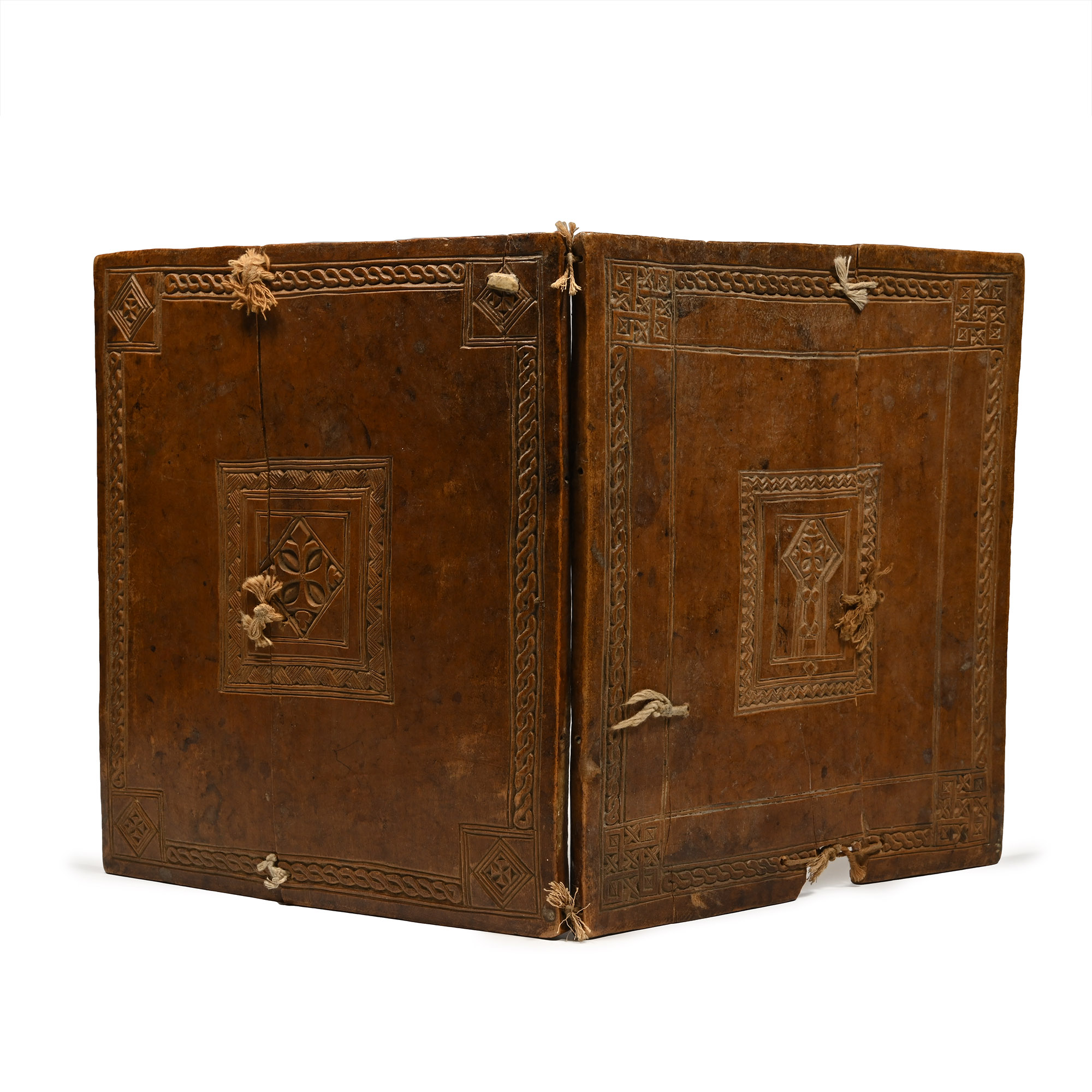
Portable shrine with geometric ornament and crosses to the outer face, opening doors to reveal a diptych with image of Mary Theotokos and Child, escorted by angels Gabriel and Michael with drawn swords, on the left; on the right, Abune Gabra Manfus Qeddus with hands raised, nimbate figures of Takla Haymanot and Ewostatewos with yellow and blue garments on the right; on the lower right corner Saint George (Bet Gorgis) killing the dragon. [No Reserve]
ProvenanceSir Alistair McAlpine, circa 2000.
This lot is accompanied by an illustrated lot declaration signed by the Head of the Antiquities Department, Dr Raffaele D’Amato.
See Chojnacki, S., 'Notes on Art in Ethiopia in the 16th Century: an Enquiry into the Unknown Author(s)' in Journal of Ethiopian Studies, Vol. 9, July 1971, No. 2 pp. 21-97, fig.10, for similar scene; Chojnaki, S., 'The Iconography of St. George in Ethiopia: Part II: St. George, the Dragon-Killer' in Journal of Ethiopian Studies, Vol. 11, No. 2 (July 1973), pp.51-92, icon I.E.S. collection no.3887; cf. also Heldman, M., Munro-Hay Stuart, C., African Zion, The sacred art of Ethiopia, Yale University Press, 1993, cat.11,13,102, for icons in similar style, and p.7.
FootnotesIn the Ethiopian icons, Gabra Manfas Qeddus (Servant of the Holy Spirit) the famous hermit whose sanctity tamed the wild beasts, is often represented. The exterior faces of these diptych panels, like the smaller bilateral diptychs of the 17th century, were carved with centralised cross designs that reflects the carved designs of contemporary wooden altar tablets.
CONDITIONTimeLine Auctions follows a vetting process to ensure the authenticity and legality of all items, reinforcing our commitment to integrity and responsible trading. Each antiquity, antique, and coin lot undergoes thorough examination by a vetting committee of at least ten external specialists, professional trade association members, scientists, and archaeologists: Our Vetting Process
AUCTIONS:
TimeLine is a leading auction house specialising in antiquities, ancient art, collectables, natural history, coins, medals, and books. Our auctions offer museums, collectors, historians, and enthusiasts the opportunity to acquire unique and historically significant pieces.
LOT 0374
Ethiopian Wooden Diptych Icon of the Virgin and Child with Gabra Manfus Qeddus and Saints
Sold for (Inc. bp): £2,210
-
Grand Tour Bronze Figures
19th-20th century A.D.Sold for (Inc. bp): £33
Comprising: girl with long hair crouching on a rock, cradling her knee, with stamped 'Bronze garanti Paris JB déposée' mark and signed 'Milo' to base, on a marble stand; youthful Roman lady in a lively pose with sweeping dress and mantle (unsigned). 2.36 kg total, 15.7-19.1 cm
Ian Wilkinson collection, Nottinghamshire, UK, formed since 1985. This lot is accompanied by an illustrated lot declaration signed by the Head of the Antiquities Department, Dr Raffaele D’Amato.
Milo Martin, 1893-1970, was a Vaudois sculptor and medalist whose foundry stamp: “Bronze Guaranteed J.B. Paris” was chosen after a famous bronze brand from the 19th century. -
Glass Bead Necklace String Group
20th century A.D.Sold for (Inc. bp): £13
Comprising: a short string of facetted oblate light blue beads, no clasp; prayer bead string with a tassel to the end. 171 grams total, 37-78 cm
Property of a Stockport, UK, collector. This lot is accompanied by an illustrated lot declaration signed by the Head of the Antiquities Department, Dr Raffaele D’Amato. -
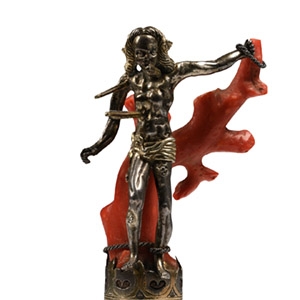
Renaissance Devotional Aid Depicting Saint Sebastian Tied to a Coral Branch
Southern Germany, circa 1500-1520 A.D., adapted by Jacob Frick of Constance, circa 1590 A.D.Sold for (Inc. bp): £2,860
Comprising a parcel-gilt raised discoid base with fluted hexafoil developing to a central column with braided collar and openwork crown socket; inset portion of natural coral branch; figure of St Sebastian modelled in the round with three arrows piercing his shoulders and chest and the stub of a fourth in his shin, portrayed with gilt loincloth and centre-parted hair, braided wire bonds to the left wrist and one ankle' old collector's numbers 'V.590.3H1 7' and '18688' to underside. 190 grams, 12.4 cm
F.K.A. Huelsmann, Hamburg. with Christie's, Geneva, 13 May 1981, no.7. Private collection, South Germany. with Hargesheimer & Gunther, 22 September 2017, no.1307. This lot has been checked against the Interpol Database of stolen works of art and is accompanied by search certificate number no.12507-230673. This lot has been cleared against the Art Loss Register database, and is accompanied by an illustrated lot declaration signed by the Head of the Antiquities Department, Dr Raffaele D’Amato.
This lot will require a CITES licence when exported outside the UK.
