
Loading, please wait...
LOT 0326
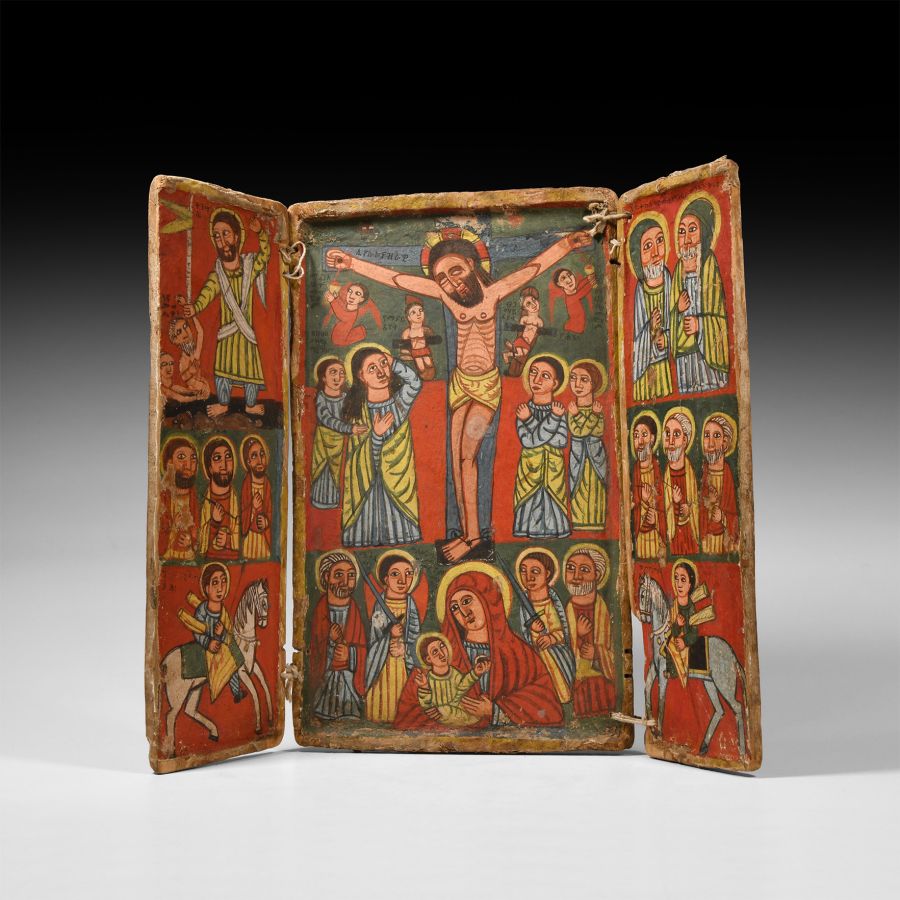
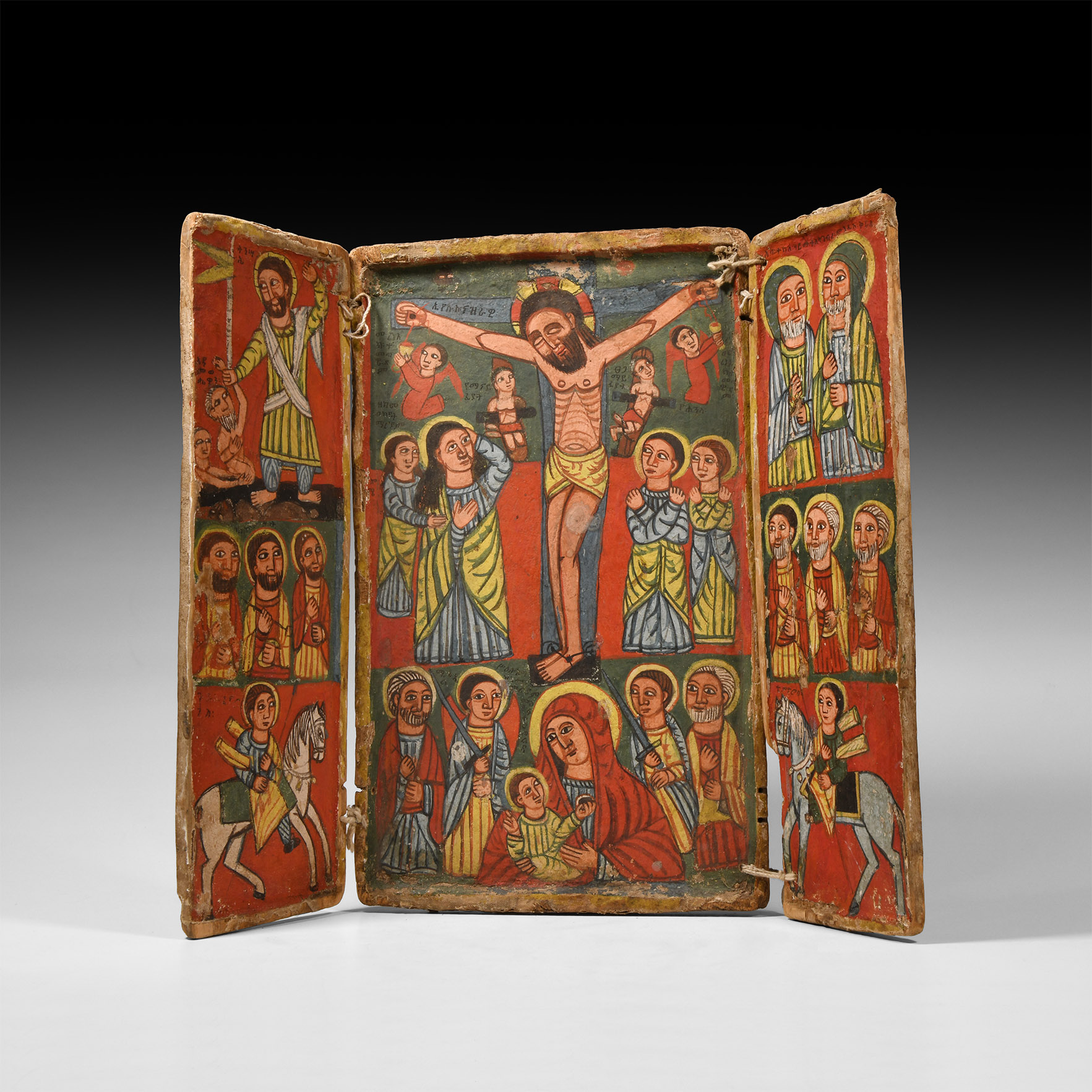
Ethiopian Triptych Icon with Mary and John the Evangelist
16TH CENTURY A.D.
14 x 8 1/2 in. (760 grams, 35.5 x 21.5 cm).
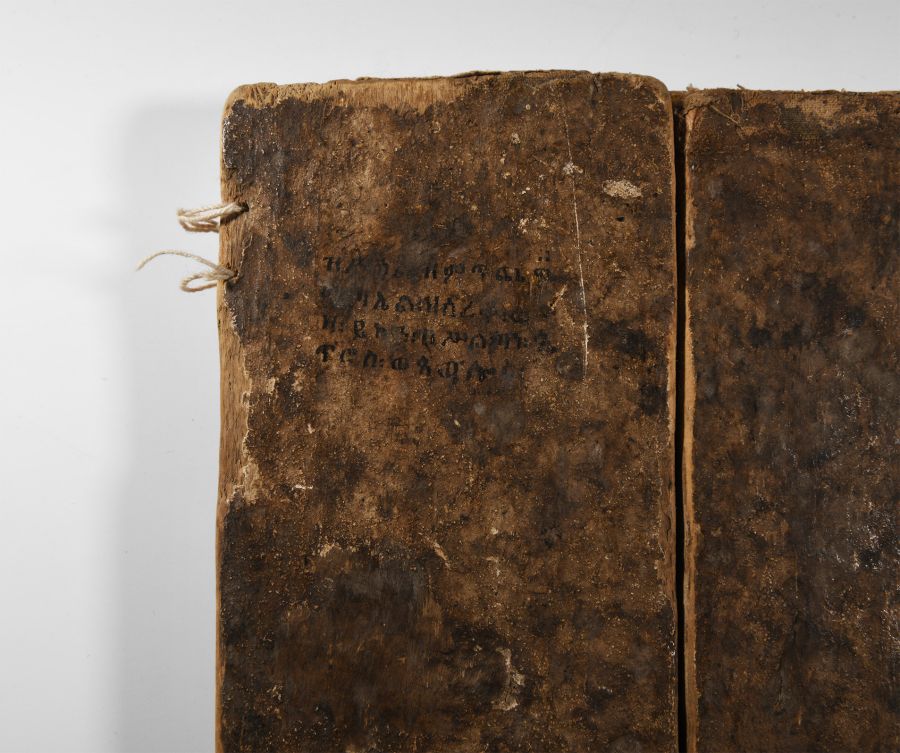
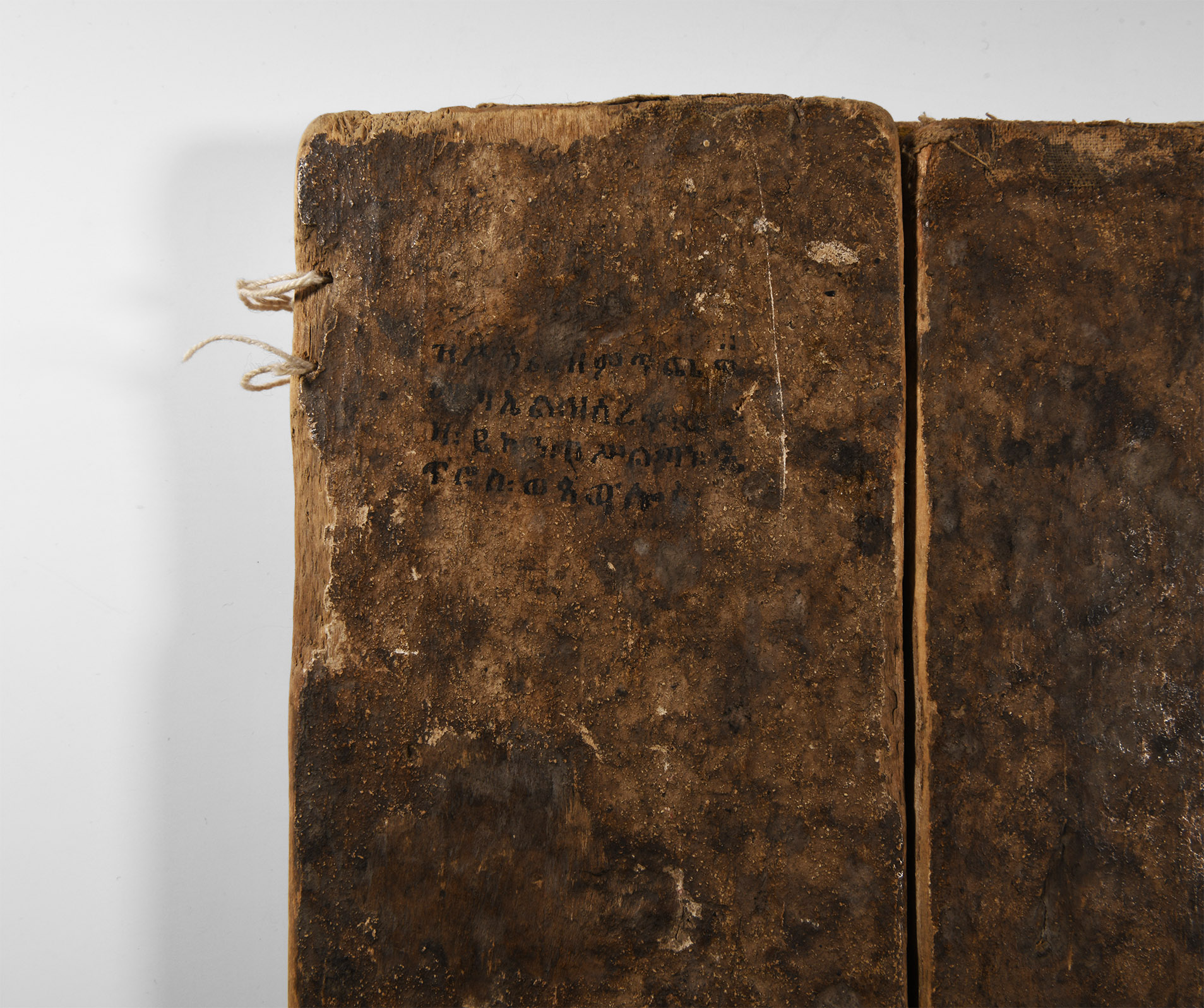
A wooden triptych with recessed central panel and two folding doors; the central panel with crucifixion scene with robed Mary and John the Evangelist, another apostle and Mary Magdalen, two crucified thieves to the rear and the angels depicted collecting the blood of God in cups; underneath the Crucifixion scene Virgin Mary and the Child escorted by armed Saint Gabriel and Saint Michael, prophets to the sides; the left door with nude Adam and Eve reaching up to the Resurrection of Christ, beneath them three prophets; the right door with two saints (upper panel) and three prophets; left and right bottom panels with Saint George (Bet Giorgis) and military Saint Victor on horseback; Ethiopian Ge'ez script legends.
ProvenanceAcquired on the London art market, 2003.
UK private collection.
See Chojnacki, S., Major Themes in Ethiopian Painting, indigenous developments, the influence of foreign models and their adaptation, from the 13th to the 19th century, Wiesbaden, 1983, pp.172ff, fig.162, for a similar triptych.
FootnotesThe icon shows the Western influence on Ethiopian art. The first element is the orb which the Child holds in his left hand and the second element is the pose of his right hand. The orb appeared in Ethiopian paintings around 1500 A.D. Moreover, his hand shows two fingers outstretched, the index and middle finger, and the two last fingers folded.
CONDITIONTimeLine Auctions follows a vetting process to ensure the authenticity and legality of all items, reinforcing our commitment to integrity and responsible trading. Each antiquity, antique, and coin lot undergoes thorough examination by a vetting committee of at least ten external specialists, professional trade association members, scientists, and archaeologists: Our Vetting Process
AUCTIONS:
TimeLine is a leading auction house specialising in antiquities, ancient art, collectables, natural history, coins, medals, and books. Our auctions offer museums, collectors, historians, and enthusiasts the opportunity to acquire unique and historically significant pieces.
LOT 0326
Ethiopian Triptych Icon with Mary and John the Evangelist
Sold for (Inc. bp): £1,040
-

Renaissance Gold Ring with Ruby and Enamelling
Late 16th century A.D.Sold for (Inc. bp): £14,300
A classic, Renaissance era gold ring composed of a slender D-section hoop, widening at the shoulders, fashioned as architectural capitals with strapwork and elaborate projecting scrolls in opaque white and blue enamel, embellished with red and green enamelled detailing; square bezel with box setting set with a table-cut ruby, pairs of blue enamelled cusplets to each of the four faces, stepped base below ornamented with a black enamelled bead moulded collar, bezel reverse of flat inverted pyramidal form and divided into four triangles, two with black enamelled hatching; retaining the majority of the original enamelling; accompanied by a Les Enluminures presentation box. 4.66 grams, 22.94 mm overall, 16.90 mm internal diameter (approximate size British H, USA 3 3/4, Europe 6.18, Japan 6)
Acquired from Les Enluminures Ltd, Illinois, USA, 2016. Property of an East Sussex collector. Accompanied by a Les Enluminures certificate of authenticity. Accompanied by a copy of the Les Enluminures invoice. This lot has been checked against the Interpol Database of stolen works of art and is accompanied by search certificate no.11670-197580.
Rubies were a potent symbol of status and social distinction in later medieval Europe, frequently adorning royal crowns. In the Renaissance, however, they conveyed a personal, more intimate message, their red colour, like the rose, emblematic of love. The intensity of the red colour was often enhanced with a foil lining to the setting and were popular as betrothal and wedding rings. It is believed that rubies symbolised the virtues of marriage and eternal matrimonial love. Such rings held an international appeal, making attribution to specific workshops or countries very difficult. The V & A Museum explains that 'Renaissance, the ring developed from the simple forms of the medieval period into a miniature work of art, combining the skills of the chaser, engraver and enameller as well as the stone cutter.' -
Marble Portrait Bust
19th century A.D.Estimate: £3,000 - 4,000 (+bp*)
Opening Bid: £1,500
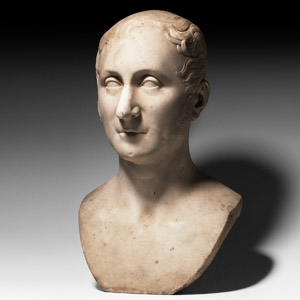
A marble bust of a middle-aged man with short hair combed over his forehead, the face shown with a slight smile. 22.6 kg, 43 cm high
French collection, 1960s-early 2000s. From an important Paris gallery, France. with Hampel Fine Art Auctions GmbH & Co KG, 12 December 2014, lot 1919. This lot has been checked against the Interpol Database of stolen works of art and is accompanied by search certificate number no.11693-199346. -
Tudor 'Thames' Pipe Clay Bishop Chess Piece
Circa 16th century A.D.Sold for (Inc. bp): £39
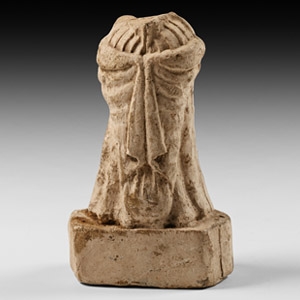
An acephalic clay chess piece representing a Bishop, with detailing to his robes and their voluminous sleeves. 18.1 grams, 45 mm high
Found on the Thames foreshore, London, UK. Acquired on the UK antiques market between 1974-1985. Albert Ward collection, Essex, UK.
