
Loading, please wait...
LOT 0369
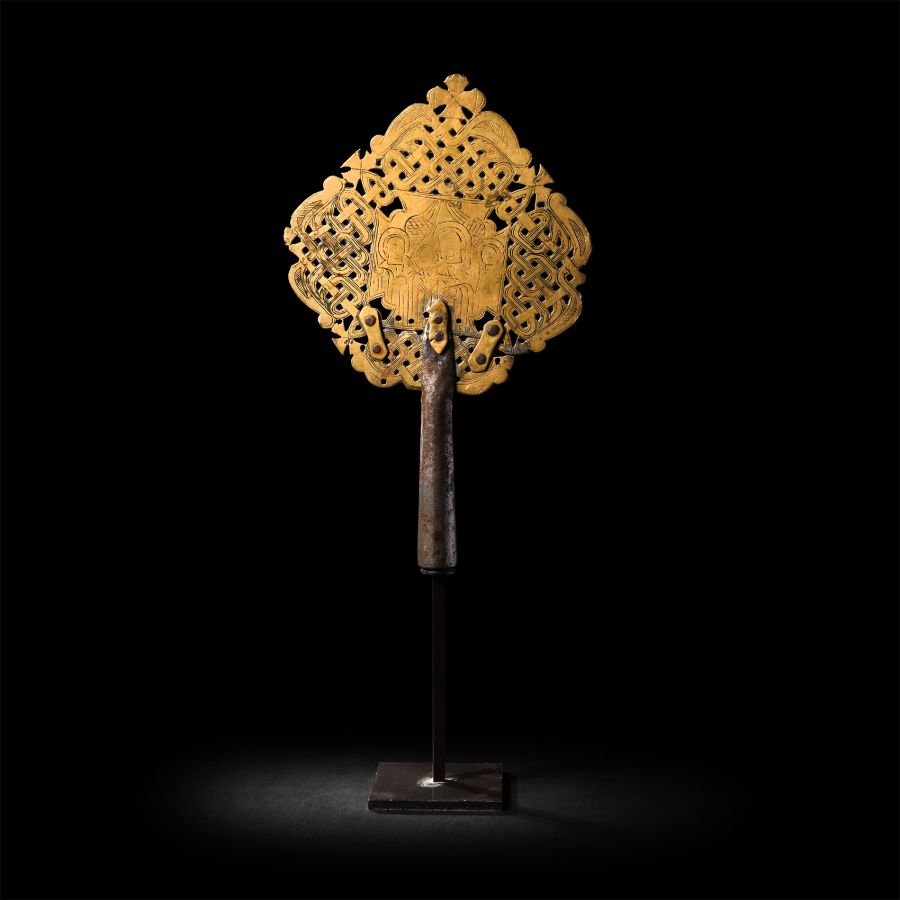
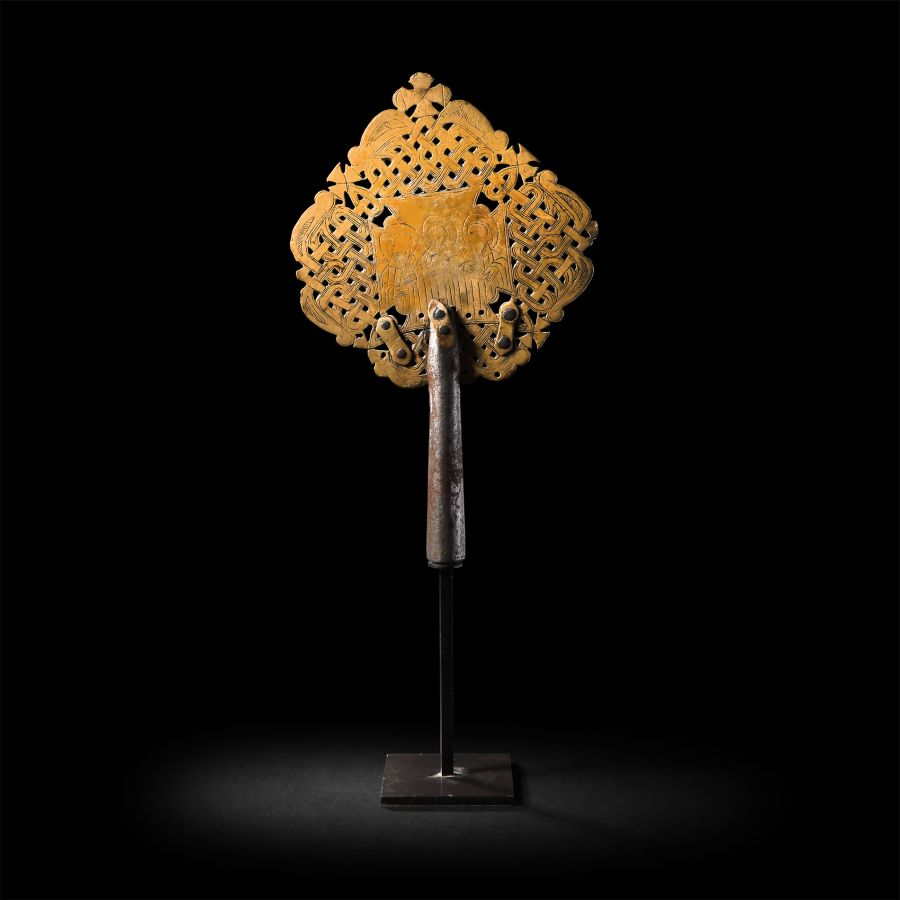
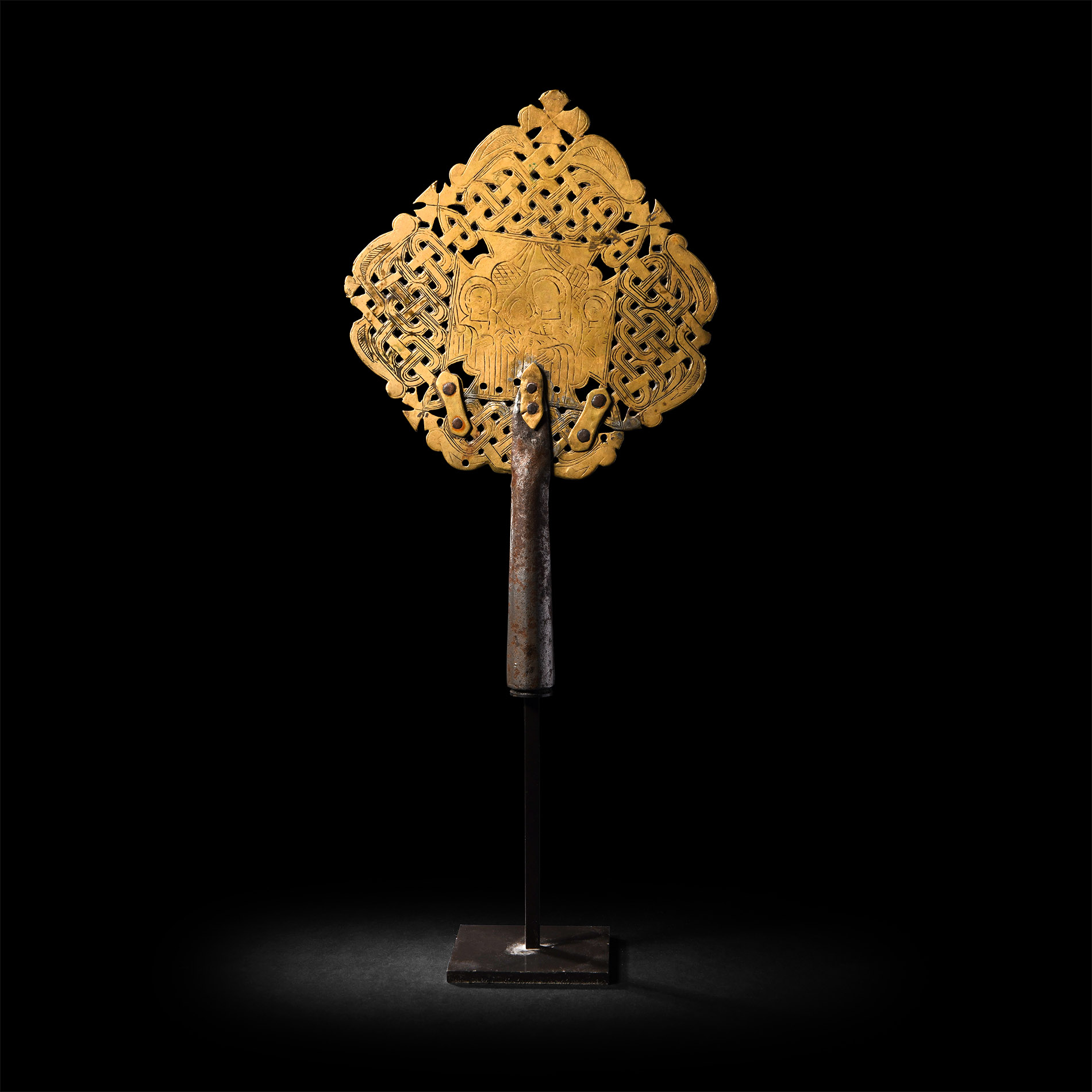
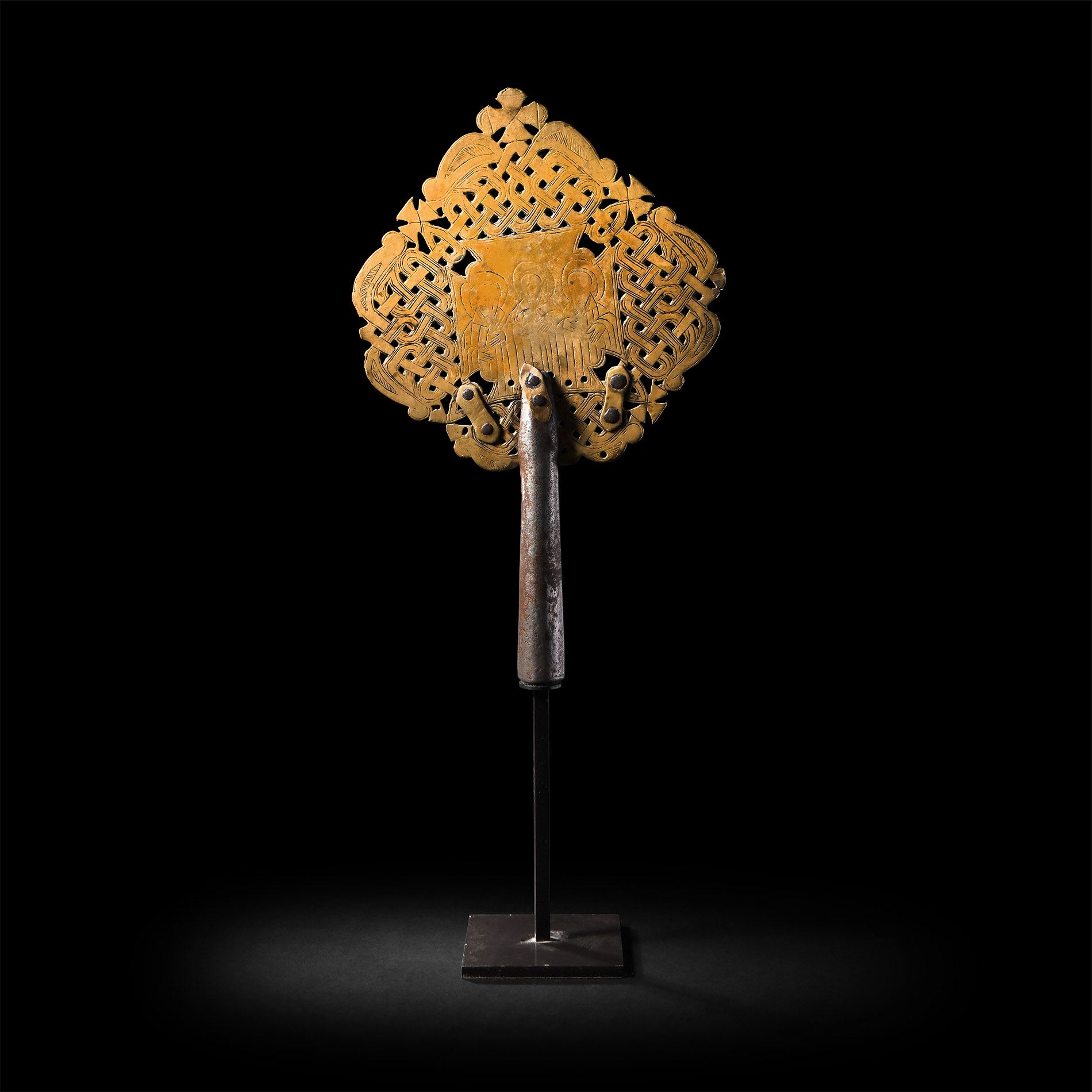
Ethiopian Processional Cross
15TH-16TH CENTURY A.D.
10.2 in. (14.8 in.) (55 grams, 26 cm (37.5 cm including stand)).
A bifacial bronze Yämäṩor Mäsqäl processional cross finial with later replaced socket, flanking bird motifs and dense block of tendrils and wheels with seven cross-shaped finials, central panel with Virgin Mary, Holy Child and angels to the front, saints and Evangelists to the back.
ProvenanceAcquired on the London art market, 2006.
UK private collection.
Cf. Chojnacki, S., Major Themes in Ethiopian Painting, indigenous developments, the influence of foreign models and their adaptation, from the 13th to the 19th century, Wiesbaden, 1983, figs. 72-73; Chojnacki, S., Ethiopian Crosses, a Cultural History and Chronology, Milano, 2006, fig.83, for similar processional crosses.
FootnotesIn contrast with the hand cross that is fitted with a grip, the processional cross has a hollow shaft into which the pole supporting the cross is inserted, although the use of both is interconnected in the liturgy and ceremonial aspects of the Ethiopian Orthodox Church. In Amharic it received the name of yämäṩor mäsqäl or "cross to [carry] on a pole", the term mäṩor also meaning a wooden handle. Processional crosses are used on "every qaddase day" occasions - an expression meaning whenever the liturgy is performed. This includes displaying the cross during the reading of the Gospels and other sacred texts, as well as holding it up to be viewed at the end of the service for the final blessing.
CONDITIONTimeLine Auctions follows a vetting process to ensure the authenticity and legality of all items, reinforcing our commitment to integrity and responsible trading. Each antiquity, antique, and coin lot undergoes thorough examination by a vetting committee of at least ten external specialists, professional trade association members, scientists, and archaeologists: Our Vetting Process
AUCTIONS:
TimeLine is a leading auction house specialising in antiquities, ancient art, collectables, natural history, coins, medals, and books. Our auctions offer museums, collectors, historians, and enthusiasts the opportunity to acquire unique and historically significant pieces.
-
Marble Head of a Roman Emperor
20th century A.D.Estimate: £4,000 - 6,000 (+bp*)
Opening Bid: £2,000
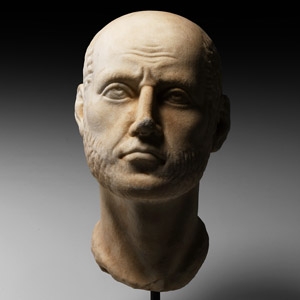
A carved marble bust of a mature male with stern features, likely the emperor Carus, shown with short, neatly-dressed hair and beard; mounted on a custom-made display stand. 10.4 kg, 38 cm high including stand
French collection, 1960s-early 2000s. From an important Paris gallery, France. This lot has been checked against the Interpol Database of stolen works of art and is accompanied by search certificate number no.11694-199338.
Carus reigned 282-283 A.D. He served as a prefect of the guard to emperor Probus, whom he succeeded. Whilst leading a campaign against the Sassanians, Carus died suddenly and under mysterious circumstances, leading to the belief that he was struck by lightning. Little is known of his life, owing to the relative instability of that time period. Whether he had Probus murdered, or whether he was killed by mutinous troops was disputed even by his contemporaries. Carus was succeeded by his sons Carinus and Numerian, although their reigns were short-lived and his dynasty was soon supplanted. Carinus’ lasting legacy was principally the suppression of the authority of the senate. He has gone down in history as one of the tyrants of ancient Rome. -
.jpg)
Post Byzantine Triptych Centre Icon of the Intercession
17th-19th century A.D.Sold for (Inc. bp): £44
A central plaque from a brass triptych with standing nimbate Mother of God, dressed in a chlamys and tunica talaris, with her arms extended outward and the head turned to the right, surrounded by two groups of worshippers, arranged in three rows: the angels at the top, the right ones at the centre and prophets with angels at the bottom; two flags flying horizontally on each side of her head, surrounded by plant decorations, while the sun and moon are depicted at the two corners of the plaque, separated by an inscription in Russian; in the upper part, in the shape of an eastern dome, is represented the Holy Trinity, Father and Son, seated on a throne of clouds, a cross in the middle surmounted by a dove. 142 grams, 13 cm high
Fair condition.
Acquired on the UK art market, 2000s. Property of an Essex gentleman.
The icon represents the Intercession of Mary, 'Joy of all who sorrow'. It formed the central part of a triptych with the Mother of God at the centre, surmounted by iconography of veneration. The (here missing) other parts of the triptych were embossed with scenes of the lives of Christ or Mary. -
Post Medieval Pewter Ring with Inlay
Circa 16th-18th century A.D.Sold for (Inc. bp): £26
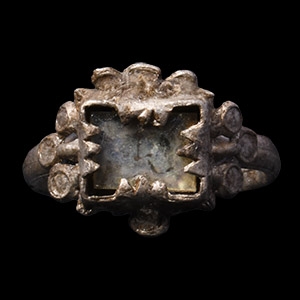
A pewter finger ring composed of a lentoid-section hoop supporting a cushion-shaped bezel, decorated with three graduated arms at each shoulder terminating in shallow recessed circles, additional decorative lobes to the upper and lower edges and four clusters of claws holding a clear rectangular glass inlay. 4.02 grams, 26.59 mm overall, 19.50 mm internal diameter (approximate size British S, USA 9, Europe 20, Japan 19)
Found Cambridgeshire in the 1990s.
