
Loading, please wait...
LOT 0378
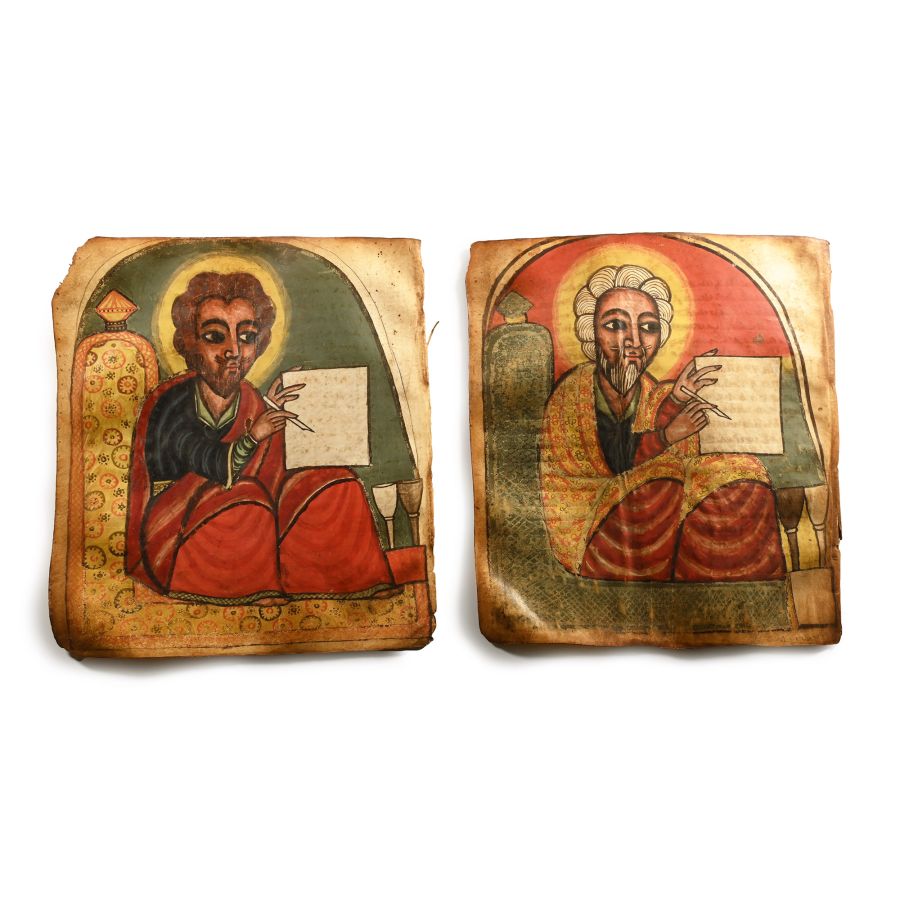
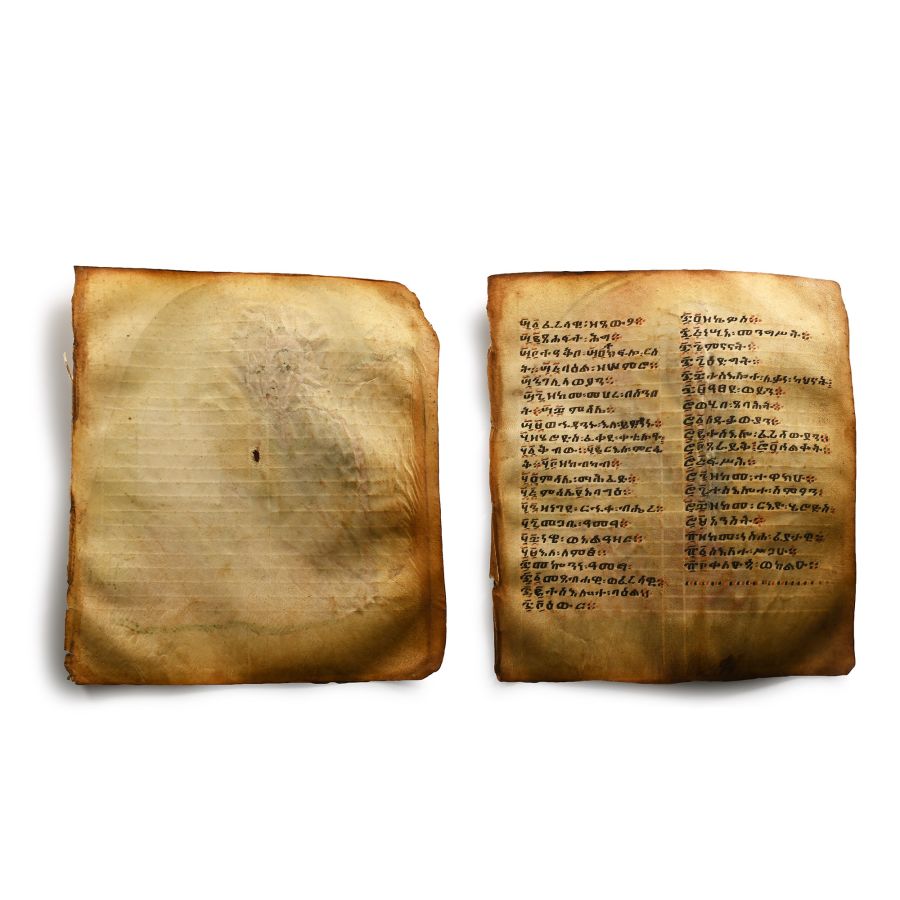
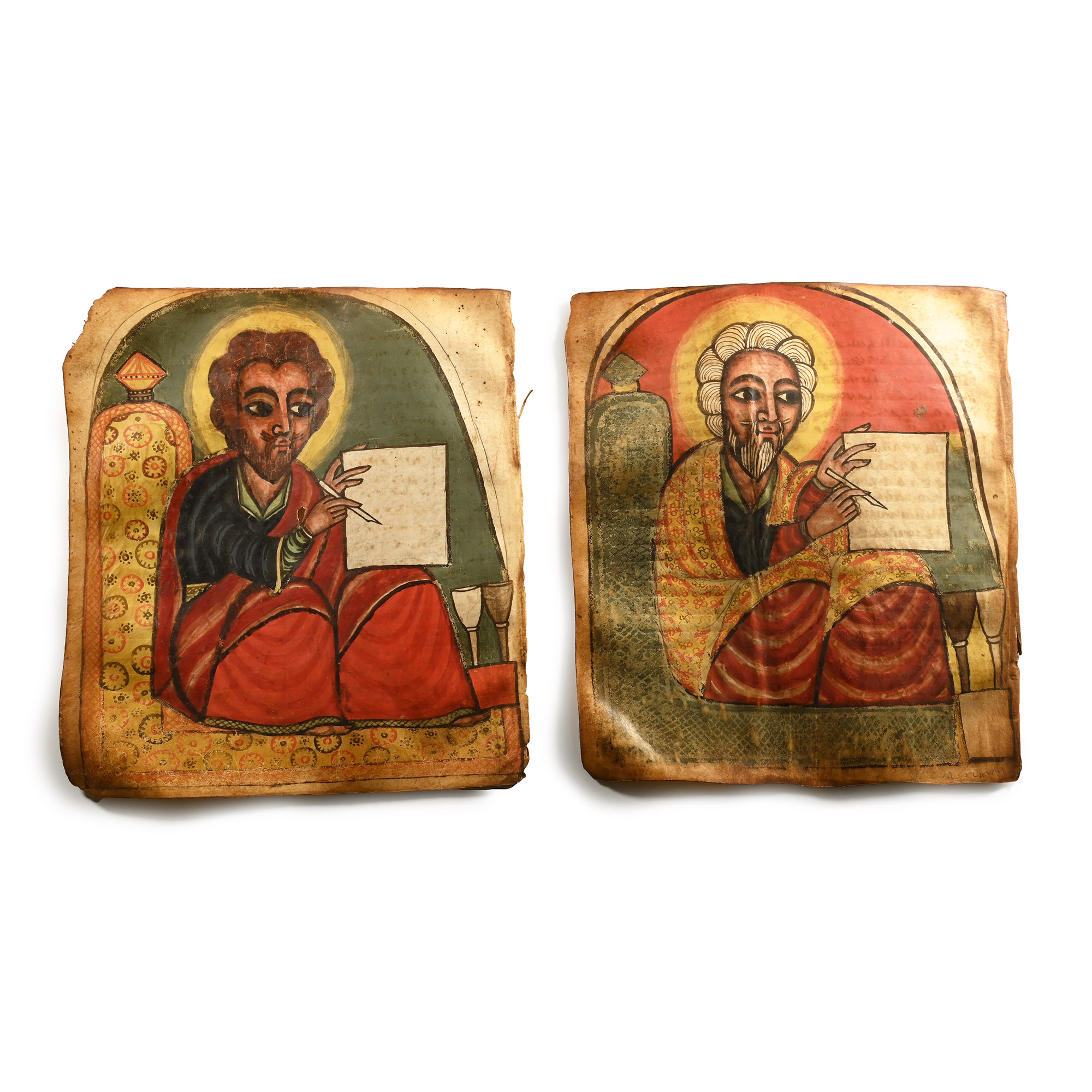
Ethiopian Painted Parchment of Two Evangelist Portraits from a Gospel
CIRCA 1650-1700 A.D.
8 7/8 x 7 3/4 in. (19 grams total, 22.5 x 19.8 cm each).
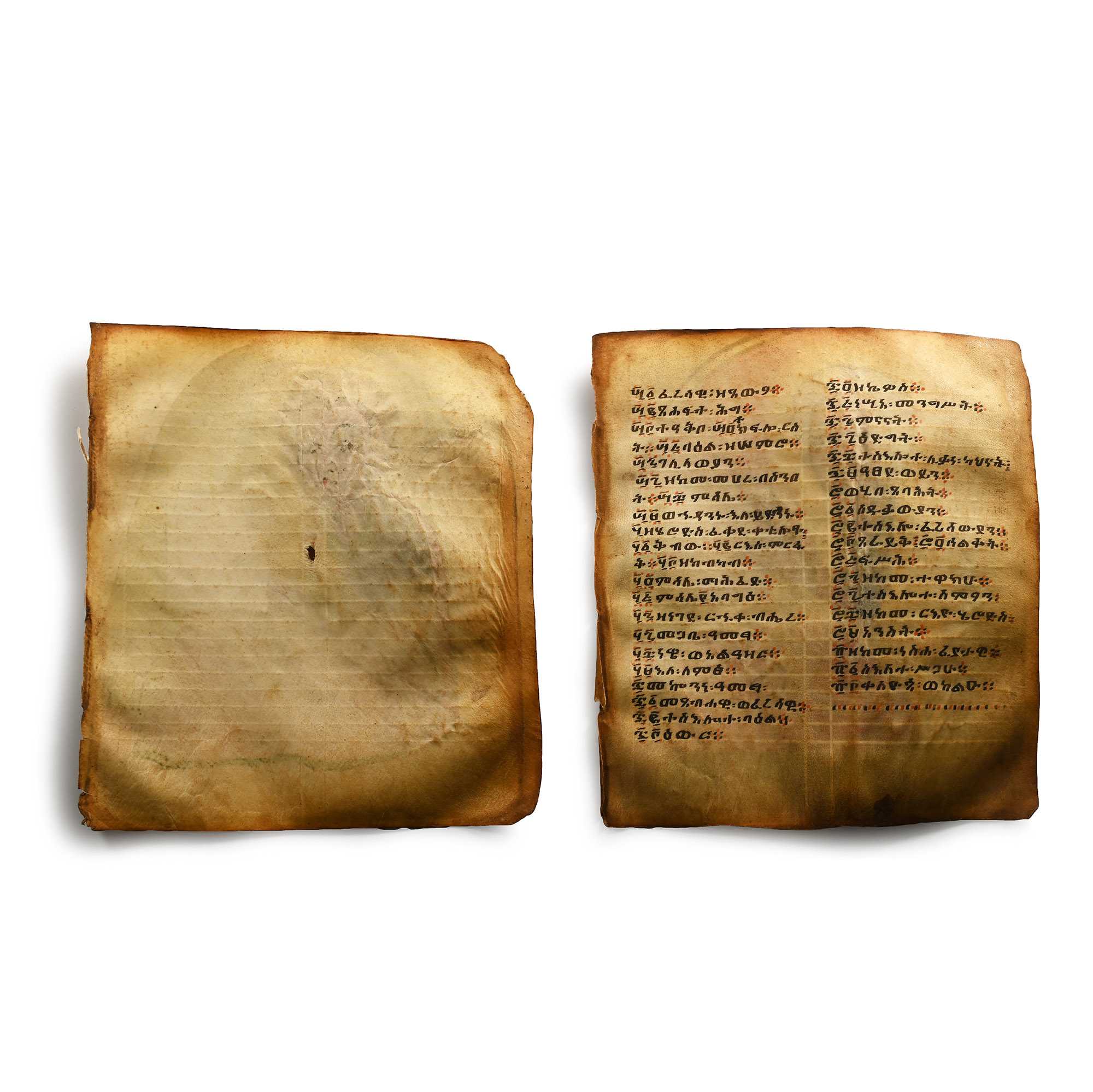
Two leaves from a vellum manuscript, each with a hand-coloured image of a male figure (Evangelists) seated on low stools, covered with embroidered cloths, holding a vellum page in one hand and quill in the other, nimbus around their head; dressed in blue, red and green garments, in front of them two cups in brown and white colour. [2, No Reserve]
ProvenanceEx central London gallery.
This lot is accompanied by an illustrated lot declaration signed by the Head of the Antiquities Department, Dr Raffaele D’Amato.
Cf. image of Evangelist on a vellum page from Ethiopian Gospel Book, ex Gunda Gunda Monastery, 16th century A.D., Ethiopia, in The Walters Art Museum, accession no. W.850.153V.
FootnotesDuring the Aksumite period, the Greek text of the Gospels was brought to Ethiopia and translated into Geez. Along with the Greek text came a standard method of Gospel manuscript production, as well as the Eusebian canon tables with their characteristic decoration and tholos miniature, and portraits of the evangelists. In the Gondar period, the tradition continued: usually the four Evangelists were portrayed as a series. Evangelist portraits serve as an introduction, and narrative illustrations were placed within the Gospel texts.
CONDITIONTimeLine Auctions follows a vetting process to ensure the authenticity and legality of all items, reinforcing our commitment to integrity and responsible trading. Each antiquity, antique, and coin lot undergoes thorough examination by a vetting committee of at least ten external specialists, professional trade association members, scientists, and archaeologists: Our Vetting Process
AUCTIONS:
TimeLine is a leading auction house specialising in antiquities, ancient art, collectables, natural history, coins, medals, and books. Our auctions offer museums, collectors, historians, and enthusiasts the opportunity to acquire unique and historically significant pieces.
LOT 0378
Ethiopian Painted Parchment of Two Evangelist Portraits from a Gospel
Sold for (Inc. bp): £1,235
-
Greek Icon with Saint Anthony the Abbot and Saint Charalambos
Early 19th century A.D.Estimate: £300 - 400 (+bp*)
Opening Bid: £150
Saint Anthony the Great on the left, represented in monastic dress holding a scroll of holy writings with his left hand; Saint Charalambos dressed as a bishop, with a green sticharion embroidered in gold, covered by a pink gold embroidered phelonion, a gold embroidered square epigonation with blue edges, and a long orange gold embroidered epitrachelion, holding a gold covered gospel with the image of Christ's resurrection with his left hand; tempera on wood. 558 grams, 25 x 18.6 cm
Acquired from Portobello Road, London, in the 1990s. Property of a London, UK, gentleman collector. This lot is accompanied by an illustrated lot declaration signed by the Head of the Antiquities Department, Dr Raffaele D’Amato.
Saint Anthony the Great, who lived in the 3rd-4th century A.D., was the father of the Eastern Monachism. According to the tradition, Saint Charalambos was martyrised in 202 A.D. He is the protector of prosperity and health -
'The Burstow' Clasped Hands 'No Treasure to a True Friend' Gold Posy Ring
1650-1780 A.D.Sold for (Inc. bp): £624
The bezel with a clasped hands motif with a heart at the centre and elaborate cuffs, narrow D-section hoop; inscribed to the inner face 'No treasure to a true friend' with a long S, worn maker's mark at the end of the inscription, appearing to have the letters 'IV' or IW' in Roman capitals within a simple escutcheon. 2.26 grams, 18.54 mm overall, 16.40 mm internal diameter (approximate size British L, USA 5 3/4, Europe 11.24, Japan 10)
Found near Burstow, Tanbridge, Surrey, UK, on Monday 1st May 2023; disclaimed with treasure reference 2023 T419. Accompanied by a copy of the British Museum's Portable Antiquities Scheme report no.SUR-OAA74B. This lot is accompanied by an illustrated lot declaration signed by the Head of the Antiquities Department, Dr Raffaele D’Amato.
If the maker's mark is 'IV' it may correspond to John Vickerman, a goldsmith active in London from 1768 to 1773. Alternatively, if the maker's mark is 'IW' it may correspond to a number of makers: John Williamson, 1650; John Ward, 1660; James Wilkes, 1722; or John White, 1724. -
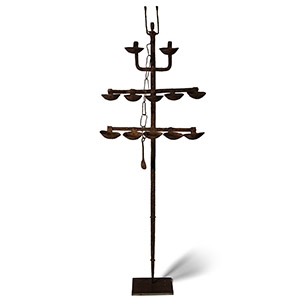
Dogon Iron Multiple Oil Lamp Stand
Circa 19th century A.D.Estimate: £600 - 800 (+bp*)
Opening Bid: £300
Iron flat-section shaft with three tiered cross-bars, the two lowest each with five iron lamp-bowls to the forward face; above, a U-shaped bar with a lamp bowl at each upper end; top of the shaft developing to an anthropomorphic torso with ellipsoid head and two narrow arms raised vertically; chain around the neck with hand-forged extinguishing spoon; mounted on a square base; Dogon, Mali, workmanship. 6.25 kg total, 132 cm including stand
From the private collection of Dr Hans-Joachim Koloss, Berlin, Germany, 1975-2002. Gorny & Mosch, Munich, Germany, auction 279, no.410. Accompanied by a copy of the Gorny & Mosch invoice and illustrated catalogue listing. Accompanied by a copy of the German cultural export licence. This lot is accompanied by an illustrated lot declaration signed by the Head of the Antiquities Department, Dr Raffaele D’Amato.
The figure is probably a Nommo a primordial ancestral spirit in Dogon cosmogony. A Nommo is usually considered to be amphibious, hermaphroditic and fish-like depicted in Dogon art with a humanoid upper torso, and a fish-like lower torso and tail.
