
Loading, please wait...
LOT 0371
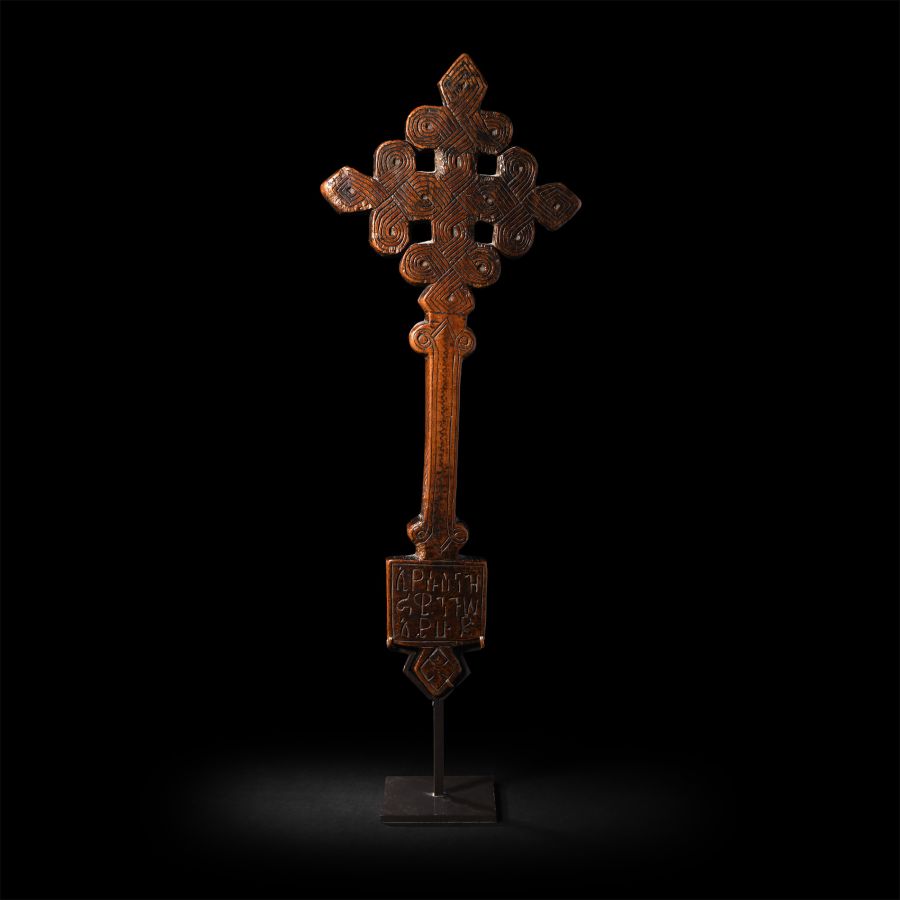
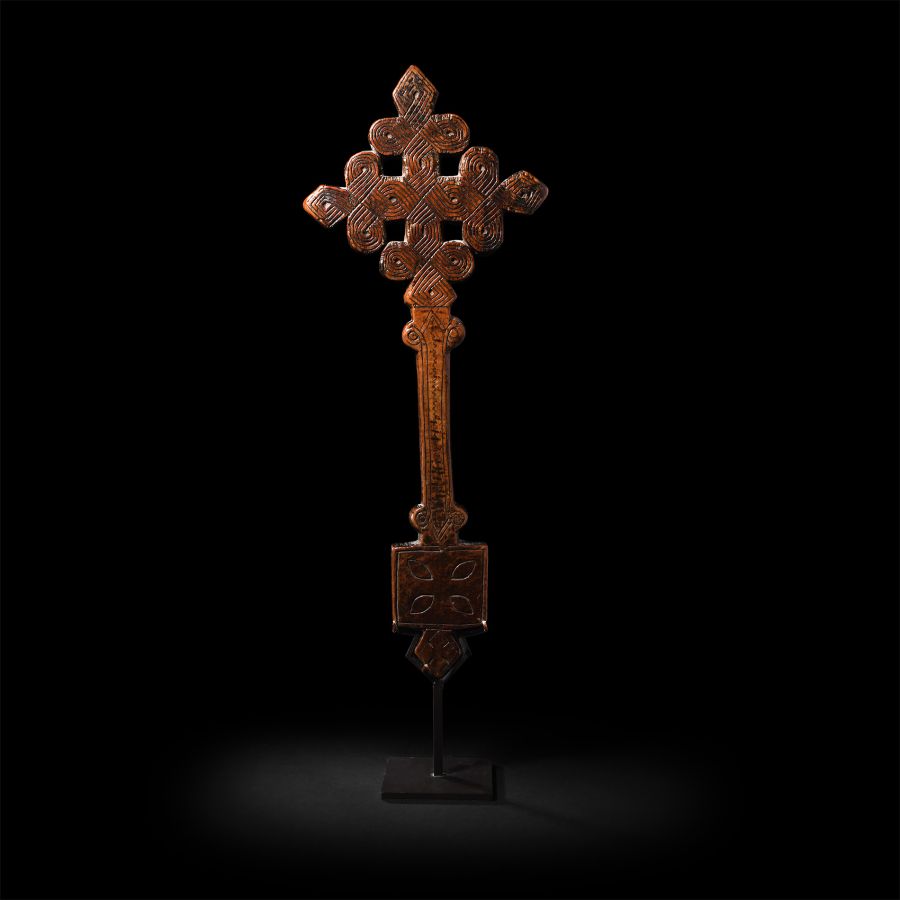
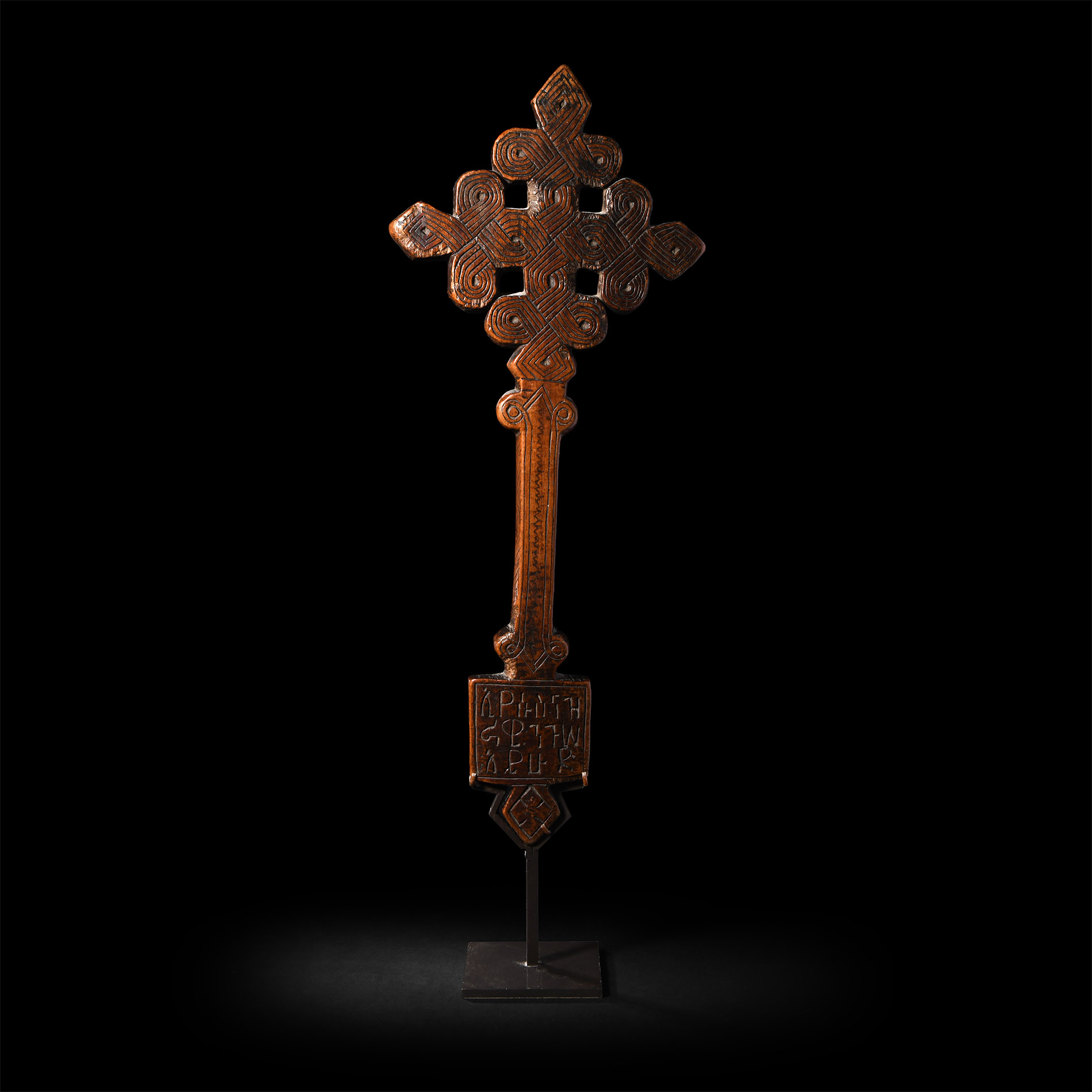
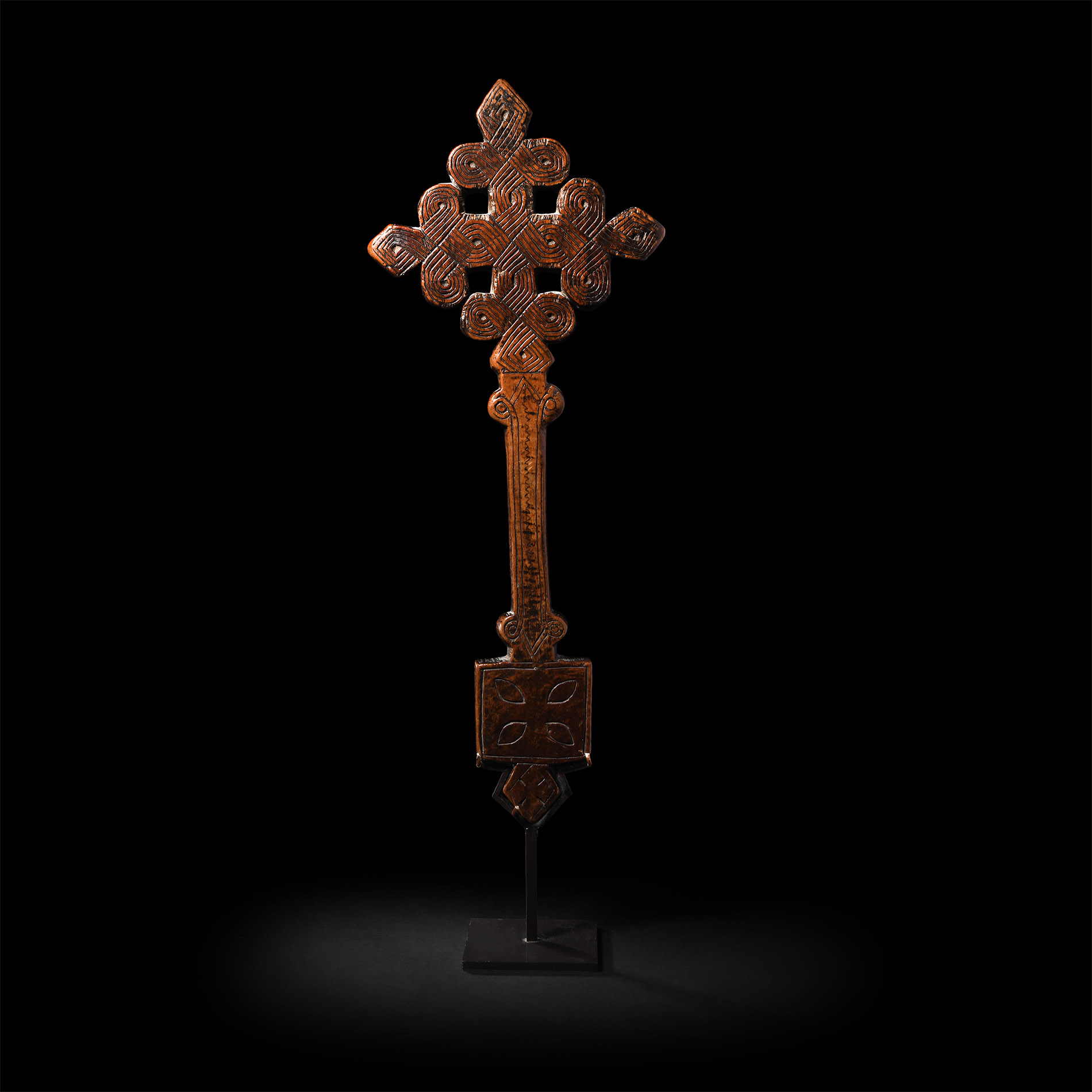
Ethiopian Maskal of Kernebege Type Hand Cross with Inscription
17TH-18TH CENTURY A.D.
16 1/1 in. (20 in. including stand) (600 grams, 43 cm high (50.7 cm high including stand)).
A bifacial wooden cross comprising intertwined elements with trefoil finials, resting on a tall stem decorated with wavy lines enclosed within a geometric frame, the stem resting on a tabula with an inscription on the front and vegetal decorative element on the back, rhomboidal termination with inscribed cross on both sides; mounted on a custom-made display stand.
ProvenanceAcquired from Owen Hargreaves, 2003.
UK private collection.
Cf. Korabiewicz, W., The Ethiopian cross, Addis Ababa, 1973, fig.66.
FootnotesThe Ethiopian manual cross is usually divided in three parts: the cross at the top; the handle; and a square element, the tablet, at the base. It is not easy to define the origin of the cross-borne tablets. There are three suppositions as to what they signify: according to one, the tablet represents the earth with its four corners. According to the second one, the tablet represents Adam's grave on Calvary. The third one is that it represents the Tabot, the highest relic of Ethiopia, the Ark of the Covenant. The cross belongs to the Kernebege (Horns of Ram) group, where the tips of the cross are reminiscent of ram's horns or trefoils. Inscriptions are only very rarely found on wooden, manual crosses like this maskal. They usually give the name of the owner or donor.
CONDITIONTimeLine Auctions follows a vetting process to ensure the authenticity and legality of all items, reinforcing our commitment to integrity and responsible trading. Each antiquity, antique, and coin lot undergoes thorough examination by a vetting committee of at least ten external specialists, professional trade association members, scientists, and archaeologists: Our Vetting Process
AUCTIONS:
TimeLine is a leading auction house specialising in antiquities, ancient art, collectables, natural history, coins, medals, and books. Our auctions offer museums, collectors, historians, and enthusiasts the opportunity to acquire unique and historically significant pieces.
LOT 0371
Ethiopian Maskal of Kernebege Type Hand Cross with Inscription
Sold for (Inc. bp): £520
-
Renaissance Bronze Female Figure
16th-17th century A.D. or earlierSold for (Inc. bp): £3,900
A naturalistic bronze female figure modelled standing contrapposto, nude, looking down towards her feet, one arm reaching over her head towards her neck, the other resting by her side, her weight placed on her right leg, hair tied into an elaborate bun with a ribbon, short ringlets falling down her nape and the end of the ribbon cascading over her shoulder, along the side of her right breast and down to her thigh, where she is holding the end; mounted on a custom-made display base. 754 grams, 20.5 cm high
English private collection.
With stylistic similarities to work by Giovanni Bologna; possibly Italian or Northern European. -
Tudor Period Ring with Intaglio
16th-17th century A.D.Sold for (Inc. bp): £33
A copper-alloy ring composed of a slender hoop supporting an octagonal bezel, set with a blue glass intaglio displaying an enigmatic, possibly pseudo-armorial design. 2.72 grams, 21.50 mm overall, 19.47 mm internal diameter (approximate size British N 1/2, USA 6 3/4, Europe 14.35, Japan 13)
Acquired 1990s. English private collection. Property of an Essex gentleman. -
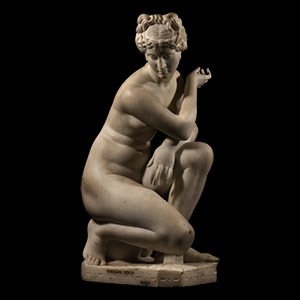
Marble Statue of Kneeling Venus
20th century A.D.Sold for (Inc. bp): £14,950
A marble copy of the kneeling Venus (original in the Vatican Museums), crouching on an octagonal base; the arms raised in expressive pose, head tilted, hair drawn up in a chignon; lettering to base 'KNEELING VENUS' and 'ROME'. 135 kg, 88.5 cm high
French collection, 1960s-early 2000s. From an important Paris gallery, France. with Auktionshaus Kaupp GmbH, Salzburg, Germany, 25 September 2016. This lot has been checked against the Interpol Database of stolen works of art and is accompanied by search certificate number no.11688-199351.
The statue is modelled on an ancient original, commonly thought to represent Aphrodite. The original statue of the Crouching Venus was excavated in Salona (modern Solin near Split, Croatia). It was purchased for the Vatican Museums from where it was confiscated by the French under Napoleon, and subsequently returned to the Vatican in 1816.
