
Loading, please wait...
LOT 1475
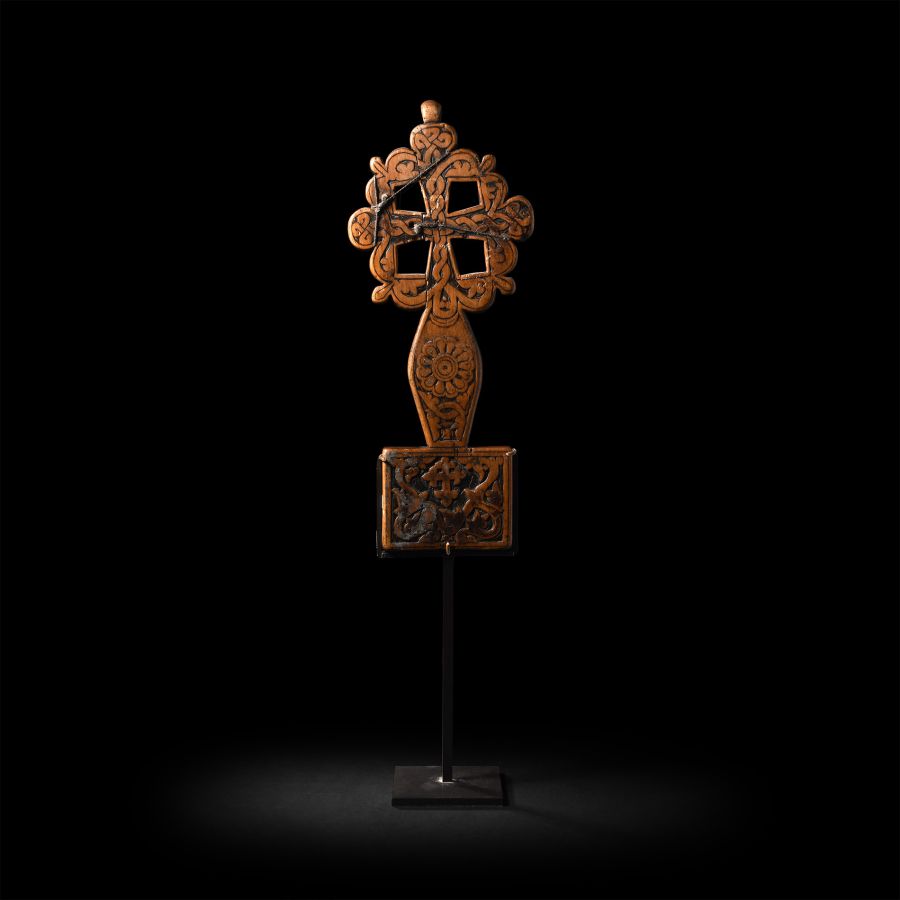
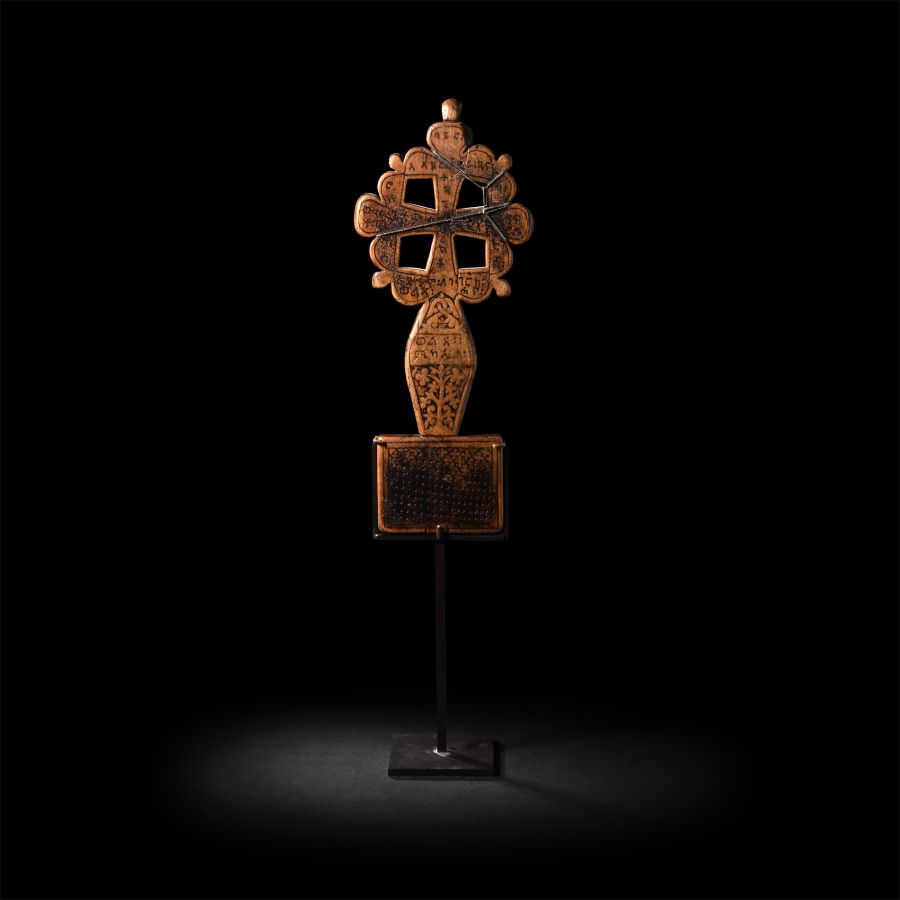
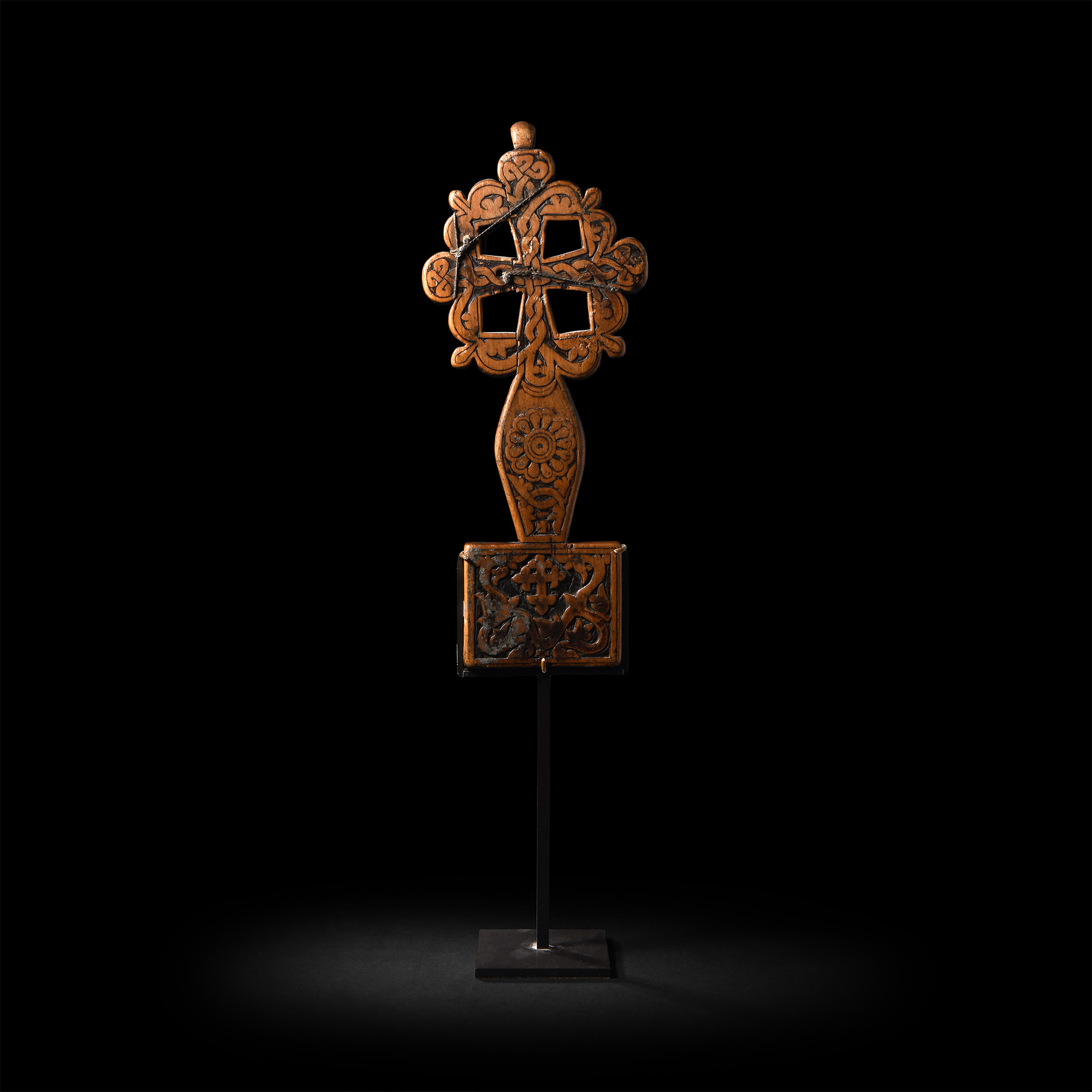
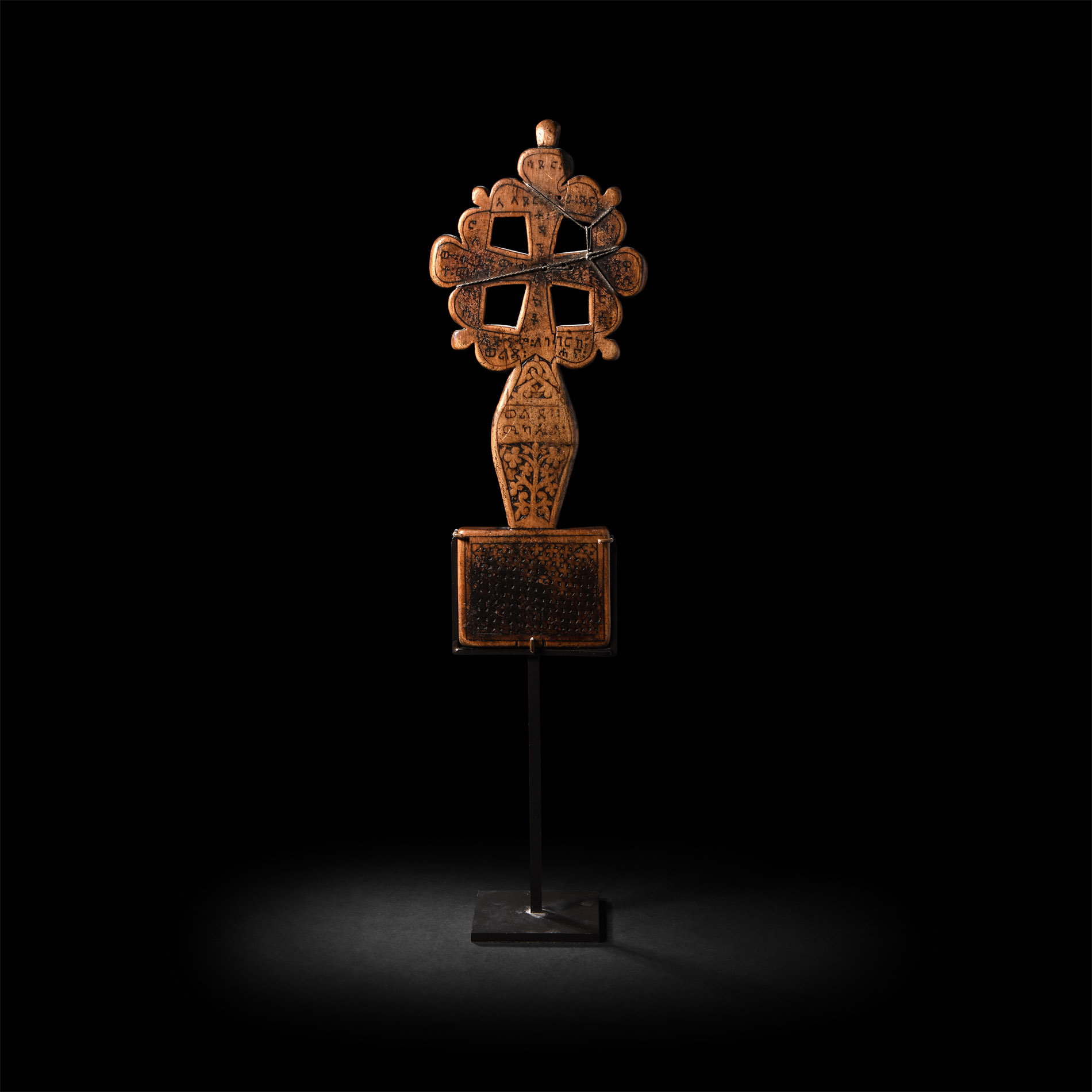
Ethiopian Maskal Cross with Ge'ez Inscriptions
15TH-16TH CENTURY A.D.
11 1/2 in. (16 in.) (500 grams, 29 cm high (43 cm high including stand)).
A large bifacial wooden hand cross with engraved interlace borders and stylised flowers around crosses to one side, and blessing inscriptions in Ge'ez to the other framed by foliage; mounted on a custom-made display stand.
ProvenanceAcquired from Owen Hargreaves, 2003.
UK private collection.
Cf. Korabiewicz, W., The Ethiopian cross, Addis Ababa, 1973, figs 3, 4, 5, for similar.
FootnotesEthiopian crosses, called in Amharic Maskal are divided into four main types: a) handcrosses, which can be large (22 to 53 cm) or small (14 to 21cm); b) processional crosses, usually measuring 22-60cm; c) pectoral or neck crosses, measuring 1-10cm; d) apex or architectural crosses, measuring 50-150cm. Our maskal belongs to the large hand cross category, probably of Havaria group, most common in the Shoa and Gojam provinces. The inscription reads from top to bottom: Sdar Alazar (name of locality) – Egzten nute mäsqäl (cross) on the left side, and Egzten Jesus (on the right side) followed by Adoneh Gavriil – Welde Hannah – Welde Michail. The cross invokes the blessing of God through the three Saints Hannah, Michael, Gabriel, who can be also the names related to the family of the priest who once owned the cross.
CONDITIONTimeLine Auctions follows a vetting process to ensure the authenticity and legality of all items, reinforcing our commitment to integrity and responsible trading. Each antiquity, antique, and coin lot undergoes thorough examination by a vetting committee of at least ten external specialists, professional trade association members, scientists, and archaeologists: Our Vetting Process
AUCTIONS:
TimeLine is a leading auction house specialising in antiquities, ancient art, collectables, natural history, coins, medals, and books. Our auctions offer museums, collectors, historians, and enthusiasts the opportunity to acquire unique and historically significant pieces.
-
.jpg)
Massive Painted Oak Framed Slate Altar Screen
19th century A.D.Sold for (Inc. bp): £169
A magnificent and superb quality Victorian Gothic revival painted altar or reredos panel, as exemplified by the works and designs of Augustus Pugin, on Welsh slate depicting a large golden cross with latticed arms and squared quatrefoil terminals showing the emblems and names of the four Evangelists, Matthew, Mark, Luke and John; the cross set over a circle enclosing a quatrefoil background with the main discus showing a white cross trefoil on a red expanding cross against a green background with the Christogram letters 'IHS' entwined for Jesus Christ; the design set against a dark blue field ornamented with 48 golden radiant six-pointed stars; complete with the original carved oak frame together with the carved oak projecting base plinth shelf with quatrefoil perforations and another Christogram 'IHS' within a blue oval to the central projection. 73 kg total, 134.5 cm base and 159 cm high
Fine condition.
Collection formed in the 2000s. Property of an East Anglia gentleman.
From the 4th century A.D., the vision of Ezekiel and John's Apocalypse, assigned the lion, the angel, the eagle and the ox a stable place in the iconography of the tetramorph to represent the evangelist Mark (lion) next to the calf (Luke), the angel (Matthew) and the eagle (John). They are, in Christian iconography and theology, the four winged cherubs singing the triumphal hymn, exclaiming, proclaiming, and saying: 'Holy, holy, holy, Lord Sabaoth'. The oldest representations date back to the 5th century A.D., and are found in the mosaics of the baptistry of Naples and in the apse of S. Prudenziana in Rome. The tetramorph was a favourite subject in 12th century ecclesiastic art and its use has continued to the present day. -
Post Medieval Gold Ring with Gemstone
19th-20th century A.D. or earlierSold for (Inc. bp): £1,170
A gold finger ring with openwork and granulation to the shoulders, ellipsoid bezel with inset jasper cloison, intaglio profile male bust wearing a wreath. 5.02 grams, 25.02 mm overall, 20.60 mm internal diameter (approximate size British V, USA 10 1/2, Europe 23.77, Japan 22)
Ex private Swiss collection. English private collection. -
Ancient Style Object Group
20th century A.D.Sold for (Inc. bp): £26
A mixed group of archaistic items including a lapis lazuli cylinder seal, glazed composition scarab in white metal setting and other items. 507 grams total, 27-85mm
Acquired 1990s. Ex French collection.
