
Loading, please wait...
LOT 0377
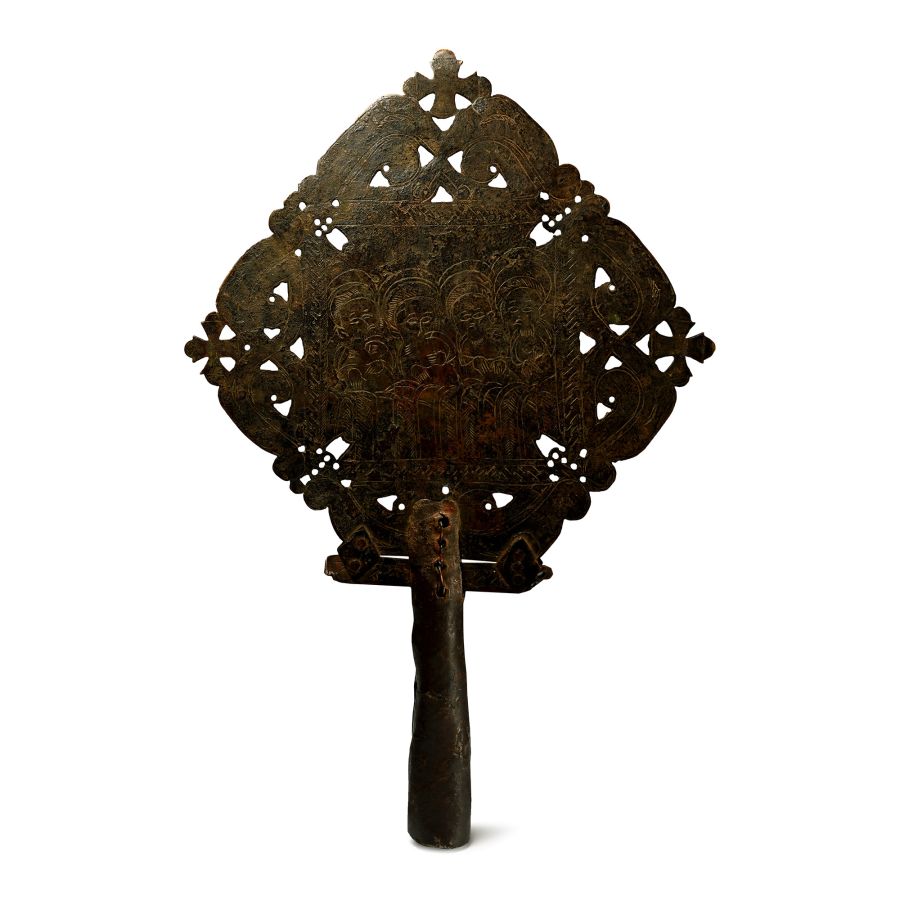
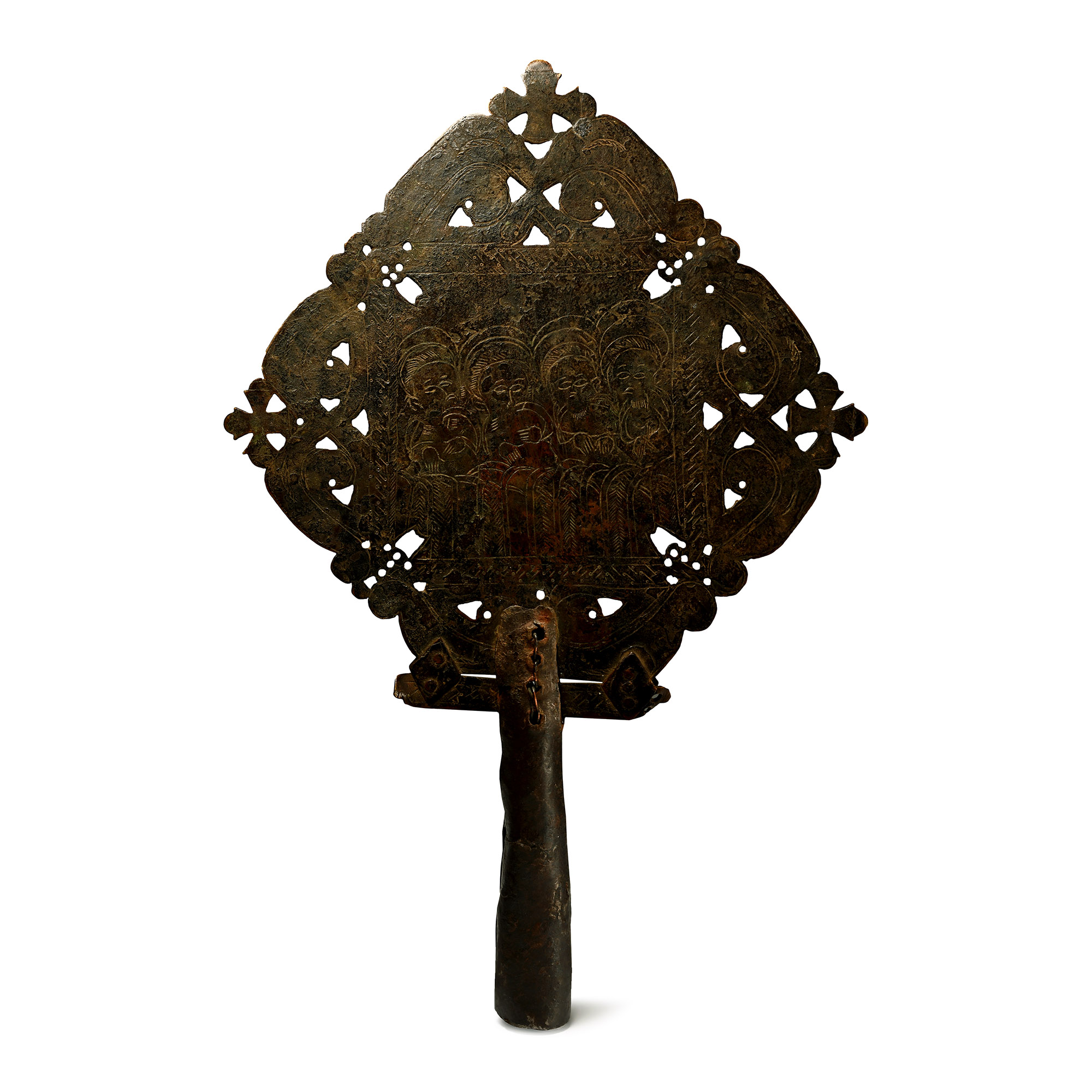
Ethiopian Engraved Bronze Cross with Figures of the Holy Fathers
CIRCA 1450-1480 A.D.
12 in. (404 grams, 30.5 cm).
A bifacial Yämäṩor Mäsqäl processional cross finial comprising an openwork flat-section panel surmounted by a cross, with interlaced tendril design engraved with four seated saints on both faces in low-relief; tapering tubular socket with circumferential ribbing, lateral angled crosses. [No Reserve]
ProvenanceEx central London gallery.
This lot is accompanied by an illustrated lot declaration signed by the Head of the Antiquities Department, Dr Raffaele D’Amato.
Cf. Chojnacki, S., Major Themes in Ethiopian Painting, indigenous developments, the influence of foreign models and their adaptation, from the 13th to the 19th century, Wiesbaden, 1983, figs. 72-73; Chojnacki, S., Ethiopian Crosses, a Cultural History and Chronology, Milano, 2006, fig.83, for similar processional crosses.
FootnotesIn contrast with the hand cross that is fitted with a grip, the processional cross has a hollow shaft into which the pole supporting the cross is inserted, although the use of both is interconnected in the liturgy and ceremonial aspects of the Ethiopian Orthodox Church. In Amharic, it received the name of yämäṩor mäsqäl or "cross to [carry] on a pole", the term mäṩor also meaning a wooden handle. Processional crosses are used on "every qaddase day" occasions - an expression meaning whenever the liturgy is performed. This includes displaying the cross during the reading of the Gospels and other sacred texts, as well as holding it up to be viewed at the end of the service for the final blessing.
CONDITIONTimeLine Auctions follows a vetting process to ensure the authenticity and legality of all items, reinforcing our commitment to integrity and responsible trading. Each antiquity, antique, and coin lot undergoes thorough examination by a vetting committee of at least ten external specialists, professional trade association members, scientists, and archaeologists: Our Vetting Process
AUCTIONS:
TimeLine is a leading auction house specialising in antiquities, ancient art, collectables, natural history, coins, medals, and books. Our auctions offer museums, collectors, historians, and enthusiasts the opportunity to acquire unique and historically significant pieces.
LOT 0377
Ethiopian Engraved Bronze Cross with Figures of the Holy Fathers
Sold for (Inc. bp): £2,080
-
.jpg)
Post Medieval Painted Terracotta Cherub Applique
20th century A.D.Sold for (Inc. bp): £39
Ellipsoid plaque with baroque-inspired putto ornament, the head modelled in the round and painted in pink and auburn tones, face tilted downwards; robe, upper body and wings modelled in high relief with left arm held straight at the side and right arm bent, hand on the chest; feather detailing to wings; pierced either side of the shoulders for suspension; knop to reverse of head and hole to void. 833 grams, 29.5 cm
From a Cambridgeshire, UK, collection. This lot is accompanied by an illustrated lot declaration signed by the Head of the Antiquities Department, Dr Raffaele D’Amato. -
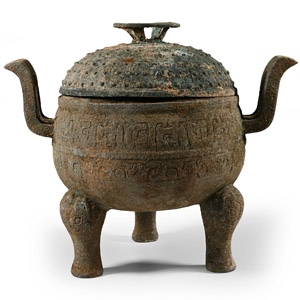
Archaic Chinese Style Bronze Vessel
20th century A.D.Sold for (Inc. bp): £169
With barrel-shaped profile to the body, three radiating stub legs, scooped square handles, domed lid with annular handle; low-relief cloud pattern ornament; after the antique. 3.1 kg, 31 cm wide
Acquired from the London art market in the 2000s. This lot is accompanied by an illustrated lot declaration signed by the Head of the Antiquities Department, Dr Raffaele D’Amato. -
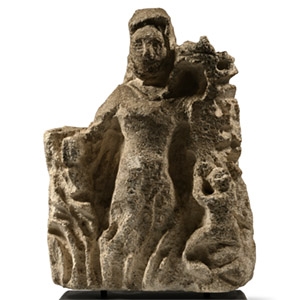
'Our Lady of the Flames' Figural Scene
15th century A.D. or laterEstimate: £500 - 700 (+bp*)
Opening Bid: £222
Carved in the half-round frieze fragment or devotional sculpture of the Madonna del Fuoco, facing female in wimple and long robe with her right arm bent forward, left arm extended above a child gripping the folds of her robe; billowing flames surrounding the pair; mounted on a custom-made stand. 10.55 kg total, 37.7 cm including stand
Acquired Lukas Pearsie, Suffolk, 2012. Property of a Kent collector. From the N.J. collection, Leicester, UK. This lot is accompanied by an illustrated lot declaration signed by the Head of the Antiquities Department, Dr Raffaele D’Amato.
