
Loading, please wait...

LOT 1573
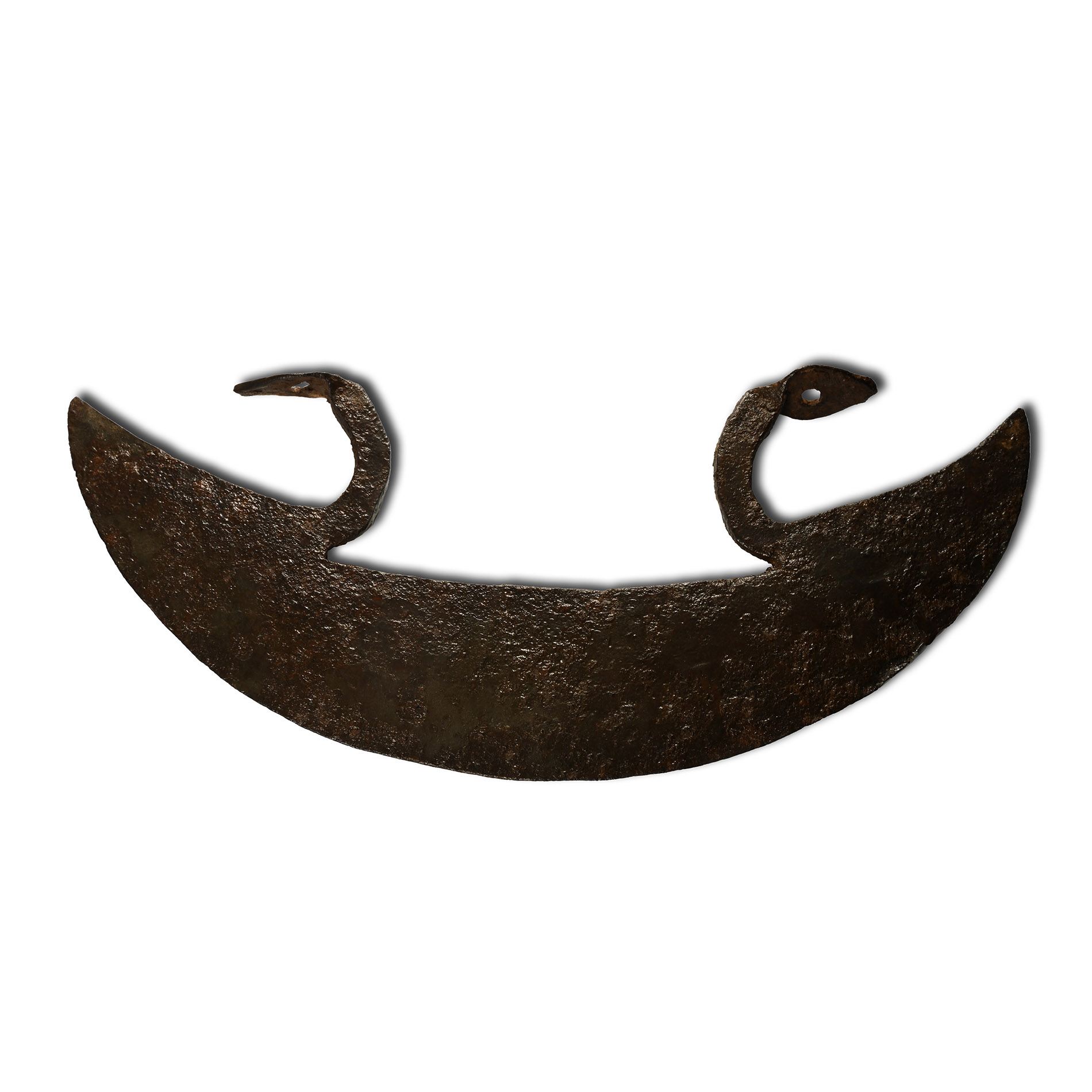
Ethiopian Coptic Iron Halberd
15TH-17TH CENTURY A.D.
9 1/8 in. (308 grams, 23.2 cm).
Single-edged crescent-shaped blade equipped with two curved pins with holes for attachment to a wooden shaft. [No Reserve]
ProvenanceEx USA private collection, 1970s-1990s.
This lot is accompanied by an illustrated lot declaration signed by the Head of the Antiquities Department, Dr Raffaele D’Amato.
See similar type in Flinders Petrie, W., Tools and Weapons, British School of Archaeology in Egypt and Egyptian Research Account 22nd Year, 1916, UC, 1917, pl.VIII, no.189.
FootnotesThe blade belongs to the category of crock-backed blades, as classified by Flinders Petrie. More ancient fine Coptic examples are engraved with zigzag lines, a cross, fishes, and vine pattern. The iron halberd, viii, may be of some later date. The iconography of the medieval churches in Ethiopia suggest that these weapons were used as ceremonial halberds, and worn by guardsmen of rulers and bishops. A form similar to these halberds was used as a hoe in South Africa.
CONDITIONTimeLine Auctions follows a vetting process to ensure the authenticity and legality of all items, reinforcing our commitment to integrity and responsible trading. Each antiquity, antique, and coin lot undergoes thorough examination by a vetting committee of at least ten external specialists, professional trade association members, scientists, and archaeologists: Our Vetting Process
AUCTIONS:
TimeLine is a leading auction house specialising in antiquities, ancient art, collectables, natural history, coins, medals, and books. Our auctions offer museums, collectors, historians, and enthusiasts the opportunity to acquire unique and historically significant pieces.
-
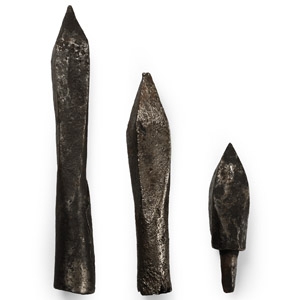
Medieval Iron Crossbow Bolt Collection
15th-16th century A.D.Sold for (Inc. bp): £117
Comprising three hefty bolts, two socketted and one with a short tang. 174 grams total, 5.5-10.6 cm
Acquired from Coincraft, London, UK. From the private collection of Kenneth Machin (1936-2020), Buckinghamshire, UK; his collection of antiquities and natural history was formed since 1948; thence by descent. Accompanied by three original certificates of authenticity from Coincraft. This lot is accompanied by an illustrated lot declaration signed by the Head of the Antiquities Department, Dr Raffaele D’Amato. -
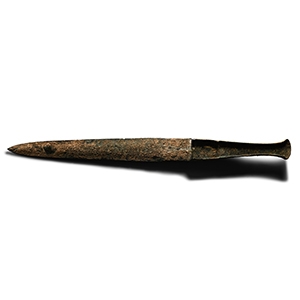
Luristan Bronze Dirk
13th-12th century B.C.Estimate: £300 - 400 (‡+bp*)
Opening Bid: £150
With lentoid-section blade, tongue-shaped in plan, integral tapering hilt with flared finial, lateral flanges to accept a panel of bone or wood to each face forming the grip. 174 grams, 34 cm
Ex Joseph J. Gancie (1923-2010), Washington, Silver Spring, Maryland. with Alex Cooper Auctioneers Inc., sale 1035, 27 January 2013, lot 162a. This lot is accompanied by an illustrated lot declaration signed by the Head of the Antiquities Department, Dr Raffaele D’Amato.
The dirk belongs to the type III in the Medvedskaya classification, used in Near East from the 13th to the 6th century B.C. The type is the 32a of the Maxwell-Hyslop study. The Asiatic daggers of this type are confined to Syria and Persia, but Transcaucasia also provides an interesting analogy from Kalekent on the Baku peninsula, where a pointed straight-sided dagger blade has a flanged hilt with the whole of the side flanges bent over the centre. -
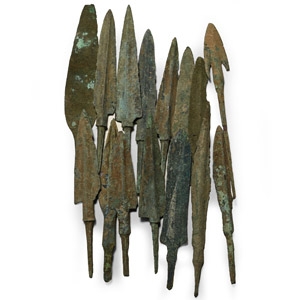
Luristan Bronze Arrowhead Group
13th-6th century B.C.Sold for (Inc. bp): £234
Including leaf-shaped, ribbed, triangular and other tanged types. 407 grams total, 11.3-15.2 cm
Acquired 1980-2015. Ex Abelita family collection. This lot is accompanied by an illustrated lot declaration signed by the Head of the Antiquities Department, Dr Raffaele D’Amato.
